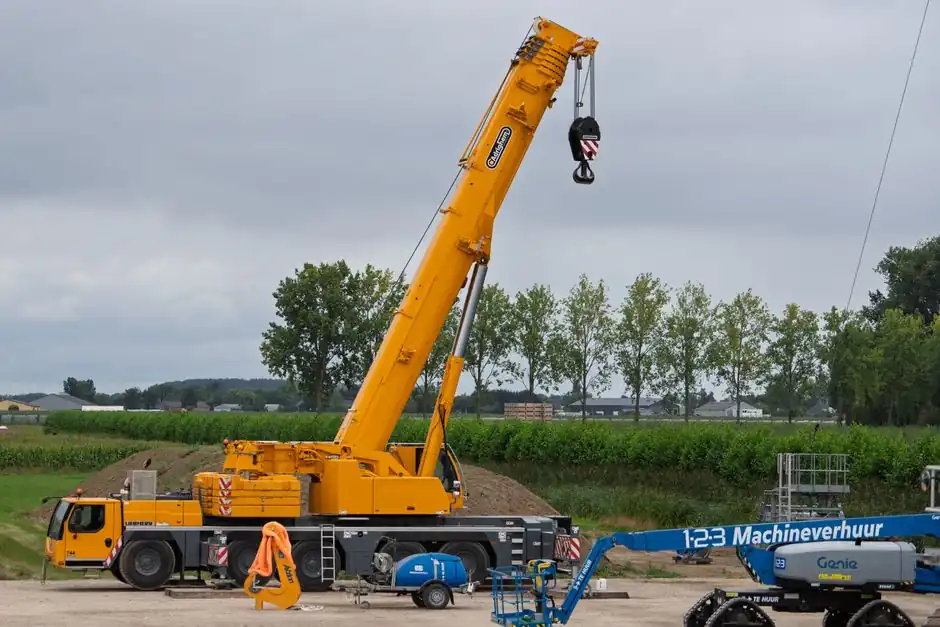
Crawler cranes typically lift more at a given boom length than truck-mounted cranes because their stable tracked base allows less conservative load charts, with lattice-boom crawler models reaching 2,500+ tons while typical truck-mounted units top out near 1,200 tons [S1][S6][S8].
For foundation work, that gap is decisive: drilled-shaft rebar cages, large-diameter casings, genset modules, and pre-assembled pier caps commonly run 80 to 400 t per pick, and the job site that hosts them is rarely a finished slab, so ground pressure and outrigger footprint drive the crane choice before capacity alone does [S4][S7].
Ground pressure, stability, and why a tracked base matters on a foundation site
A crawler crane's wide steel-tracked undercarriage spreads load over a much larger contact area than rubber tires, dropping ground bearing pressure into a band soft subgrade and matting can usually handle, which is why crawlers walk on rough, muddy, or freshly graded pads without outriggers [S1][S4]. Truck-mounted cranes, by contrast, must deploy hydraulic outriggers to a level pad and concentrate the entire lifted load plus machine weight through four tire-borne pads, which rules them out on unprepared ground unless mats or a stone pad are laid first [S1][S3].
The stability math is straightforward: a wider effective base lets OEM load charts assume smaller overturning margins, so at the same rated capacity a crawler carries more useful load at radius than a truck crane of equal nominal tonnage, and lattice-boom crawlers like the Liebherr LR 11000 can hoist 1,000 t at 11 m radius with a 168 m main boom, figures no production truck crane matches [S3][S6]. For heavy foundation picks (pier caps, large casings, transformer blocks) the practical decision is rarely "which crane has the higher chart number," it is "which crane can stand on this ground while the chart number is being used" [S4][S7].
Mobility, redeploy time, and transport cost on multi-pad foundation work
Truck-mounted cranes self-drive to site at highway speeds, arrive ready to rig in minutes, and can walk between foundation pads on a single site without disassembly, so their mobilisation cost per shift is far lower than a crawler on short, scattered jobs [S1][S3]. A crawler, by contrast, cannot legally or practically travel on public roads between sites, must be broken down, loaded onto low-bed trailers, permitted, and reassembled, which routinely adds one to three days and significant freight cost per move [S1][S6].
This is why rough-terrain and truck cranes dominate urban utility work, substation pad pours, and commercial foundation packages where pads are poured in sequence across a city block, while crawlers dominate bridge piers, wind-farm foundations, refinery foundations, and any project where the crane arrives once and stays for months [S2][S3][S8]. Maintenance footprint is the mirror image: crawlers need daily track-pin grease, pad-bolt torque checks, and track-frame inspection, while truck cranes share driveline maintenance with the carrier and need shorter daily walks-around [S1][S2].
Setup, rigging, and crew size on a foundation lift
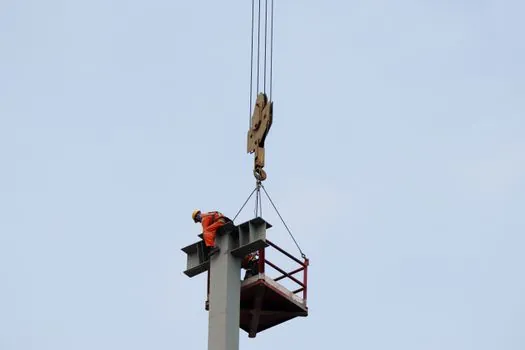
Truck cranes need a level outrigger pad surveyed for bearing, jacking time of 10 to 25 minutes, and counterweight rigging before the first pick, after which they can lift immediately and reposition between pads by retracting outriggers and driving short distances on the carrier [S1][S3]. Crawler cranes require boom assembly (lattice sections pinned up to 168 m on large units), counterweight stacking, and self-erection sequences that consume half a day to two days depending on size, but once assembled they can pick, walk a few metres with load on the hook, swing, and set without re-rigging [S3][S4].
For foundation work specifically, "walk-with-load" matters: a crawler can lift a casing or rebar cage, traverse 5 to 20 m on soft ground while suspended, and set it on the next open pier without a secondary crane, a sequence impossible on outriggers and impractical on a truck crane without re-rigging each time [S1][S4]. The trade is crew and rigging labour: a 600 t-class lattice-boom crawler typically needs a four- to six-person rigging crew plus a crane operator and oiler for assembly, versus two operators and minimal rigging on a 100 to 200 t truck crane [S1][S3].
Decision matrix: which to specify for a given foundation job
The decision is criterion-driven, and four numbers pick the winner on most foundation bids: maximum single-pick tonnage, ground condition, project duration, and number of separate foundation pads. As a working rule used across heavy civil and energy work, a crawler is specified when any one of these is true: single pick over 200 t, ground bearing under 100 kPa without mats, project duration over 4 weeks on one site, or fewer than 4 separate heavy pick locations [S6][S7][S8].
The comparison can be lined up as follows for a spec sheet. Lifting capacity: crawler leads, with lattice-boom models rated to 2,500+ t versus 1,200+ t for the largest truck cranes; truck wins on speed of redeploy, with self-drive arrival versus multi-trailer crawler transport; crawler wins on soft-ground operation, with tracked contact pressure versus outrigger-pad loading; truck wins on mobilisation cost and permit burden, with no oversize-load escort on most highway moves; crawler wins on walk-with-load capability and on-site repositioning, with rubber-tire trucks needing outrigger cycles between lifts; truck wins on crew and rigging simplicity, with two-operator self-deploy versus multi-day lattice assembly [S1][S3][S6][S8].
Where each type fails: constraints engineers miss on a foundation bid
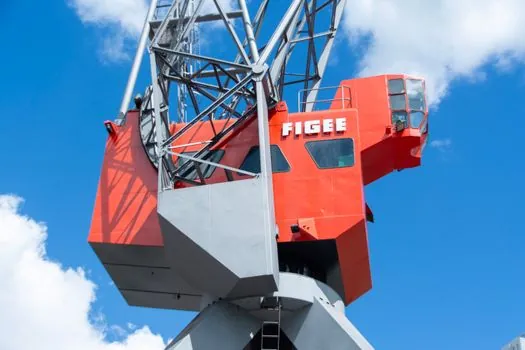
Crawlers are the wrong tool on short, multi-site urban foundation packages where mobilisation cost exceeds the crane day rate by week two, and on sites with finished access roads that cannot be crossed by steel tracks without protective matting, a logistics burden that adds 10 to 20% to setup cost [S1][S6]. Truck cranes fail on soft, wet, or uncompacted subgrade where outrigger pads punch through, on single picks over roughly 200 t where their load chart is exhausted, and on long-radius foundation work where a lattice boom of 100 m+ would carry far more useful load at the same outreach [S3][S6].
For ground-bearing checks on crawler moves between pads, a useful cross-reference is the haul-road width decision mapped against track gauge and transport envelopes, since the same transport corridor the crawler needs on arrival is the corridor it needs to walk on site. For mobile assets that can move between pads under their own power, the truck-mounted crane spec pathway on the encyclopedia side covers the carrier, boom, and outrigger envelope used in transit and setup calculations.
Standards, sourcing, and what the load chart actually means
Crane selection for foundation work is governed by the OEM's load chart combined with the project's ground-bearing study; load-chart figures assume the chart's published outrigger or track extension, full counterweight, and specific reeving, and deviations require a derate or a different machine. A tracked crawler on a 1.5 m wide shoe at full extension typically publishes ground pressures in the 80 to 120 kPa range, well within the bearing capacity of most engineered mat systems and of firm clay subgrade, while a 100 to 200 t truck crane on outrigger pads can demand 200 to 400 kPa local pressure unless heavy matting is used [S4][S7].
For the heavy foundation segment, the sourcing pool in 2026 includes established crawler lines (Liebherr LR series, Manitowoc/MLC/Model classes, Sany and XCMG lattice crawlers up to 4,000 t class) and the truck-mounted lattice and telescopic segment led by Link-Belt, Tadano, Grove, Liebherr, and the same Chinese OEMs in sub-1,200 t classes; the underlying engineering trade-off (tracked base and higher chart vs. road-legal carrier and lower mobilisation cost) is unchanged across the brands [S1][S3][S5]. The clearest signal on a future bid: if the geotech report shows soft near-surface soils and the structural drawing shows single picks over 200 t, default to a crawler and accept the mobilisation cost; if the project is a half-dozen pads in a developed yard with frequent moves under 150 t, default to a truck-mounted crane and budget for outrigger matting [S1][S6][S8].
Trackable next signals: OEM release of larger self-erecting telescopic crawlers (compresses crawler setup time toward truck-crane norms) and ongoing tightening of oversize-transport escort rules in North American metros, both of which move the crawler-vs-truck crossover point upward in capacity and downward in project duration respectively.
Component reference pages worth checking: aerial work truck, crawler crane, and foundation vehicle.
Related analysis: Double Disc vs Single Disc Coupling: Misalignment Decision Map.