Concrete vibrators and concrete mixer trucks solve opposite ends of a pour — the vibrator densifies the mix after placement, the truck keeps it plastic during transit. The two are routinely specified together: a CIFA HD-series truck outputs 560 l/min at the chute and 7-15 m³ of wet mix, while a matched concrete vibrator bank handles the consolidation step on the slab or wall [S1].
Both equipment classes sit in the "Building - Construction / Construction and Mining Equipment" category, span 6 m³ underground coal-mine units to 15 m³ on-highway drums, and overlap in only one function: keeping concrete workable. Concrete mixer trucks in current spec sheets range 6-15 m³ (211.89-529.72 ft³) with hydraulic, diesel, and lightweight hydraulic variants [S1][S2][S3].
Duty Split: Truck Transports, Vibrator Consolidates
A concrete mixer truck is an in-transit agitator that keeps the drum rotating at 2-6 rpm throughout the journey to prevent premature set, with operators relying on retarders and on-site water dosing to extend working life [S6]. Once the chute is open, the truck's job ends and the vibrator's begins: a concrete vibrator applies high-frequency mechanical energy to drive air bubbles out of the placed mix, raising in-place density and surface finish quality.
Selection rule of thumb: match drum capacity to peak pour rate, and match vibrator frequency/amplitude to member geometry. A 12 m³ SEMIX SM9 lightweight hydraulic drum can be discharged in roughly 10 minutes at rated output, demanding at least four 3 kW poker vibrators running in parallel on the deck [S3].
Spec Bands and Drive-Type Comparison Across the Two Equipment Classes
Three current truck models anchor the spec band: the CIFA HD hydraulic series (7-15 m³, 560 l/min output) [S1], the SEMIX SM9 hydraulic lightweight (7-12 m³, SSAB Swedish steel drum) [S3], and the EMSUNTOUR WC6BJ explosion-proof diesel (6 m³, 0.7 m³/min) for underground coal mines [S2]. For comparison against the concrete vibrator types, spec bands, and jobsite fit reference: vibrators cover a separate spec axis — frequency (200-12,000 rpm for high-cycle hydraulic units), amplitude (1-3 mm), and power (0.5-7.5 kW) — and do not overlap with the truck's volume-and-throughput axis.
Decision matrix across the two classes, criterion by criterion:
Duty cycle: trucks are rated for 8-hour continuous transit with intermittent full-load discharge; vibrators are rated for 100% duty on most modern inverter-driven models, with a 30-minute thermal limit on some older single-phase units.
Capacity vs frequency: truck capacity is volumetric (6-15 m³ in current spec sheets [S1][S2][S3]); vibrator output is energy-based (amplitude × frequency, typically 1-3 mm at 200-12,000 rpm depending on type).
Power source: trucks use diesel, hydraulic, or PTO drive; vibrators use electric (1-phase 230 V, 3-phase 380/415 V), battery, or hydraulic. Match the site power — diesel-dominant remote sites pair with a power mixer and engine-driven vibrators, grid-connected urban pours pair with electric pokers.
Maintenance interval: truck drum blades and rollers are wear-protected bolted assemblies rated for 1-2 year change cycles [S1]; vibrator heads are consumables (eccentric bearings replaced every 800-1,200 operating hours).
Hydraulic vs Diesel vs Lightweight Hydraulic Trucks
The CIFA HD series runs a hydraulic motor at 560 l/min (147.9 us gal/min) on a high-torque reducer with reinforced basic frame and wear-protected blades, with drum water-tank capacity 800 l on the HD7-HD10 and 1,200 l on the HD12+ and HD15 [S1]. This is the heavy-duty on-highway spec for ready-mix fleets running daily 6+ trips.
The SEMIX SM9 keeps the same hydraulic architecture but drops drum mass using SSAB high-strength Swedish steel, holding 7-12 m³ within road tonnage limits and using premium components from Rexroth, ZF, and AKG [S3]. Choose this when regional road-load law is the binding constraint.
The EMSUNTOUR WC6BJ is a purpose-built diesel mixer truck for underground coal mines, 6 m³ at 0.7 m³/min, with the engine mounted at the rear away from concrete contamination and a combined oil-gas/leaf-spring suspension for mine-road ride quality [S2]. A separate mining-specific truck-mounted concrete pump handles the placement end on these sites. Surface civil work should not specify this — explosion-proof certification adds cost without benefit above ground.
Pour-Volume vs Crew-Size Sizing Rule
A 7 m³ truck can realistically discharge its load in 10-15 minutes at the chute; the receiving crew needs at least 2 vibrator operators and 1 screed operator on standby to avoid cold-joint risk on the larger pours. For a 15 m³ HD-class drum at 560 l/min output, the same crew composition stretches to 20-25 minutes of continuous vibration [S1].
Underground mining spec, by contrast, is crew-and-throughput-constrained rather than volume-constrained. The WC6BJ's 0.7 m³/min output matches a 2-person mining crew working within 30 m of the loading point, with the front inlet/outlet design enabling single-operator handling [S2].
Quality and Specification Anchors
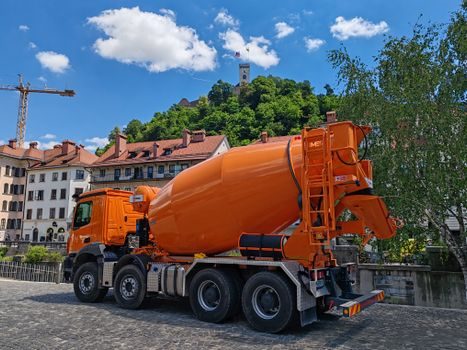
Concrete quality data points anchored in current spec sheets: HD-series truck provides a manometer for concrete consistency, a water meter, and an anti-rebound drum device to hold slump at discharge [S1]. SEMIX SM9 ships with helical blades designed against abrasive aggregate wear for multi-year service [S3]. EMSUNTOUR WC6BJ is built around continuous drum rotation during transport "to significantly improve the efficiency and quality of concrete delivery" [S2].
Vibrator-side quality anchors are independent of truck spec: amplitude 1-3 mm and frequency matched to the nominal aggregate size (low frequency / high amplitude for 40 mm+ aggregate, high frequency / low amplitude for 10-20 mm aggregate and formwork-tight work).
Common Failure Modes and Job-Site Constraints
Truck-side: drum blade wear under abrasive aggregate (a documented failure mode on all three spec sheets, mitigated by wear plates and bolted replaceable blades [S1][S3]); concrete setting inside the drum if rotation drops below the 2 rpm threshold [S6].
Vibrator-side: eccentric-bearing seizure from concrete ingress when the head is withdrawn too slowly; operator fatigue from handheld units on long pours — drive the selection toward back-pack or wheel-mounted units above 1 kW. Formwork blowout risk rises if amplitude exceeds 3 mm on thin walls.
Joint constraint: the two classes must be crew-synchronized. A 15 m³ truck arriving at a site with only one vibrator on the deck is a wasted pour — typically spec 1 vibrator per 3-4 m³ of expected discharge rate.
Sourcing Map and Price Bands

Verified sourcing nodes from the 2026-07-12 Made-in-China supplier catalogue: 3.5 CBM self-loading mixer trucks at US$10,000-30,000 per piece MOQ 1, and 1-6 CBM mini self-loading units at lower per-unit cost from Shandong manufacturers [S5]. A separate Jidong listing shows a 1-set MOQ at US$100,000 with 500 sets/year capacity, reflecting the heavier on-highway 8-12 m³ segment [S4].
For procurement, the decision is concrete-pour profile, not price alone: high-frequency urban pours in mature ready-mix markets favor CIFA HD or SEMIX SM9 trucks paired with electric vibrators; remote mining and tunnel work favor explosion-proof diesel trucks and engine-driven vibrators; entry-budget low-volume sites favor 1-6 CBM self-loading mixers from Shandong OEM factories [S4][S5].
Track these signals: CIFA's Intermat 2027 Paris (21-24 Apr 2027) will be the next public showing of HD-series literature, and the next move to watch in this class is the wider take-up of lightweight SSAB-steel drums for 12-15 m³ road-legal payloads across European ready-mix fleets [S1][S3].