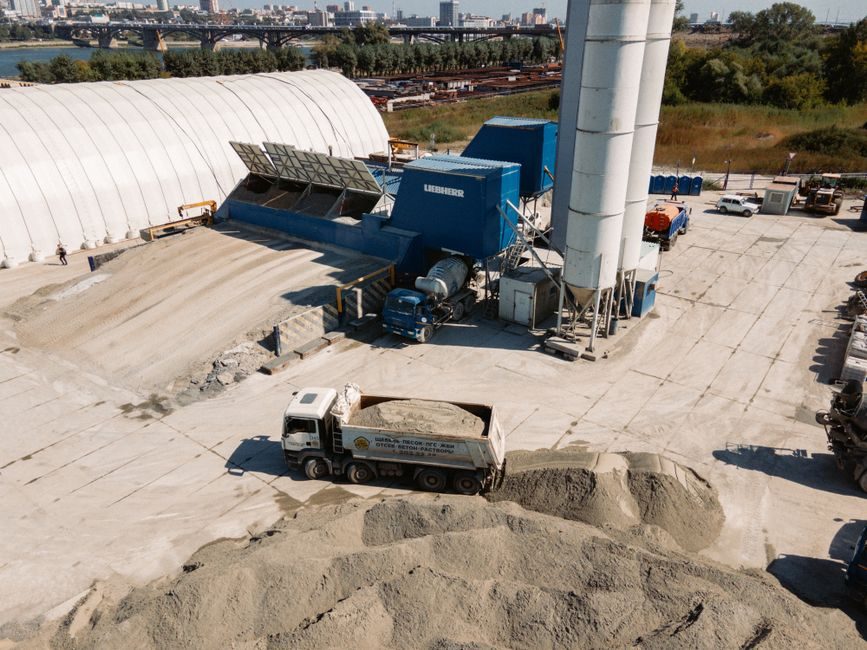
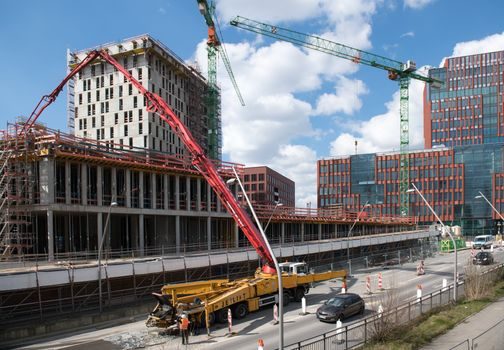
A concrete pump truck places concrete through a hydraulic boom and pipeline, while a concrete mixer truck only agitates and transports the mix — two machines that are routinely confused on small sites but engineered for opposite tasks.
The Putzmeister M20-4 truck-mounted concrete pump delivers 110–150 m³/h output at 78–83 bar (1,131–1,204 psi) pumping pressure on a 2,500 mm wide × 10,000 mm long chassis with a 4,000 mm overall height [S1]. The CIFA HD series concrete mixer truck tops out at a 15 m³ (529.7 ft³) drum capacity with a 560 l/min hydraulic drive output and no placement function at all [S2]. The two specs already tell the operational story.
Function and Core Mechanism
A pump truck integrates a boom, a hydraulic pumping cylinder, and a placing pipeline; an M20-4-class unit reaches 78–83 bar concrete pressure and pushes 110–150 m³/h through the boom [S1]. A truck-mounted concrete pump is, in effect, a conveyor with a robotic arm — its value is reach and rate, not holding mix quality.
A mixer truck integrates a rotating drum, a charging hopper, a discharging chute, and a water system; the CIFA HD series pairs a 7–15 m³ drum with a 560 l/min hydraulic output, an 800 l water tank on HD7–HD10 models and a 1,200 l tank on HD12+/HD15, plus two quick-joint water fillers on the front sides of the supporting frame [S2]. Its value is mix homogeneity and transport, not vertical or horizontal reach.
Spec Comparison Across Four Decision Criteria
Output rate: pump truck M20-4 reaches 110–150 m³/h (3,885–5,297 ft³/h) under pressure [S1]; mixer truck HD series discharges at a 560 l/min hydraulic output driving the drum, not placing concrete at a rate that can be directly compared [S2]. The pump unit's spec is placement rate; the mixer's spec is agitation hydraulic capacity.
Pressure vs capacity: pump pressure 78–83 bar (1,131–1,204 psi) on the M20-4 [S1] versus 7–15 m³ (247–530 ft³) drum payload on the HD series [S2]. One figure is a hydraulic delivery limit, the other is a load-volume envelope — neither is interchangeable with the other.
Footprint: the M20-4 occupies 2,500 mm wide × 10,000 mm long × 4,000 mm high (98 × 394 × 157 in) [S1]; a 15 m³ HD-class drum truck is typically longer and heavier because the drum itself dictates chassis length, with the HD series engineered around a "reinforced basic frame" and "high thickness drum and blades" for demanding jobsites [S2].
Use-case fit: pump trucks are specified for high-rise pours, tunnel work, line-pump jobs, and tight urban sites where the M20-4's small support width and 3.9 m boom unfolding height are decisive [S1]. Mixer trucks are specified for any haul from batch plant to jobsite where slump retention and homogeneous agitation are the deliverable — see the dump truck comparison for non-agitating haul-only alternatives.
When a Pump Truck is the Right Choice

Pick a pump truck when the pour must move continuously up, over, or into forms that a chute cannot reach. The M20-4 is documented for "halls, tunnels, renovations, or line jobs" with a 4-arm ZR boom folding to a 3.9 m unfolding height and a stepless outrigger system allowing any leg position [S1].
Pick a pump truck when output rate matters more than drum payload. At 110–150 m³/h [S1], a single pump truck replaces multiple mixer trucks' worth of chute-and-buggy placement. The hybrid-drive Putzmeister iONTRON option (3-axle chassis) is offered for emission-restricted urban sites, and the Ergonic 3 control system manages boom and pump sequencing [S1]. For buyers comparing OEM sourcing strategy across construction equipment, the framework in OEM vs ODM in Additive Manufacturing: Decision Map for Buyers is transferable to chassis and boom assembly sourcing decisions.
When a Mixer Truck is the Right Choice
Pick a mixer truck when the jobsite has its own placing method (crane-and-bucket, boom pump, conveyor) and the only requirement is delivered, agitated, homogeneous concrete. The HD series' "drum antirebound device," "wear protected blades," and "two man holes on the drum" point to a machine engineered for continuous agitation under heavy load rather than placement force [S2].
Pick a mixer truck when payload and road-going rules govern. Drum sizes 7–15 m³ (247–530 ft³) on the HD series map to a payload envelope that must respect national gross-vehicle-weight limits [S2]. A 15 m³ drum on a 6×4 chassis is the workhorse configuration for ready-mix fleets — see the CIFA SL, SLX, and ENERGYA series for lighter and electrified alternatives within the same product family [S2]. For buyers building a ready-mix fleet sourcing plan, supplier maps like the Galvanized Steel Sheet 2026 sourcing reference show the same kind of spec-band reasoning applied to raw material sourcing.
Limitations and Failure Modes
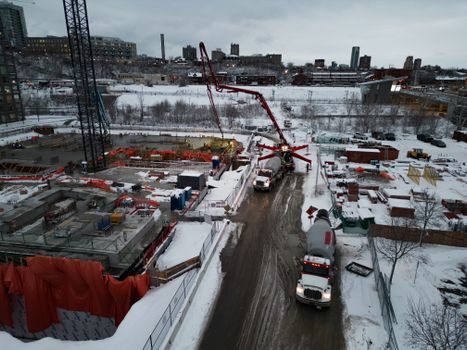
A pump truck cannot carry mix for long: the boom and pump hydraulics are the design centre, and a pump truck's hopper is sized to feed the pump, not to hold concrete for 90 minutes of travel. Forcing a pump truck into a haul-and-wait role burns boom and pump hours on a machine whose hourly operating cost is dominated by placement, not transport. [S6]
A mixer truck cannot place concrete above its own chute reach. A CIFA HD-series unit discharges via "a two strong armed swivel chute system" plus two zinc-coated additional chutes, with chute height limited by the chassis [S2]. On a 3rd-floor deck pour or inside a tunnel face, the chute geometry simply will not reach — the sand mixer and power mixer classes are downstream production equipment, not placement equipment, and likewise cannot substitute for a boom.
Cost and Sourcing Reality (2025-2026)
FOB-Asia export pricing for a 6×4 diesel self-loading mixer truck sat in a US$7,000–15,000 per-piece MOQ-1 band on Made-in-China.com listings as of 2026-06-16, with a separate HK-series self-loading mixer truck offered at US$11,000 per piece [S7]. An older Jidong listing for a China-made concrete mixer truck showed a US$100,000 per set MOQ-1 with a 500-set/year production capacity (2022-03 reference, retained for historical band) [S3].
On the pump side, a Schwing KVM37XG truck-mounted concrete pump was listed with a Shanghai FOB loading port, TT-or-LC payment, MOQ 1 piece, and a 1,500-piece-per-month supply capability as of 2026-06-09, with a published 90 m³/h productivity figure and wet-shotcrete hydraulic-cylinder structure [S4]. Buyers comparing chassis and assembly sourcing channels should weigh the OEM-vs-ODM logic in OEM vs ODM in Additive Manufacturing: Decision Map for Buyers when deciding whether to brand a Putzmeister-class pump or a CIFA-class drum.
Standards and Engineering References
Boom pump hydraulic circuits are governed by the same ISO 4413 / EN 982 family that applies to any high-pressure hydraulic concrete-pumping circuit, and the concrete-side pressure class on the M20-4 (78–83 bar) sits inside the typical 85-bar maximum concrete-pressure envelope that truck-mounted boom pump hydraulic systems are designed around [S1]. No specific standard number is cited here unless the research names it.
For the mixer truck side, drum geometry, water-tank capacity, and axle load must be checked against the destination country's gross-vehicle-weight and concrete-transport rules; the HD series' 800 l water tank (HD7–HD10) and 1,200 l water tank (HD12+/HD15) and 560 l/min hydraulic motor output are the data points a fleet engineer uses to right-size the chassis against the regulatory payload envelope [S2]. Sourcing channels through Zhengzhou Una Machinery and AISI Machinery Co. in Sichuan are part of the active China-side supply base for concrete equipment and parts as of 2025-2026 [S5][S8].
Trackable next signals: (a) the next Putzmeister M-series update past the M20-4/M24-4/M28-4/M31-5/M36-4/M38-5/M39-4/M42-5/M47-5 line-up [S1] — any new model introduction will reset the small-boom-pump reference point; (b) the next CIFA HD-series variant past the HD7/8/9/10/12+/15 drum range [S2] — any HD-class drum enlargement or electrification will shift the mixer-truck reference. Watch the Intermat 2027 (21–24 Apr 2027, Paris) booth disclosures from CIFA for that next move [S2].