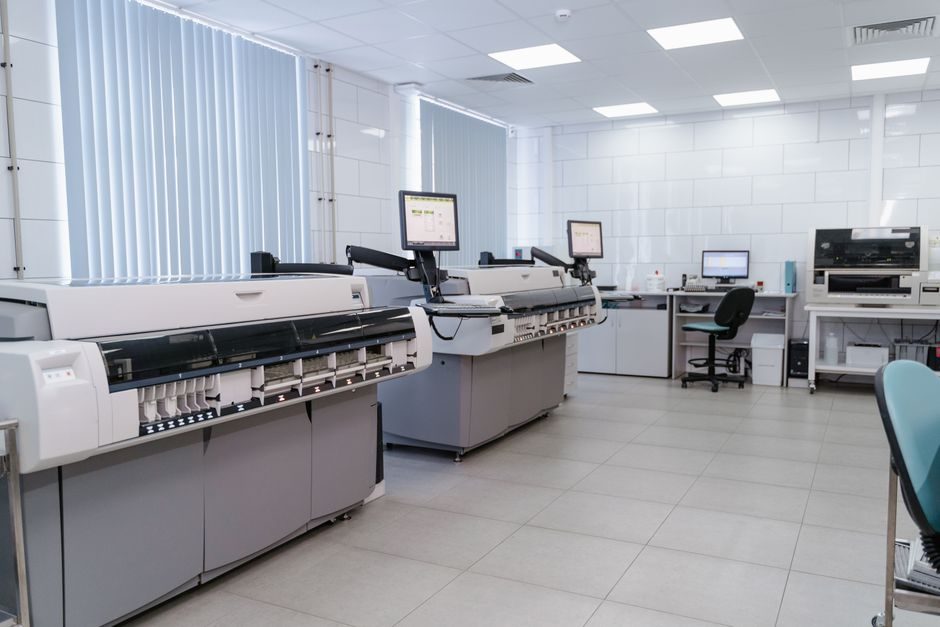
Specifying a contour measuring machine where a tensile rig is needed — or the reverse — is one of the most expensive QA mistakes a process engineer can make in 2026, because the two instrument classes share a physical lab footprint, similar fixturing vocabulary, and overlapping software stacks, but measure fundamentally different quantities [S1][S5].
As of 2026-06-21, active OEM catalogs from PW Instruments, Fine Manufacturing, Labortech, Shanta Engineering, and MPK cover a combined span of electromechanical and servo-hydraulic tensile frames (5 kN–2000 kN class) and benchtop contour profilers down to sub-micrometer resolution; both segments also cross-sell hardness, environmental, and vision measuring machine options to the same buyers [S1][S4][S5][S6][S7][S8].
What each machine actually measures
A contour measuring machine traces a probe — typically a diamond-tipped stylus with 2 µm or 5 µm radius — across a workpiece while recording vertical displacement against horizontal travel, producing a 2D profile that is compared against a CAD curve to extract Ra, Rz, Rq, and step-height parameters per ISO 21920 / ASME Y14.36 surface-finish conventions [S8]. The output is a geometric description of an existing part.
A tensile testing machine, by contrast, applies a controlled uniaxial load to a specimen — usually a standardized dog-bone or threaded round bar — and records force vs. elongation until yield, ultimate tensile strength, and fracture; the same frame is typically reconfigured for compression and bending tests, with optional environmental chambers for elevated or sub-ambient conditions per ISO 6892-1 / ASTM E8 [S1][S5][S6]. The output is a material property, not a part property.
Selection criteria that actually separate the two
Decision criterion 1 — what you need a number on. If the question is "does this turned shaft match the 2D profile on the drawing to within ±0.01 mm," you need a contour or vision measuring machine; if the question is "does this batch of 304 stainless yield above 215 MPa," you need a tensile frame [S1][S5][S8].
Decision criterion 2 — load class vs. resolution class. Tensile frames are sold by capacity (5 kN benchtop units for plastics and cables up to 2000 kN servo-hydraulic systems for rebar and structural steel), while contour instruments are sold by stylus radius, traverse length (typically 25–200 mm), and vertical resolution (down to 0.01 µm on shop-floor units, sub-nm on metrology-grade instruments) [S1][S3][S4][S5].
Decision criterion 3 — sample form. A contour probe needs a feature it can trace without losing stylus contact; a tensile frame needs a specimen that can be gripped without crushing the gauge section. Workpieces that fail one requirement usually fail the other as well, which is why the two machines are commonly co-located in incoming-inspection labs but rarely share an operator skill set [S5][S8].
Comparison: contour, tensile, and the hybrid edge cases

Across the three most common 2026 spec patterns, the trade-off reads cleanly. A contour measuring machine delivers Ra/Rz and profile deviation in micrometers, requires no destructive prep, and runs in 30–120 s per feature; a tensile testing machine delivers UTS, yield, and elongation in MPa and percent, requires a prepared specimen, and runs 2–30 min per test. A vision measuring machine overlaps the contour instrument on 2D dimensional checks but cannot replace a tensile rig because it applies no controlled force [S5][S8].
For buyers who only have budget for one platform, the choice collapses to "are you characterizing geometry or material?" — MPK, PW Instruments, and Fine Manufacturing all sell combined hardness / tensile / chamber lines, but none of them bundles a contour or surface-roughness module, because the fixturing and metrology loops are physically incompatible with a load frame [S1][S4][S5][S6][S7].
Who the contour instrument is for — and who it is not
Contour machines are the right tool for machinists verifying turned, milled, or ground profile features against a 2D CAD curve, for tool-and-die shops checking edge radii, and for incoming-inspection teams that need a quick pass/fail on seal grooves, O-ring lands, and cam profiles — a category that overlaps heavily with vision measuring machine buyers in the same plant [S8].
They are the wrong tool for anyone who needs to certify material strength, validate a heat-treatment batch, or generate an ISO 6892-1 / ASTM E8 stress-strain curve; those buyers should be talking to MPK, Labortech, Shanta, Fine Manufacturing, or PW Instruments instead, with the load class picked from the lowest expected specimen strength rather than the highest [S1][S3][S4][S5][S6][S7].
Who the tensile frame is for — and who it is not

Tensile frames are the right tool for QA labs tied to material specifications (ISO 898-1 fasteners, ISO 6892-1 metals, ISO 527 plastics, ASTM D412 rubber), for fastener and wire drawers who need to certify UTS and elongation, and for process engineers validating a forging or heat-treat recipe against a published datasheet [S1][S3][S5][S6].
They are the wrong tool for dimensional inspection of finished parts, for surface-finish surveys, and for any application where the buyer actually needs a coordinate or profile measurement — those tasks require a contour, vision, or coordinate-measuring machine, and force-testing the part will only damage it and the grips [S5][S8].
Real use cases from 2025-2026 catalogs
Labortech's E.2 series (catalog entry dated 2026-06-08) is positioned as a universal compression / tensile / bending platform for incoming material QC, with the bending jig sold as a separate fixture [S1]. Shanta Engineering, established 1978, targets the same market but specifically for plastic, rubber, and cable tensile testing, with optional melt-flow indexers for process control [S3].
On the contour side, visionmeasurementmachine.com (catalog entry dated 2026-06-19) lists vision measurement machines, 3D coordinate measuring machines, and tool-inspection systems with auto-focus — a portfolio that lives one aisle over from the tensile rigs in most 2026 plant layouts, often the same procurement code [S8]. MPK's tensile-and-torque line (2026-06-19) is explicitly sold on the depth of its German-engineered load-frame family, with torque testing as the differentiator against the more common axial-only competitors [S5].
Limitations, failure modes, and procurement pitfalls
The most common 2025-2026 spec error is ordering a low-capacity benchtop tensile frame (typically 5–50 kN) for a fastener line that needs 100–300 kN, which forces operators to swap frames mid-batch and breaks the calibration chain. Conversely, ordering a 1000 kN hydraulic frame for a cable-tensile lab wastes capital and floor space, since cable specimens rarely exceed 5 kN [S1][S3][S5].
For contour instruments, the recurring failure is stylus crash on parts with undercuts or step transitions larger than the stylus can climb — a limitation that no amount of resolution upgrade fixes, and that pushes those applications back toward vision measuring machine or laser-based alternatives [S8]. Buyers should match stylus radius, traverse length, and stage flatness to the largest expected feature, not to the smallest.
Sourcing, standards, and trackable signals
For procurement in mid-2026, the credible vendor shortlist on the tensile side includes Labortech (E.2 universal series), MPK (German-engineered axial and torque), Fine Manufacturing (hydraulic portable Brinell + Rockwell + tensile), Shanta Engineering (plastic / rubber / cable specialty), and PW Instruments (US72 single-screw + climate-chamber cross-sell) [S1][S3][S4][S5][S6][S7]. On the contour and vision measuring machine side, the active 2026-06 OEM entries are PW Instruments and the visionmeasurementmachine.com catalog [S4][S8].
Applicable standards to anchor any spec sheet are ISO 6892-1 / ASTM E8 for metals tensile, ISO 527 for plastics, ISO 898-1 for fastener mechanical properties, ISO 21920 / ASME Y14.36 for surface texture, and ISO 10360 for coordinate metrology; buyers should also confirm that load cells carry a traceable calibration certificate accredited to ISO/IEC 17025.