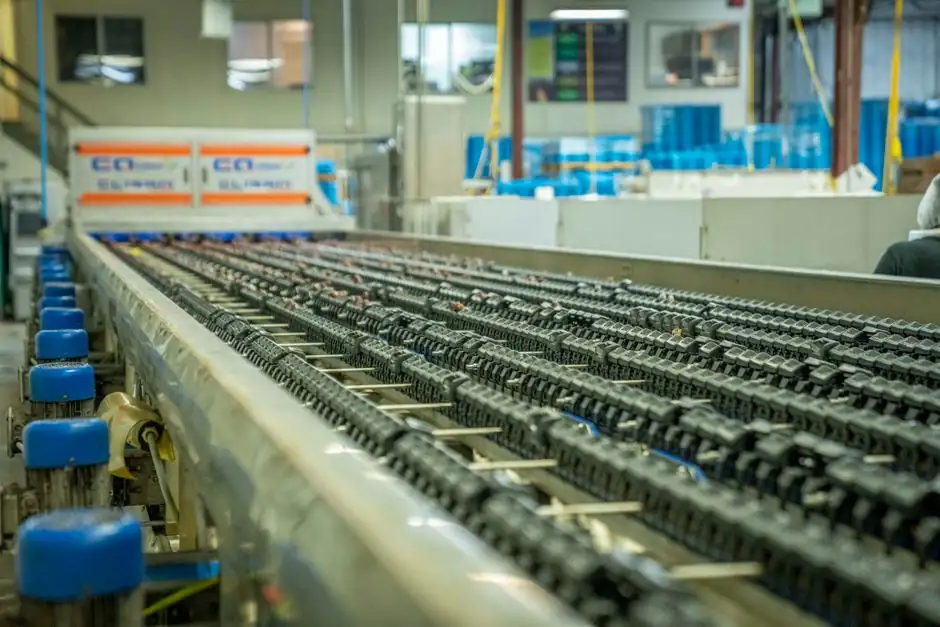
Pulp and paper conveyor chains fail on a predictable pattern: conveyor chains carrying raw wood and wood pulp wear mainly due to corrosion caused by the acidity in the wood, with moisture, chemicals, and wood fibres compounding the attack on pins, bushes, and side plates [S6][S9].
Selection is therefore less about generic chain strength and more about matching chain architecture to the process zone: wood yard, pulp prep, wet end, dryer section, calender, rewinder, and finished-roll handling each impose a different mix of load, temperature, moisture, and chemical exposure [S5][S1].
Process zones and the chain families that fit each
Wood-yard and bark-handling lines run welded steel drag chains, welded steel mill chains, and combination (WS/DW) block-link chains, the latter designed with extra wear surfaces for sliding on both the carrying and return runs so that return idler sprockets, a classic internal-wear source, can be eliminated [S1]. Apron conveyors with overlapping steel pans and lip contact between adjacent pans cover inclined runs up to about 60 degrees and tolerate high-temperature, abrasive feed out of the digester area [S4].
Wet-end and dryer sections are dominated by steel-bushed roller (SBR) chains and precision roller chains, where heat-treated rollers, hardened bushings and pins, and steel sidebars lower operating friction and let designers shrink the conveyor drive train [S1][S3]. Finished-paper handling, including large paper rolls, uses gull-wing conveyor chains with V-shaped top plates and wider outboard rollers for roll stability, alongside roll-transport and ground conveyor chain variants sized for the working load limit of the roll being carried [S2][S1].
Material, hardness, and corrosion: the three numbers that matter
To ensure optimum wear life the pin and bush are hardened, the bush outside diameter is hardened to contend with the load-carrying pressure and the gearing action imparted by the chain rollers, and the roller material and diameter are selected to suit the application, per the Renold designer reference [S3]. In wood-yard and pulp-prep duty the wear envelope is dominated by acidic moisture plus abrasive fines, so many operators move to stainless or nickel-plated variants, or adopt sealed SBR geometries, on the wettest runs [S6][S9].
Lubrication policy is part of the material decision: properly lubricated conveyor chain requires less power to operate, acts as a barrier inhibiting the penetration of moisture, and reduces friction at the pivot points that otherwise become the initiation sites for corrosion-driven fatigue, with tissue and paper producers increasingly specifying automated lubrication specifically to keep industrial chain oils away from the product being conveyed [S5]. The harder the chain specification, the more the lubrication interval becomes the limiting factor on chain life rather than the bulk material strength.
Selection criteria and a side-by-side comparison

Four criteria actually drive the spec in a paper-mill enquiry: corrosion resistance, load capacity, operating speed, and ability to run with minimal or food-grade-compatible lubrication. Lining the common options up against those criteria gives a workable shortlist rather than a catalogue dump [S1][S2][S3][S5].
Welded steel mill and drag chains lead on load capacity and abrasion tolerance, score medium on corrosion resistance unless upgraded, and accept minimal lubrication. Steel-bushed roller chains score high on speed and efficiency, medium-high on load, and respond well to automatic lubrication. Combination WS/DW block-link chains lead on sliding wear life in wood-yard return runs and score high on eliminating internal sprocket wear. Gull-wing roll-handling chains are essentially a stability-optimised variant for cylindrical finished-roll loads, not a general-purpose choice [S1][S2].
Lubrication regime, safety, and product contamination
Traditional lubrication by manual grease, brush, drip, or spit feed is being replaced in tissue and food-contact paper by automated systems that apply metered lubricant at each pivot, because keeping oil away from the web is now treated as a product-quality and contamination-control requirement on par with chain survival [S5]. Reduced friction at the chain pivot points also lowers energy consumption, an increasingly trackable KPI in mill energy audits.
For explosion-risk areas such as dryer exhaust hoods and certain black-liquor handling enclosures, pan conveyors and some chain designs can be specified in fire- or explosion-proof builds, with the chain running on rollers inside an enclosed housing to contain both dust and ignition sources [S4].
Failure modes and what they tell the specifier

Three failure modes dominate field reports. First, corrosion-driven elongation at the pin-bush joint, accelerated by acidic wood moisture and aggravated by infrequent lubrication; this is the textbook pulp-prep failure [S6]. Second, abrasive wear on drag-chain flights and barrel surfaces in wood-yard duty, where welded heavy-duty drag chains with larger, heftier parts and extra surface area are used to push service intervals out [S1]. Third, surface fatigue and pitting on dryer and calender chains exposed to elevated temperature and steam, where hardened-through pins and bushes are mandatory rather than optional [S3][S5].
When pitch elongation exceeds roughly 3 percent on a precision roller chain, the standard industry guidance is replacement, because beyond that point sprocket fit deteriorates rapidly and the chain starts to jump teeth under shock loads; in paper mills those shock loads arrive with every reel change on the rewinder, so the 3 percent threshold is usually treated as a hard ceiling, not a target [S3].
Standards, sourcing, and specification hygiene
Conveyor-chain selection should be anchored to ISO 1977 conveyor-chain dimensions and chain attachments, with working-load ratings taken from the chain maker's certified data sheet rather than generic catalogue numbers, and with material certificates called out for any wetted or food-contact zone [S3]. For pulp-line conveyor systems the typical configuration pairs a segmental drive sprocket design that allows tooth replacement without removal of the drive shaft, which simplifies the maintenance windows that mills can actually get [S4].
Sourcing should also verify that any metric replacement chain physically drops into the existing traction wheels or sprockets, otherwise the retrofit becomes a sprocket redesign rather than a chain swap, and the OEM-replacement path through suppliers such as Webster for floating-attachment, central bucket elevator chains is sized exactly for that drop-in constraint [S1].
For a closer look at the material-handling selection logic that overlaps with paper-mill conveyor chain work, see Roller chain selection for material handling: load class, service factor, pitch. A reasonable next spec node is to confirm the chain maker's published corrosion data on stainless or coated variants in the pH 3 to 5 range typical of fresh wood-chip pulp, and to lock the lubrication interval on the same data sheet so that chain life and lube consumption are tracked as one number rather than two.