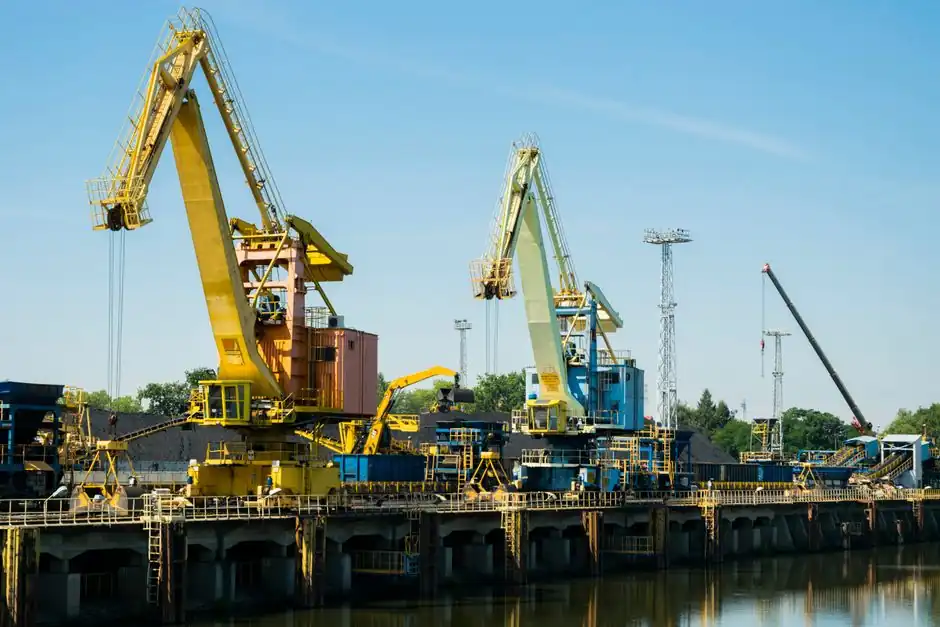
Specifying a roller chain in a pulp or paper mill is a two-track problem: the drive side follows the same horsepower, RPM, service factor, and small-sprocket tooth count procedure used in any ANSI B29.1 drive, while the conveyor side (log handling, chip feeding, roll transport, reel yard) almost always uses mill-specific chain constructions such as steel bushed roller, welded steel mill, welded steel drag, and gull wing roll chains [S1][S2].
Five baseline numbers govern every selection: design horsepower (HP multiplied by service factor), small-sprocket RPM, minimum number of teeth (17 for moderate speed, 21 or more for high-speed operation), chain pitch from the kW/HP rating table, and the strand count needed to stay inside that table [S2][S3][S7].
What a pulp-and-paper roller chain actually has to do
The product is a roller chain or a mill-specific variant carrying wood, pulp stock, or finished paper reels through abrasive, wet, and chemically aggressive service [S1]. The load profile is dominated by bulk solids: bark, chips, pulp laps, and paper rolls, and that profile drives both the chain construction and the service factor used on the design horsepower [S2].
Webster's published mill product line includes apron conveyors, welded steel heavy-duty drag chains, welded steel mill chains, steel bushed roller (SBR) chains with heat-treated rollers and hardened bushings, combination chains (WS/DW), combination rooftop transfer chains, and gull wing conveyor chains with V-shaped top plates used almost exclusively to handle paper rolls [S1].
Roll-handling chains for finished reels are typically run as heat-treated, G70-grade transport chains with grab hooks for cargo securement; the same reference also names ground conveyor system chains and dedicated pulp and paper industry chains as the other two construction classes used side-by-side in a mill [S5].
Drive-side selection: power, pitch, teeth, strands
The Renold Jeffrey published procedure starts from nine inputs (input power type, driven equipment, HP, full-load RPM of the fastest shaft, desired slow-shaft RPM, shaft diameters, center distance, space limits, and drive conditions) and ends with a pitch and strand recommendation taken from a Quick Selector chart, with service factors of 1.0/1.2/1.4 for uniform, 1.2/1.3/1.4 for moderate, and 1.4/1.5/1.7 for heavy-shock loads across electric motor, turbine, and mechanical-drive prime movers [S2].
For a typical mill main drive, the published rule is to pick a small sprocket with a minimum of 17 teeth for smooth operation at moderate speeds and 21 or more teeth for high-speed applications, then to take the chain pitch from the kW rating table at the small-sprocket RPM and the strand-corrected horsepower [S3][S7].
Design horsepower equals nameplate HP times the service factor from Table 1, and the chain is then chosen so that the rating for the selected pitch at the small-sprocket RPM and tooth count exceeds that design horsepower on the chosen strand count; borderline intersections should be re-checked on the next pitch up or down [S2].
Conveyor-side chain constructions used in mills
Steel bushed roller (SBR) chain is the mill's general-purpose precision chain, with heat-treated rollers, hardened bushings, hardened pins, and steel sidebars giving lower operating friction, longer life, and a range of standard attachments for delivery from stock [S1]. It is the default when a power-transmission roller chain is needed inside the mill.
For abrasive, high-load bulk handling, welded steel mill chains and welded steel heavy-duty drag chains are the workhorse constructions: heavier parts, extra surface area at wear points, and a two-piece welded barrel on drag chains that improves scraper action and roughly doubles material at the wear surface [S1]. The WS and DW combination chains add block links with extra wear surfaces on both carrying and return runs, which lets the conveyor drop the return idler sprockets that cause internal chain wear [S1].
For finished paper reels, gull wing conveyor chains carry V-shaped top plates with outboard rollers on a wider wheel gauge to stabilise the roll, and that construction is described as used almost exclusively for paper roll handling [S1]. On the wrapping and securement side, the operating practice is heat-treated, G70 transport chain with grab hooks, selected against the working load limit for the largest reel in the line [S5].
Environment, wear limit, and installation tolerances
Mill atmospheres are wet, often steamy, and frequently carry chlorides, acids, or coating chemicals; published chain selection guidance flags temperature, moisture, dust, and chemicals as the four environment variables that decide material and coating choice, and it warns against specifying a standard carbon-steel chain where the corrosion duty requires it [S3].
Hitting either number is the practical end-of-life signal even if the chain has not yet broken.
On installation, the same published guidance calls out sprocket alignment within 0.050 in/ft and a slack of about 1/120 of the shaft center distance, both of which matter more in a mill because contamination accelerates wear on a misaligned drive [S3].
How the four chain types compare on the criteria that matter in a mill

Lining the four common mill chain types up against the selection criteria gives a structured way to choose: SBR roller chain scores on precision, speed, and low friction, welded steel mill and drag chains score on abrasive wear life and bulk-handling capacity, gull wing chains score on roll stability and reel-handling duty, and G70 transport chains with grab hooks score on working load limit and cargo securement [S1][S5].
On cost per kilowatt transmitted, SBR chain is the most economical for general drives because it uses the fewest strands at a given pitch, but it has the lowest tolerance for abrasive contamination; welded steel mill and drag chains are heavier and slower but tolerate bark, chip, and lime slurry service that would destroy a precision roller chain in a fraction of the run time [S1][S2].
On maintenance access, SBR and welded-steel drag chains both accept standard attachments and field modification, while gull wing and G70 transport chains are typically procured as complete conveyor modules with matched sprockets, so spare-parts stocking is done at the chain rather than the link level [S1][S5].
Failure modes and limits to plan for
Published selection guidance lists the four failure modes that drive chain replacement: wear elongation past 1.5% (drive) or 2% to 3% (conveyor), tensile breakage from overload, accelerated sprocket wear from pitch mismatch or misalignment, and corrosion-driven failure in wet or chemical service [S3]. Each one points to a different design action: reselect pitch and strand count, add a service-factor margin, realign shafts to within 0.050 in/ft, or move to a coated or stainless chain [S3].
For mill drive packages, an explicit reminder is that HART-style digital overlays, FOUNDATION Fieldbus, and PROFIBUS PA are not interchangeable with a 4-20 mA loop, so any chain-driven encoder or instrumentation on the same shaft must be specified against the bus protocol actually in use, not assumed compatible. This is a frequent source of procurement error in retrofits.
For related selection work, the same engineer's logic that drives roller chain selection for packaging lines applies to mill drives, and the broader chain reference in the roller chain encyclopedia entry lines up with the B29.1 inputs above.
Sourcing, standards, and the next spec to lock down

Mill chain drawings should be cross-referenced to ANSI B29.1 for the drive roller chain, ISO 606 for metric sizes, and the OEM's published series (Webster FS, ACTION, Tsubaki, Renold Jeffrey, Timken Drives) for the conveyor side, with material and heat-treatment call-outs written onto the BOM rather than left to supplier default [S1][S2][S6][S7].
Two trackable signals to watch before issuing a purchase order: confirm the small-sprocket tooth count against the 17/21 minimum rule at the actual installed RPM, and confirm the chain pitch is still inside the rating table for the design HP after the service factor has been applied, because that is where most pulp-and-paper chain re-specs are triggered [S2][S3][S7].
Spec-level background on the components involved: checking and testing apparatus, and construction machinery and equipment.