
Paper machines are torque-dense, humid, and chemically aggressive: pulp refiners, calender stacks, and dryer-section drive shafts demand high-strength synchronous belts that hold pitch under load. Industry data treats paper manufacturing (excluding pulp machines) as a regular-load application with a Ks factor of 1.4 for AC motors at standard duty rising to 1.8 for continuous service [S3].
Pulp manufacturing itself, by contrast, is widely treated as heavy duty and gets a higher service factor; the design rule of thumb is to size the belt for the calculated design power, then verify tooth count, mesh, and pulley speed before specifying a profile [S1][S3].
What "pulp and paper" actually means for belt load class
Pulp and paper is not one application. A Fourdrinier wet end, a press section, a calender, a reel drum, a coater, and a corrugated converting line all sit at different points on the load spectrum, and the Misumi timing-belt selection reference lists "paper manufacturing machine (excluding pulp manufacturing machine)" with a load correction factor Ko of 1.4 to 1.8 depending on motor type and duty cycle [S3]. Pulp processing typically falls one step heavier, so drives that look "the same" mechanically can land in different service-factor columns.
Three variables drive the service factor choice: motor type (standard AC vs high-torque/special vs DC series), peak output relative to rated (under or over 300%), and hours per day in intermittent, regular (3-5 h), or continuous (8-12 h) duty [S3]. Mills running 24/7 with a calender or dryer-section drive on a special motor should add an extra safety margin on top of the table value, not rely on the printed Ko alone [S3].
Tooth profile and pitch: HTD, RPP, GT, and XL/L on one chart
The four most common timing-belt families in mill retrofit work are HTD (rounded parabolic), RPP/GT (improved round tooth), classical XL/L/H (trapezoidal), and T2.5/T5/T10 (minipitch trapezoidal), and each carries a different speed ceiling. SDP-SI lists 28 m/s (5500 ft/min) for large-pitch belts, 33 m/s for HTD, 38 m/s for GT2, and 50 m/s for minipitch; T-series is capped at 20 m/s (4000 ft/min) [S5]. For a pulp refiner at 1750 rpm with a 12-tooth pinion, the surface speed is well inside the HTD band, so the limit is torque, not rpm.
Material choices split cleanly: chloroprene (rubber) belts with fiberglass or steel tension members for general paper-machine drives where noise and dampening matter; cast polyurethane (TPU) with steel or aramid cords where chemical resistance and clean-room behaviour matter, such as coater lines and film-and-foil laminators [S4]. Belts with Fibrex glass-fiber tension members must never see sharp bends or rough handling during install, because the glass will fracture and the belt will lose pitch [S5].
Six-tooth-in-mesh rule and the minimum pinion

Every synchronous-belt specification on a paper line must clear two gates: a minimum pinion size and a minimum number of teeth in mesh on the small pulley. The classical rule, repeated in SDP-SI's design notes, is six or more teeth in mesh on the smaller pulley to deliver rated horsepower, and a single belt tooth carries only a fraction of belt break strength [S5]. MXL pitch is the only family that explicitly allows a 10-tooth pinion; every other pitch follows the table-8 lookup and rises with pitch [S5].
PIX's paper-and-pulp application page reinforces the same physics from a different angle: high-strength synchronous belts sized to mill loads, paired with pulleys that maintain tooth geometry under continuous service [S1]. If the calculated pinion drops below six teeth in mesh under worst-case center-distance and tension, the belt cannot transfer rated power regardless of tensile strength.
Flanges, alignment, and center-distance ratio
Synchronous belts generate a small axial side thrust as they run, so every paper-machine drive needs at least one flanged pulley. SDP-SI's guideline states that when shaft center distance is eight or more times the diameter of the smaller pulley, or when the drive is on vertical shafts, both pulleys must be flanged [S5]. Skip this and the belt will walk off the pulley within a shift.
Common misalignment symptoms read like a paper-mill maintenance log: belt appears longer (center distance drifted, fasteners loose, or pulleys worn), belt drifts off-center (shafts not parallel), or excessive noise (misalignment plus over-tension) [S2]. On a calender stack, the cure is rarely a new belt; the cure is re-aligning shafts, resetting tension with a gauge such as the WF-TC 1.0 type tool, and replacing worn flanged pulleys [S2].
Surface, corrosion, and clean-room considerations
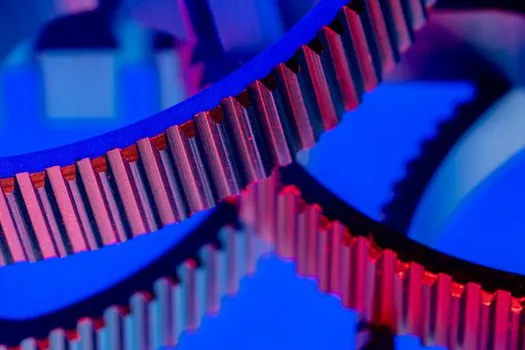
Paper-machine atmospheres combine steam, bleach chemicals, and condensate, so pulley surface treatment matters almost as much as belt material. Zinc, nickel, and chromate conversion coatings handle general corrosion; hard anodizing lifts wear resistance; nickel-PTFE is the go-to for combined corrosion, wear, and low-friction demands [S2]. Note the practical cost: surface treatment typically adds 2-3 weeks to pulley delivery, which has to be planned into the mill's outage schedule [S2].
For coating and converting lines where cleanliness dominates, a polyurethane belt on a nickel-PTFE-coated aluminum pulley is the standard pairing; for a dryer section where heat is the main enemy, a chloroprene belt with a hardened steel pulley and at least one flange is the more durable choice. Belt drive efficiency is above 95% when the geometry is right, so the real losses on a paper line are typically the bearings and the gearboxes, not the belt itself [S5].
Lifetime, rating margin, and noise
A properly specified synchronous belt in steady service is rated for a minimum of 3000 hours of useful life when installation, tension, and alignment match the design rules [S5]. The corollary is that belt life is set by the design margin, not the catalogue figure: SDP-SI recommends rating belts at only 1/15th of their ultimate tensile strength, so any drive that asks the belt to run closer to its break strength is buying a short overhaul interval [S5].
Noise rises with belt speed and with initial tension, and the cure on a noisy calender or winder drive is usually a profile change rather than a tension change. PowerGrip GT2-style profiles are specifically called out for substantial noise reduction over classical trapezoidal profiles, and deep-groove tooth forms cut noise at belt speeds above 20 m/s by letting trapped air escape the mesh [S2][S5]. When the application is a sensitive measuring or recording device sitting downstream of the drive, back-grinding the belt to a uniform thickness is the standard fix for thickness-induced noise [S5].
What the spec sheet should not contain
Two failure modes are predictable and avoidable: tooth shear from shock loading, and pitch loss from elongation. On stepping-motor or reversing drives (common in printing and packaging outfeeds of paper mills), high-acceleration cycles concentrate load on a few teeth, and a belt with too-stiff a tension member will transfer the shock straight into shear; the cure is a larger minimum pinion or a more compliant cord, not a higher tensile rating [S5]. For zero-backlash positioning (registration gates, cut-to-length, sheet alignment), special profile pulleys can be cut with no clearance between belt tooth and pulley, at the cost of belt life, and this trade-off has to be called out on the drawing, not buried in the BOM [S2][S5].
Track the next failure: monitor tooth-mesh count on the small pulley against the 6-tooth rule after every belt re-tension, and re-verify pinion rpm against the 28-50 m/s ceiling whenever a dryer or calender section is re-geared. If a mill-side service factor table is being updated in 2026, the change will land first in OEM pulp-and-paper application notes such as the PIX reference [S1], with the deeper engineering caveats still in SDP-SI and Misumi technical PDFs [S3][S5].
For component-level specifications, see timing belt, timing pulley, and checking and testing apparatus.
Background reading: Bump Cap vs Full Hard Hat: Low-Clearance PPE Selection Spec Sheet.