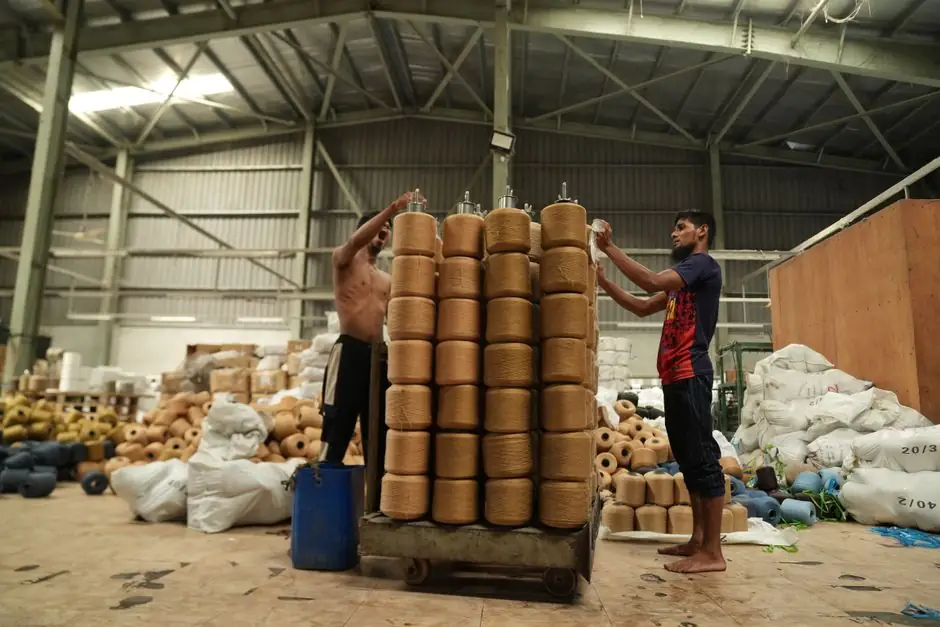
Textile machinery spans ring-spinning frames running 8,000 to 25,000 rpm at small loads, through carding, draw-frames, and loom main shafts, to dye-house and printing ranges exposed to steam, alkali, and oxidizing chemicals. Each duty sets a different requirement on roller chain pitch, strand count, and base material.
The selection workflow used by most mill engineers is the same five-step procedure documented for general roller drive chain: determine driven-load class, apply a service factor, calculate design horsepower, pick pitch from a quick-selector chart, and finally choose the small-sprocket tooth count from the chain-size horsepower table [S2]. A typical light/medium-duty textile drive with an electric motor, uniform load, sees a service factor of 1.0; a carding drive fed from an ICE through a mechanical coupling rates 1.4 to 1.7, and a loom main-shaft with frequent start-stop and shock loads pushes the design horsepower well above the motor nameplate [S2].
Pitch, Strand Count, and Speed Windows for Textile Machines
Pitch is the first lever after horsepower is fixed: smaller-pitch chain (08B-1, 10B-1, 12B-1 in ISO designations, roughly 12.7 to 19.05 mm) runs smoother and faster but carries less load per strand, while larger-pitch chain (16B, 20B, 24B, 1.0 to 1.5 inch ANSI) is reserved for heavy carding, calendar, and main-shaft drives [S3].
Single-strand chain is the default for most spinning and winding drives; multi-strand duplex, triplex, or larger configurations are specified only when either the design horsepower exceeds the single-strand table rating or when the available shaft-center envelope is too short for a large-diameter sprocket running a fine pitch [S6]. For high-speed drives above roughly 1,000 rpm at the small sprocket, fine pitch (under 25.4 mm) with a 21-tooth or larger driver is preferred to keep chain speed under 8 m/s, which is the practical upper limit for long service life on a textile floor [S2][S4].
Material and Lubrication: Matching the Mill Environment
Spinning and weaving halls are dry, lint-laden, and warm, so a standard carbon-steel precision chain with a petroleum or synthetic PAO grease is the baseline choice, and an oil-impregnated sintered-bushing or sealed-pin chain is preferred where relubrication windows are short [S4][S7].
Dye houses, Mercerizing ranges, print washers, and bleach lines demand corrosion-resistant chain: 304 stainless chain for general wet exposure, 316 stainless or nickel-plated carbon-steel chain where chlorinated and oxidizing chemistries are present, and polymer-bushing chain where the duty is light and absolute metal-ion contamination cannot be tolerated [S7]. The penalty for skipping material selection is predictable: standard carbon-steel chain in a continuous dye-house atmosphere routinely fails in 6 to 12 months against a 3 to 5 year target life. Approved-Performance-class chains are explicitly rated for light and medium loads, which covers most individual motor-to-shaft drives in spinning and weaving departments [S5].
Service Factor and Driven-Load Class for Carding, Spinning, and Looms
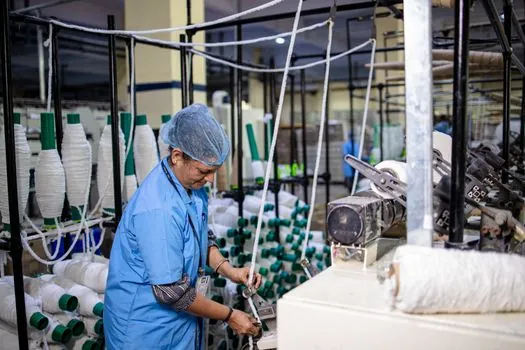
Service factor is the single most underestimated input in mill re-shoveling programs: a 7.5 kW motor with a 1.0 service factor becomes 11.25 kW at a 1.5 factor, which can move the quick-selector pick from a 12B to a 16B chain or push the design from single-strand to duplex [S2].
For an electric-motor-driven uniform load (textile winding, let-off, take-up), the published service factor is 1.0; for moderate shock (carding, draw-frame) it is 1.2 to 1.3; for heavy shock with frequent start-stop (rapier or air-jet loom main-shaft, calendar stack) it is 1.4 to 1.5 on an electric-motor drive and 1.7 on a mechanical-coupled ICE drive [S2]. Designers should treat the design horsepower as a hard floor, then check that the calculated Horsepower Table Rating (Design HP divided by the multiple-strand factor) does not exceed the catalog rating at the chosen small-sprocket tooth count and rpm [S2].
Comparison of Common Chain Options on Textile Duties
The four most common picks line up against four decision criteria as follows, drawn from manufacturer selection guidance:
Small-pitch precision roller chain (08B-1 to 12B-1): best for high speed and light load (ring spinning, winding), typically rated up to roughly 2,000 rpm at the driver, lowest cost per meter, requires routine lubrication. Multi-strand roller chain (duplex/triplex 12B-2/3 to 24B-2/3): best for heavy shock load and high design horsepower in a short center distance (card main shaft, calendar), moderate speed, moderate cost, lubrication interval similar to single-strand. Stainless-steel roller chain (304/316): best for humid or chemical-finishing areas (dye house, mercerizing, bleach), load capacity roughly 70 to 80% of carbon-steel equivalent, three to ten times the cost of carbon-steel chain. Polymer-bushing / self-lubricating chain: best where relubrication access is poor or contamination must be near zero (clean-room weaving, food-contact packaging lines adjacent to textile), limited to light loads, premium cost, very low maintenance [S4][S5][S7].
Selection Workflow and Common Failure Modes
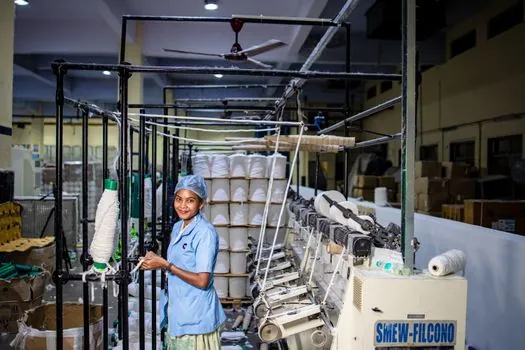
Working engineers usually start from a 5-step procedure that mirrors the Renold Jeffrey guide: classify the driven load, look up the service factor, multiply to get design horsepower, locate that horsepower on the quick-selector chart at the small-sprocket rpm, and finally read off the recommended chain pitch [S2].
Common mill failure modes are well documented and largely traceable to spec errors: pitch elongation past the 3% wear-limit indicator, which is the single most frequent reason for re-tensioning and eventual skip-tooth jamming; inadequate service factor on loom drives with cyclic start-stop; wrong material grade in wet areas; and excessive chain speed from running a coarse pitch on a small diameter driver sprocket. The Renold guidance also notes that fluctuating loads, frequent starts and stops, and corrosive or abrasive conditions warrant direct engineering consultation rather than a table lookup alone [S2]. For a side-by-side look at how the same workflow reads in a pulp-and-paper context, where corrosion and shock loads are similarly severe, see this sprocket selection for pulp and paper: teeth, material, drive sizing reference.
Standards, Sourcing, and Adjacent Component Choices
Textile-mill chain is most commonly specified to ISO 606 (BS/DIN 8187) for European machines or to ANSI B29.1 for US-built machinery, both of which define the same short-pitch precision transmission family that covers 08B-1 through 24B-1 and their multi-strand variants [S4].
Procurement should match the chain to the sprocket standard, confirm the connecting-link type (offset or slip-fit) for the planned service interval, and verify that the crossed-roller guide or shaft-bearing arrangement downstream can accept the chain's rated tensile load. Where a mill is also re-engineering its conveyor lines, the same pitch-vs-load logic applied to roller conveyor drives informs the chain-vs-roller decision for lightweight package handling. Engineers sizing a new card drive should also keep an eye on tapered roller bearing selection for the driven-shaft support, since shaft deflection under chain tension is a frequent contributor to premature chain wear.
Trackable signals for the next six months: ISO 606 chain listings published by Peer Chain and Renold Jeffrey (catalog revs that consolidate duplex and triplex ratings), and field reports from spinning-mill retrofits that compare 304-stainless versus nickel-plated carbon-steel chain life in continuous dye-house service.