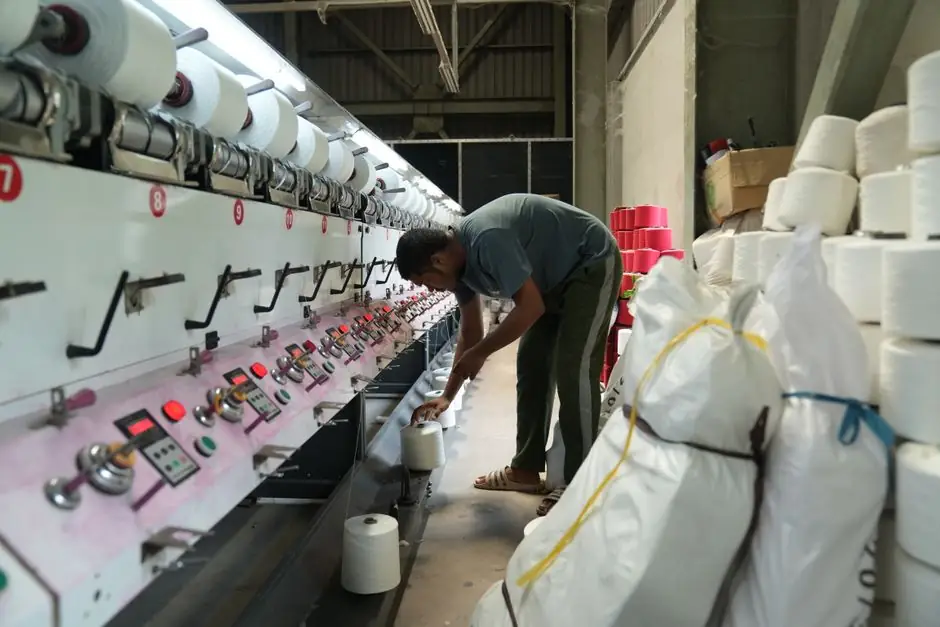
Textile mill conveyors run under conditions that punish general-purpose chain selection: continuous duty, airborne lint and fibre, humidity swings between wet-process and dry-finish areas, and zero tolerance for oil reaching the cloth. A correct pick sizes around operating speed under 200 ft/min, working load from light (bobbin transport) to heavy (greige fabric roll accumulation), and pitch in the 38-152 mm engineering range that covers most mill layouts [S3][S4].
Engineers should start from the conveyor chain family rather than transmission chain, because the former is built for sliding or rolling on a track, side load from carried product, and frequent attachment points, while the latter is optimised for sprocket-to-sprocket power transmission with minimal lateral force. Mislining these two families is the single most common textile-mill conveyor failure trigger.
Operating envelope: speed, load, and environment in a textile plant
Textile conveyors almost always sit in the low-to-moderate speed band: typical lines move fabric, sliver, yarn packages, or rolls at well under 200 ft/min, which is the upper end quoted for general engineering chain service in industrial material handling [S3]. Above that, chain wear accelerates and noise rises sharply, which matters in plants sited near residential zones where the 5-10 dB difference between a starved chain and a properly lubricated one is an operator complaint trigger [S1].
Working loads in a mill are bimodal. Light-duty lines carry yarn packages, individual garments, or small fabric bundles, with chain tension often under 1,000 lbf. Heavy-duty lines accumulate full-width greige rolls, dye-bath carriers, or stent frames, and tension can exceed 10,000 lbf on the return strand, which forces the selection toward large-pitch engineering chain with breaking loads in the 6,000-37,000 lbf band depending on pitch and construction [S3][S5].
Three environmental factors override textbook chain selection in textiles. First, lint and short fibres migrate into chain joints and mix with stray oil, forming an abrasive paste that accelerates pin and bush wear, so any chain specced into a carding or spinning area must have a credible sealing strategy, not just a lubrication plan. Second, wet-process zones (dyeing, bleaching) expose the chain to alkaline and oxidative chemistries, which rule out standard carbon-steel chain without a plated or stainless option. Third, dry-finish zones (stentering, calendering) run hot and dry, pushing lubricant selection toward high-viscosity, high-flash-point oils that survive 80-150 degC ambient without carbonising on the pin [S1].
Chain family comparison: which type for which textile duty
Five chain architectures dominate textile conveyor work, and they line up against decision criteria as follows. Small-pitch conveyor chain (under 1.5 inch / 38 mm pitch) suits lightweight garment and small-package lines where smooth, low-noise travel matters more than raw tensile capacity. Precision conveyor chain is the default pick for high-speed packaging and sorting within a mill's distribution area, holding tight dimensional tolerances for consistent sprocket engagement. Top chain, with an extended top plate for direct product carrying, fits can-and-pallet style accumulation where attachments would over-complicate the line. Free flow chain separates accumulating and conveying strands, useful in inspection or QC buffers. Large-pitch conveyor chain, often drop-forged, covers heavy-duty mill waste handling, bale transport, and effluent-plant conveyors with breaking loads from roughly 6,000 lbf at 102 mm pitch upward to over 100,000 lbf at 260 mm pitch [S4][S5].
For attachment-heavy work, hollow bearing pin chain is the standard textile-mill solution: bolts pass through the tubular pin to mount flights, pusher dogs, or cleats, and the chain can accept or shed attachments without breaking the chain. Solid bearing pin chain trades attachment flexibility for a higher breaking load, typically 15-25% above the equivalent hollow pin chain, and is the better call on heavy roll conveyors where bolted attachments would be a fatigue site [S5]. For high-turn or high-side-load layouts (textile lines with multiple 90 deg transfers, or sliver-can return loops), deep link chain adds side-plate depth that gives a continuous carrying edge above the roller, preventing product slip and keeping the chain on track under lateral load [S5].
Selection procedure: from driven load class to chain pitch
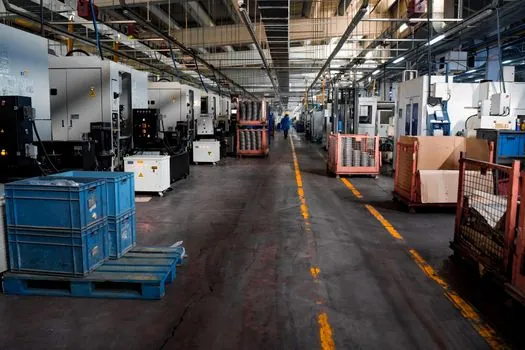
The selection flow used by chain manufacturers follows a fixed sequence and a textile-mill engineer should not skip steps even on a replacement purchase. Step 1 classifies the driven load as uniform, moderate, or heavy shock, which is set by what the conveyor handles: a garment sorter is uniform, a stent frame accumulator is moderate, and a bale or roll conveyor with stop-start cycles is heavy shock. Step 2 applies a service factor from the input-power table, ranging from 1.0 (uniform load, electric motor) to 1.7 (heavy shock, internal combustion engine with mechanical drive) [S2].
Step 3 multiplies nameplate horsepower by the service factor to get design horsepower, which is the figure the chain must transmit, not the motor rating. Step 4 reads the design horsepower against the small-sprocket RPM on a quick-selector chart, which returns a tentative chain pitch, typically 1.5 inch (38 mm) up to 6 inch (152 mm) for engineering chain in textile service. Step 5 sets the minimum small-sprocket tooth count from the horsepower table for that pitch, which is where most mis-selections happen: undersized sprockets (under 17 teeth on the small sprocket at moderate speed) cut chain life dramatically by increasing the polygon-ing effect on each drive revolution [S2][S3].
For textile conveyors, two extensions sit on top of this base flow. First, the engineer must verify roller load and attachment allowable load, which the basic flow skips when carried objects are light; in a mill, even light packages can stack, and the static load on a top-chain flight in an accumulation zone is the failure point, not the moving tension. Second, the conveyor must be classified as horizontal or free-flow, because tension calculation differs: a horizontal conveyor's effective tension is approximately the total moving load times the coefficient of friction, while a free-flow (accumulation) conveyor must add the friction of the sliding strand through the accumulation zone, which in a long inspection buffer can double the required chain rating [S4].
Lubrication strategy: the textile-specific override
Lubrication is not an add-on to chain selection in a textile mill, it is a selection criterion. The four failure modes that come back from the field are contamination, premature wear, slip risk, and excess energy draw, and all four are rooted in how the chain is oiled. Manual, brush, or drip-feed systems over-oil because they coat the entire chain rather than the pivot points, and that excess oil picks up lint, dust, and short fibre, which then mix into an abrasive grinding paste between pin and bush [S1].
Targeted lubrication systems that meter small, precise doses to the pin-and-bush interface only, such as RotaLube's per-pivot applicator, solve the contamination problem at the source. The implementation trade-off is real: brush and drip systems are cheap to fit but expensive to live with, while a per-pivot automated system adds capital cost but cuts chain replacement frequency and removes oil-related product reject waste, which in a garment or technical-textile line is a direct margin item [S1].
Regular inspection combined with correct lubrication extends chain service life by 30-50% across most industrial applications, a figure that is conservative for textile service where lint contamination can otherwise halve pin-and-bush life [S3].
Material, attachment, and standards notes
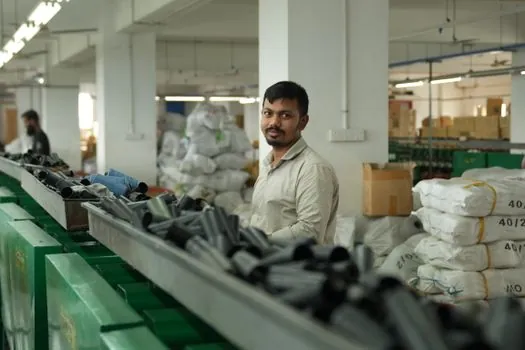
Material choice is the second textile-specific override. Carbon-steel engineering chain with through-hardened pins (typical tensile strength band 60,000-130,000 PSI per manufacturer data) is acceptable for dry-process areas, but any zone with bleach, peroxide, or acid dye carryover should specify 304 or 316 stainless chain, or at minimum a zinc or nickel plated chain with sealed joints [S3]. Plain carbon-steel chain in a wet-zone will pit and ultimately freeze at the pin within months, regardless of how well it is lubricated.
Attachment selection in a textile mill tends toward bolted, bolt-on flights and pusher dogs, and these should always be mounted on the outer link of a hollow pin chain with a single bolt, not spanning the inner link, because spanning the inner link locks the chain articulation and creates a fatigue point that breaks the side plate. The drop-forged chain sizes used in mill waste and effluent handling range from 102 mm to 260 mm pitch as standard, with breaking loads scaled accordingly, and engineers should treat the manufacturer's published breaking load as a 4:1 design minimum over calculated maximum tension for continuous-duty lines [S5].
Standards to anchor against: ISO 1977 covers conveyor chain dimensions and tolerances for the engineering and precision series commonly used in textile plants, and ISO 3512 covers the heavy-duty and drop-forged series used in mill waste and effluent service. For chain selection methodology, the Renold Jeffrey and Tsubaki catalogues remain the de facto reference flow, and the service-factor table from the Renold Jeffrey engineering information is a defensible baseline even on a non-Renold specification, because the load classifications map to any chain built to ISO dimensions [S2][S3]. Where a mill runs a roller chain baseline drive (for example a low-speed carding-line drive) it must still check the textile-specific contamination and humidity overrides; a standard drive chain from a textile mill line is often the wrong default, and a conveyor chain should be the starting point rather than the fallback.
Limits, failure modes, and what to verify on site
The two limits most often missed in textile-mill selection are side-load capacity and corrosion margin. Engineering chain ratings assume tension along the strand; side load from a swinging fabric roll or an off-centre yarn package is a separate derating, and a chain that is fine on tension can still fail by plate bending or pin shear under repeated lateral load. The second limit is corrosion: published breaking loads assume new chain, and a 10% section loss from rust in a wet-process zone drops the effective rating well below the design margin. [S5]
The dominant field failure mode is pin-and-bush wear accelerated by lint-contaminated lubricant, not chain tensile overload. On quiet lines, the first detectable sign is usually a 5-8 dB rise in operating noise from increased friction, which makes a noise walk a useful early-warning maintenance tool [S1].
For verification on a new or refurbished textile line, the engineer should confirm: (a) chain pitch is at the upper end of the quick-selector recommendation, not the lower, given the dusty and contamination-prone environment; (b) the small sprocket has 19 or more teeth, not the minimum, to keep polygon-ing low; (c) lubrication is targeted to the pin-and-bush interface, not chain-wide; and (d) attachment bolts are single, on the outer link, and torqued to the chain maker's specification rather than a generic bolt grade. For comparison against other conveyor technologies, see chain conveyor selection for air cargo, which follows the same service-factor logic but pushes toward higher speed and heavier shock loads than a textile line typically sees.
Trackable signals for the next 6-12 months: ISO 1977 revision activity on engineering-chain tolerances, the release of textile-rated stainless hollow-pin chain ranges from major manufacturers (currently still a special-order item on most lines), and the spread of automated per-pivot lubrication as a default rather than upgrade specification in new mill builds. Until those land, the safe default for any textile-mill conveyor remains engineering or hollow-pin chain, ISO 1977 dimensions, 19+ tooth small sprocket, and targeted pin-and-bush lubrication.
Spec-level background on the components involved: chain conveyor.