
Lock nut choice is governed first by thread standard and size (metric coarse M6–M30 or unified 1/4-20 to 1-8), then by base material (carbon steel grade 8/10, A2/A4 stainless, brass, nylon), and finally by the locking principle — nylon-insert prevailing torque, deformed all-metal thread, ribbed flange, or castellated with cotter pin [S3][S5][S8].
Specifying a lock nut without locking these three axes first is the most common procurement error; a correctly sized M10 nylon-insert nut in A4 stainless can still fail if the joint sees continuous temperatures above the nylon softening point, and a deformed-thread all-metal nut is wasted money on a low-vibration cabinet door.
Locking Mechanism Comparison: Nylon Insert vs All-Metal vs Castellated
A nylon-insert prevailing-torque nut is the most widely stocked variant and the cheapest path to vibration resistance on a one-shot assembly; the polymer ring is typically rated for repeated re-use up to about 5 cycles and continuous service near 120°C, above which the insert begins to lose torque retention [S3][S4].
An all-metal deformed-thread lock nut (DIN 980 / DIN 6925 style) carries no polymer, so its upper temperature ceiling is set by the base material — A2 stainless versions are routinely used from −40°C past 200°C in industrial valve actuator linkages and exhaust manifolds, at roughly 2× the unit cost of an equivalent nylon-insert nut [S5][S8].
Castellated / crown lock nuts (DIN 935) are the only variant in this comparison that accepts a cotter pin or safety wire, which is why they remain mandatory on steering linkages, kingpin assemblies, and any joint where a single nut loosening event is a documented safety failure [S3][S8]. The trade-off is assembly time: alignment of the slot with the bolt hole adds a manual step no other lock-nut type requires.
Material and Corrosion-Class Selection
Carbon-steel lock nuts (grade 8, grade 10, or class 8/10 per ISO 898-2) are the default for indoor structural joints; zinc-plated, hot-dip galvanised, and zinc-flake (Geomet/Dacromet) finishes extend outdoor life to roughly 500–1,000 h neutral salt-spray (ISO 9227) before first red rust [S5][S8].
A2 (304) stainless lock nuts cover most wash-down food, beverage, and general chemical exposures, while A4 (316) is the standard pick for chloride-rich environments (marine, de-icing salt, bleach dosing) where pitting resistance matters more than ultimate tensile strength — A4 typically costs 20–40% more than A2 in the same size [S5].
For applications where metal contact with the mating part is unacceptable — medical devices, electronics, light-alloy panels — a fully nylon lock nut is available, and the all-polymer construction doubles as electrical insulation when a pressure sensor or instrument housing is being grounded through the bolt [S4].
Reusability, Torque Range and Vibration Service Factor
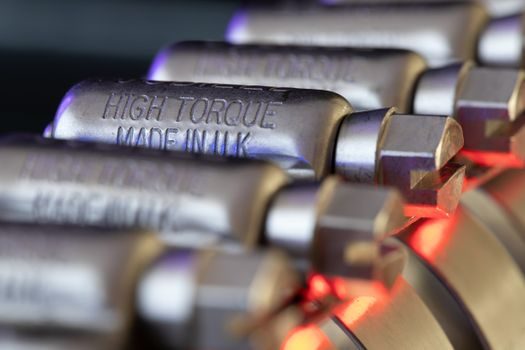
Prevailing-torque lock nuts (nylon insert and all-metal) reach their holding torque over a defined clamp band — for an M8 nylon-insert nut that band is roughly 5–8 N·m on a Class 8.8 bolt, and going below it leaves the insert unloaded while going above it strips the polymer [S3][S4].
For joints that are serviced every 1,000–5,000 hours (engine accessories, conveyor idlers, vibrating screens) a nylon-insert nut can typically survive 5–10 re-torquing cycles before the insert loses its interference; an all-metal deformed-thread nut extends that envelope to 20+ cycles at the cost of higher initial tightening torque scatter [S5].
On a flow-meter body flange or a pressure transmitter manifold stud, where the joint is rarely broken but must not loosen over 10+ years, prevailing-torque torque retention — not raw clamp load — is the controlling design variable, and the lock nut is doing the work the plain washer cannot.
Failure Modes and When NOT to Use a Standard Lock Nut
The three documented failure modes for lock nuts are: (1) nylon-insert melt-back on exhaust, turbo, or near-engine accessory joints above ~120°C; (2) vibration-induced thread strip on soft-alloy housings (aluminium, magnesium) when the clamp load exceeds the parent-material proof load; (3) galling / thread seizure on stainless-on-stainless joints assembled without anti-seize, which is often misread as a "lock nut that came loose" [S5][S8].
A standard nylon-insert nut is the wrong pick for sub-sea or permanently wetted service because the polymer absorbs water and swells, changing the prevailing-torque value; specify a fully metal lock nut or a pre-applied thread-locking coating instead. Likewise, on a PLC panel or control-cabinet door that is opened monthly, a one-way security lock nut (irregular drive pattern) is over-specified and slows every maintenance event.
Sourcing, Standards and Standards Compliance

The standards a lock nut is most commonly produced to are DIN 980 (all-metal prevailing-torque), DIN 6925 (all-metal thin hex), DIN 985 (nylon insert), DIN 935 (castellated), ISO 7042, ISO 10511, ISO 7721, and the SAE J995 series; buyers should require the standard mark on the nut face and a mill certificate for any A4 or grade-10/12 purchase [S8].
For original-equipment volumes above roughly 50,000 pieces per year, direct-from-factory sourcing out of Fujian, the Yongnian cluster (Hebei), or the Handan fastener belt is common practice; one verified OEM reports 30,000 t annual nut output across standard and non-standard lock-nut variants with OEM/ODM service available [S6]. For prototype and small-batch (under 1,000 pieces) the same M6–M16 range is available ex-stock through MISUMI catalogue in barrel, passivated, and zinc-plated surface treatments [S9].
Cross-check thread fit, proof-load class, and corrosion class against the joint drawing before releasing a purchase order; mismatches on any of the three are the dominant cause of field returns. For application context on adjacent threaded joints, the engineering trade-offs laid out in the Steel Strand Installation Guide cover torque-window discipline in the same terms, and the Air Pick Pros and Cons piece shows how a similar material-vs-mechanism trade-off maps onto a different fastening duty.
Spec-level background on the components involved: pressure transmitter, and flow meter.