
A fixed conveyor sorting line is the stronger choice for sustained high-volume flow because it provides continuous movement along a committed route without a battery charging window [S1][S2].
An AGV becomes competitive when handling heavy loads, repeating missions, and accepting moderate throughput in exchange for a smaller installation footprint and field-based reconfiguration [S2][S6].
Decision Criteria: Throughput, Flexibility, and Installation
The selection is a comparison of continuous-flow capacity, route flexibility, installation effort, obstacle response, and lifetime operating cost rather than a contest between mobile and fixed technology [S1][S2]. A conveyor sorting line is engineered around one dominant flow, while an AGV robot treats the route as a dispatch task. The choice changes when the flow profile, destination layout, or lease conditions change.
For a fixed high-volume operation, the decisive question is whether the receiving profile, item dimensions, destination count, and required output rate remain stable. If they do, a conveyor amortizes its fixed engineering and installation cost over a large number of units. If they do not, an AGV may protect the facility from an expensive rebuild, although the fleet must still be sized for peak demand rather than average demand.
A practical screen is to model annual units, peak-hour units, required destinations, load mass, route length, and expected layout life. Compare the conveyor's units per hour and destination capacity with the AGV fleet's mission cycle, availability, battery charging, and traffic delay. Do not compare advertised vehicle speed with conveyor speed, because the AGV figure excludes loading, queuing, intersections, charging, and empty travel.
Throughput and Operating Continuity
Conveyors provide the stronger result for continuous, predictable demand because the product moves continuously at a controlled line speed, while an AGV completes discrete missions with loading, travel, waiting, and recharge periods [S2]. A conveyor provides continuous movement along a fixed route, whereas AGVs and AMRs perform discrete transport missions.
Fixed sortation architectures also support predictable destination density. Loop sorters deliver the highest throughput for operations with consistent volumes. These are configuration classes rather than guarantees, so the sorter supplier must confirm performance against the actual item mix and induction profile.
An AGV system does not inherently deliver low throughput. With enough vehicles, it can support a substantial flow, but usable capacity is constrained by mission time, traffic control, charging strategy, and the duty cycle of loading equipment. A conveyor also offers clearer accumulation behavior: accumulation conveyors buffer product between zones and prevent back-up when a downstream process slows [S3][S4].
Flexibility, Footprint, and Layout Changes
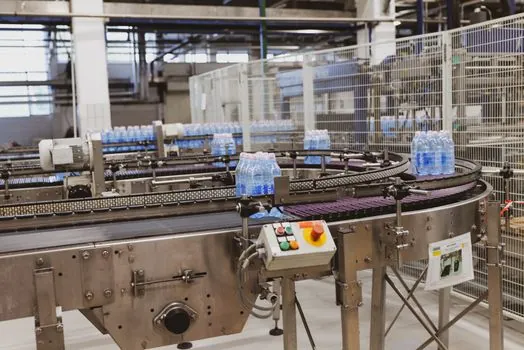
An AGV generally wins where routes or destinations change repeatedly because its mission can be changed in fleet software, while a conveyor route is embedded in physical infrastructure [S1]. This makes reconfiguration a dispatch and field-route task rather than a full construction project [S1].
More broadly, a conveyor build is stated at 8–24 months, an AGV fleet at 3–9 months, and an AMR deployment at 2–8 weeks [S2]. These ranges describe implementation environments, not universal delivery promises, but they show why an AGV or AMR is usually easier to introduce incrementally.
Conveyors permanently occupy their footprint and create fixed obstructions, whereas mobile robots can use shared aisles and move between receiving, storage, replenishment, and outbound tasks [S1]. A low-footprint mobile solution can therefore be outweighed by the space consumed around its routes, charging area, traffic lanes, and transfer stations.
Comparison of Conveyor and AGV Options
Cost, throughput, flexibility, and integration effort align the technologies differently: a conveyor offers the lowest cost per unit at sustained volume, while an AGV offers stronger reconfiguration and heavy-load mobility at the cost of lower transport continuity [S1][S3][S6].
For this decision, an AMR robot is not the same proposition as an AGV. An AMR builds its own map and plans around obstacles in real time, while an AGV follows a fixed, pre-mapped route. If the requirement is specifically an AGV comparison, do not credit it with autonomous obstacle avoidance unless the selected model and control architecture provide it.
Use Cases and Exclusions

A conveyor is appropriate when parcels, totes, cartons, or polybags arrive in a repeatable stream and must reach fixed destinations at high sustained rates [S3][S4][S7]. It is particularly suitable for receiving-to-storage, storage-to-pick, pack-to-ship, and high-density induction-to-destination flows [S3]. The system is not appropriate when destinations change every few weeks, the facility has a short lease, or future growth makes a rebuild likely [S1][S5].
An AGV is appropriate for heavy pallet movement between receiving and storage, transport between pick zones and outbound staging, and repeatable fixed routes with moderate flow [S2][S6]. It is not the natural choice for a continuous parcel stream requiring a high destination count, continuous accumulation, or the lowest cost per unit moved. A route must also remain physically stable, and transfer points must deliver load presentation consistently without manual intervention.
For a facility with both patterns, divide the decision by zone rather than forcing one technology across the building. Mobile fleets are often assigned receiving, storage replenishment, and outbound staging, while fixed conveyors or sorters handle the high-rate core [S2]. A useful design rule is to place the AGV where it removes walking, truck traffic, or heavy manual travel, and place the conveyor where it creates a continuous flow advantage.
Safety, Reliability, and Failure Modes
AGV safety requires controlled traffic and functional safeguards; ISO 3691-4 and ANSI/RIA R15.08 are identified as applicable safety requirements for driverless industrial trucks and their systems [S2]. The same design must address mixed pedestrian traffic, intersecting routes, emergency stops, charging areas, and vehicle recovery. Conveyors create a different hazard set involving nip points, falling loads, guarding, emergency stops, and maintenance access [S3].
The principal conveyor failure modes are jam accumulation, induction imbalance, misread identification, diverter misalignment, and downstream blockage. Accumulation zones are specifically used to prevent product backup when a downstream zone slows [S3][S4]. Preventive maintenance should cover drives, rollers or belts, chains, sensors, diverters, controls, and structural interfaces.
The principal AGV failure modes are blocked routes, traffic starvation, unavailable chargers, battery degradation, localization or marker problems, and insufficient spare vehicles. An AGV that meets a parked forklift stops and raises an alarm rather than rerouting [S2]. Route design must therefore reserve passing space and define how forklifts, pedestrians, and mobile robots interact.
Sourcing, Standards, and Acceptance Tests

A performance-based specification should separate line rate, sort accuracy, availability, and fleet mission capacity: conveyor acceptance should verify units per hour, sustained rate over the defined shift, destination accuracy, jam recovery, and accumulation behavior, while AGV acceptance should verify missions per hour, load cycle time, route congestion, charging coverage, and fleet availability [S2][S3].
Quote the conveyor at the required peak rate rather than nominal belt speed, and specify the item mix by mass, dimensions, packaging, and destination distribution. For loop sorters, published configuration ranges include 8,000–43,000 units per hour for tilt-trray systems and 15,000–80,000 units per hour for cross-belt systems [S5]. For the AGV, define payload, load-transfer interface, traffic priority, charging strategy, spare ratio, and WMS or fleet-control integration.
One related design issue is the conveyor surface itself. The comparison of belt and roller surfaces for fragile items is covered in Belt vs Roller Surface for Fragile Conveyor Sorting, because a high-rate route is only valid when the item remains stable through induction, transfer, accumulation, and discharge.
Before final approval, track three signals: measured peak-hour demand, the planned life of the physical flow, and the vendor's demonstrated recovery time at the specified failure point. If peak demand is stable and the route has at least the intended operating life, specify the conveyor and reserve AGVs for adjacent heavy or variable transport zones. If the route or destination profile is not committed, evaluate an AGV fleet with a capacity model rather than treating it as a drop-in conveyor replacement.