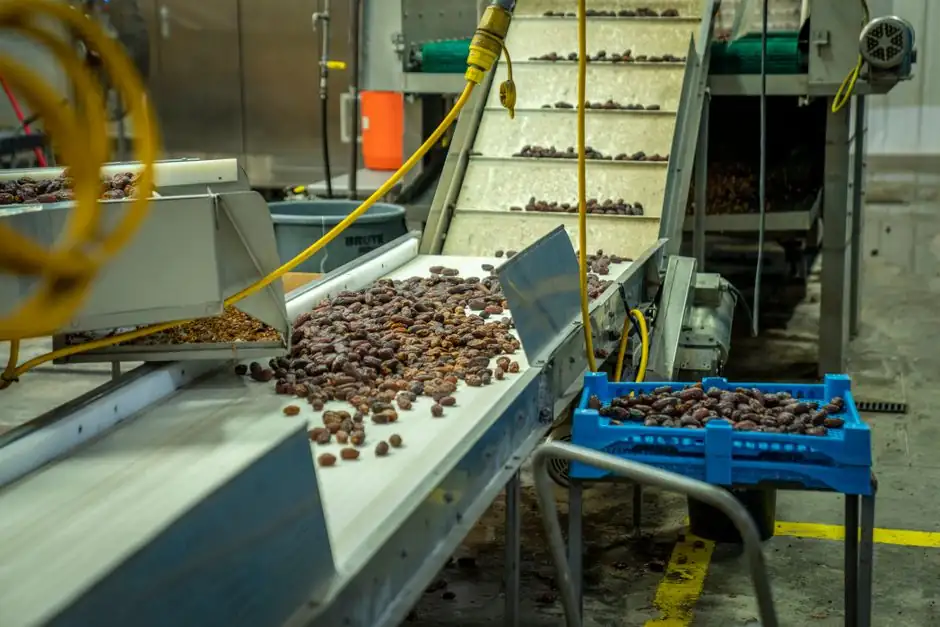
A continuous belt supports fragile and irregular products across an uninterrupted surface, while rollers provide controlled accumulation for rigid loads supported by at least three rollers [S1][S3].
The choice depends on product geometry, load mass, stopping frequency, divert method, incline and sanitation exposure, not on conveyor speed alone [S2][S5].
Belt or roller selection criteria
Belt conveyors suit small, light, irregular or soft-bottomed items because the moving belt provides a continuous supporting surface, whereas roller conveyors suit flat-bottomed, heavier products and accumulation [S2]. A belt is the stronger choice for loose plants, individual containers, bags and irregular packages because each item remains supported across its base instead of balancing across separate cylinders [S3][S5].
The material transported on a roller conveyor must have a rigid riding surface supported by a minimum of three rollers [S1]. The rollers can also permit lighter or uneven loads to tilt, while a flat belt is more forgiving of poor loading [S3][S6].
Use the comparison matrix as follows: belt wins for surface continuity and delicate handling; powered rollers win for controlled stops, accumulation and divert actuation; gravity rollers win for light-to-medium loads moving downhill without a motor [S1]. Cost should be evaluated by installed function rather than purchase price, because a belt may require more complex framing while a powered roller line may need individual drives, controls and divert hardware [S1][S2].
Product geometry and contact behavior
Fragile-item handling starts with the contact footprint. A belt carries an item directly on one continuous surface, which improves stability for irregularly shaped and weighted goods, cartons, bags and delicate materials [S2][S5]. Powered rollers create several discrete contact points, so a product must have a firm, flat base to contact enough rollers and move without rocking [S1][S3].
The smallest items need a tightly spaced or solid conveying surface. Small products can drop between rollers or tilt across roller gaps, whereas belts avoid that transfer mode [S6]. For containers that do not have a broad flat bottom, specify a belt section before the rollers. For totes and cartons with a stable base, rollers can provide a more compact accumulation and control arrangement.
Fragility also changes with speed and transfer design. A constant-speed belt provides a smooth support plane, but the product still experiences acceleration, deceleration and transfer impact. Minimum distance to the next line, controlled acceleration, and a defined transfer point should therefore be treated as part of the conveyor specification rather than left to the controls contractor.
Accumulation, stopping and divert design
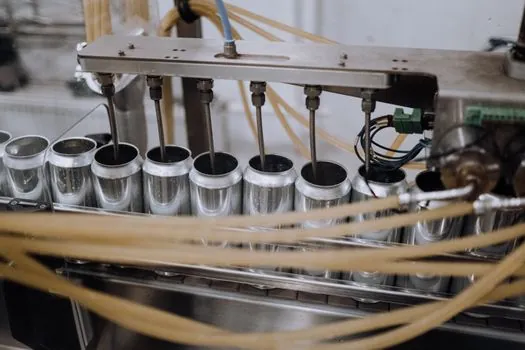
Powered roller conveyors are preferred when products must stop momentarily at control points, turn, undergo side loading, or be slide-unloaded [S1]. Their powered drive can equalize product motion along the line, while a force-sensitive transmission can disengage individual rollers to create accumulation zones used in merging and sorting operations [S1][S8].
Mechanical roller accessories can perform specific functions. Steel pins or blades can stop packages for inspection or removal, angled wheels can divert products, and lift bars can raise an item for a secondary operation before returning it to the line [S5]. The spacing between rollers constrains where those devices can engage the product, so diverter geometry must match both the item envelope and the roller pitch.
A belt does not inherently provide the same positive product stop. Where accumulation, holding, merging or sorting control is central, powered rollers usually provide the cleaner functional choice. The roller conveyor architecture is preferable when the product has a broad flat base and must be buffered, stopped or repeatedly diverted. For soft-bottomed or unstable items, divert away from the accumulating zone or use a carrier-based sorter rather than forcing side contact onto the item.
Fragile-item use cases and recommended layouts
Use a belt main line for potted plants, trays, loose produce, bags, irregular parcels and other products with a continuous-contact requirement [S3][S5]. A belt can also serve inclines and declines because the product rides on the belt rather than depending on gravity alone to move across cylinders [S2][S5]. These uses make a belt conveyor the normal recommendation for a fragile-product transport section.
In a mixed sorting line, a practical arrangement is a belt for induction and delicate transfer, powered rollers for controlled buffering and process stops, and a dedicated sorter after item identity and destination have been established [S4].
Carrier-based sorting is preferable when packages must be handled without sliding across a conveying surface. Parcel sorters using individual carriers can provide gentler handling and support destination-based routing through sensors, scanners and control software [S4]. For a broader view of that architecture, compare the conveyor sorting line with manual or modular alternatives.
Environment, maintenance and operating limits
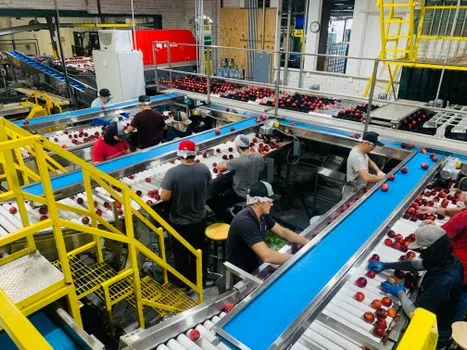
Horticultural environments impose three separate requirements: moisture resistance, soil exclusion and continuous-duty wear resistance [S3]. A belt selection must therefore specify the belt material, cleat or surface pattern, joint type, frame exposure and cleaning access. A roller selection must specify roller material, bearing sealing, shaft exposure, corrosion class and the degree of washdown exposure.
Roller constructions can use steel tubing with low-friction bearings, composite rollers for corrosive or wash-down environments, or aluminium and plastic in gravity applications [S1][S5]. Belt constructions commonly use rubber, fabric or synthetic materials [S2]. Material choice alone does not establish compatibility with soil, fertilizer, cleaning chemicals or moisture; validate the complete surface and bearing assembly against the actual duty cycle.
Maintain the distinction between conveyor bed and belt. The bed supports the belt, limits sag and guides the product path; it may be flat or trough-shaped according to material behavior [S7]. Inspect belt tracking, splice condition, frame alignment, roller rotation and bearing drag on a defined interval. A jammed roller creates a local impact point, while a damaged belt splice can release the product onto an unsupported transfer.
Decision matrix and implementation specification
Specify the conveying surface from four decision criteria. First, product support: use belt when the base is soft, irregular or narrower than the reliable roller contact zone, and use rollers only when the item has a firm, flat base supported by at least three rollers [S1][S3]. Second, motion control: use powered rollers for momentary stops, accumulation, turning and side unloading; use belt where uninterrupted gentle support outweighs positive accumulation [S1].
Third, load and layout: belts accommodate light, irregular and inclined movement, while roller conveyors are better aligned with heavier, flat-bottomed products and shorter modular installations [S2][S5]. Fourth, divert method: roller-mounted wheels or lifters suit rigid packages, but a belt-side diverter must be designed around the product envelope, and a carrier sorter avoids product sliding altogether [S4][S5].
Before approval, record product mass, maximum dimensions, base geometry, acceptable impact, belt or roller speed, incline, minimum transfer gap, accumulation length, stop frequency, divert frequency and cleaning chemicals. Also record the control requirement: continuous movement, zone accumulation, scanning, merging or destination sorting. If a line must support both fragile irregular goods and rigid accumulating totes, use both technologies rather than forcing one surface across the whole duty cycle.
For equipment comparison and budget planning, the AMR vs conveyor sorting line decision matrix provides a useful adjacent check when the order mix is variable, while the belt-versus-roller choice should remain based on contact geometry and control requirements.