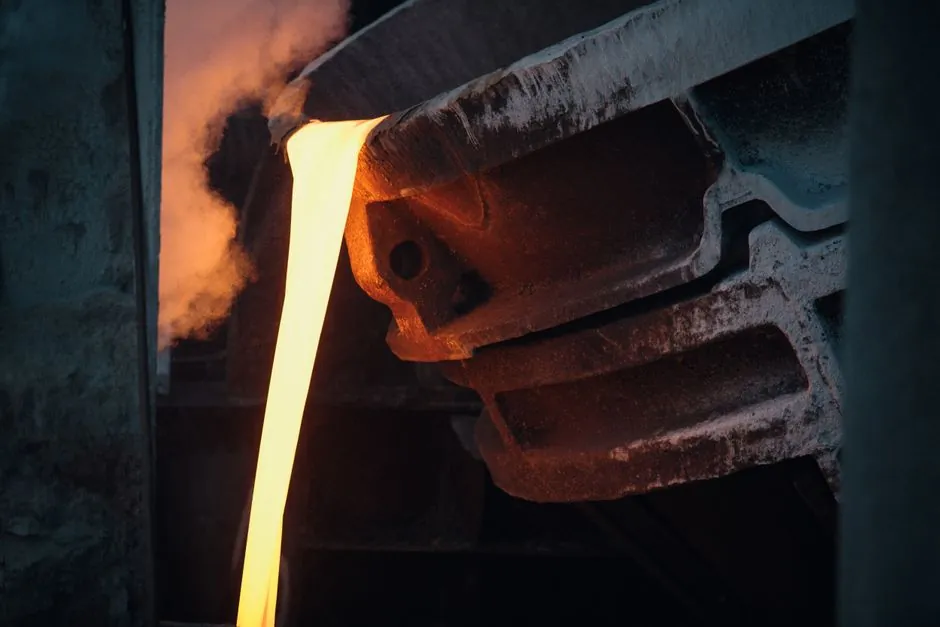
On high-volume green sand and no-bake lines, the cooling conveyor sitting between the mold dump and the shakeout machine does two jobs at once: it strips loose sand off hot castings and it holds each part on the deck long enough for temperature to drop evenly through the section [S1]. The retention window is the controlling variable: too short and the casting enters the shakeout too hot, risking thermal shock, sand burn-on, and downstream shot blast overload; too long and the line loses throughput [S1][S6].
Foundry equipment builders frame the conveyor as part of a coupled system, not a standalone cooler. Carrier's mold dump and cooling conveyors are explicitly described as equipment that "remove sand from hot castings and allow them to cool evenly for the required retention time, ensuring consistent metallurgical results" [S1]. Magaldi's Superbelt® in-mold cooling conveyor extends the cooling line to increase residence time of the cast part within the mold, reducing the cooling burden after de-molding and cutting the space needed for traditional post-pour cooling [S4].
What the pre-shakeout cooler actually has to do
The pre-shakeout cooler has three measurable duties: control residence time, deliver a uniform bulk temperature, and minimize the sand load the shakeout machine has to handle. Carrier's Delta-Phase Drive® is advertised as giving the operator direct command over "shakeout angle of attack and RPM," with adjustable conveying speed and retention time so each casting's time on the deck can be set per part [S1]. The pitch is the same on the Magaldi Superbelt®: gentle, low-impact transport that prevents mold shifts and reduces sand spillage, while letting line designers trade conveyor length for retention [S4].
The penalty for missing the target is concrete. Reliance Foundry's shakeout reference states a casting "must be cool enough to avoid galvanizing embrittlement while shaken out," and that pulling a too-hot casting into relatively cold air can cause metallurgical problems [S6]. On the equipment side, Didion's shakeout write-up ties sand carryover directly to shot blast cost: "the amount of sand carryover as well as the sand adhering to the castings is the single biggest factor relating to shotblast costs (labor to operate, shot consumption, energy consumption, replacement wear parts, and maintenance time)" [S3].
In-mold cooling vs post-mold cooling vs combined drum cooling
High-volume lines solve the retention problem in three distinct ways, and the choice cascades into the shakeout and cleaning cell. In-mold cooling extends residence time while the casting is still in the mold, on equipment such as Magaldi's Superbelt® steel-pan belt, which is "partially overlapping steel pans securely bolted on a patented steel double-wire mesh system" and marketed for "high reliability" under continuous thermal load [S4]. Post-mold cooling is the conventional mold-dump-and-convey step before the shakeout, served by vibrating cooling conveyors from builders like Carrier and JOEST [S1]. Combined drum cooling collapses the cool / shake / pre-clean steps into a single rotating or vibrating unit, as in Didion's Mark 5 Rotary Media Drum® and General Kinematics' VIBRA-DRUM® Sand & Casting Conditioner [S3][S5].
On a 2-3 axis decision matrix the three options split clearly. In-mold cooling (Magaldi Superbelt®) wins on cooling control and on eliminating the need for extra flasks, but it sits inside the molding line envelope and is fixed-length; one German iron foundry replaced "two rubber belts (the first one in operation and the second one on standby) used to transfer the molds from the punch-out to the shake-out" with a 24 m Superbelt® conveyor and reduced maintenance cost [S4]. Post-mold cooling conveyors are the simplest retrofit, give operators a separate retention-time knob, and slot ahead of any standard shakeout, but they need floor space and still feed hot sand into the shakeout [S1]. Combined drum units, like the VIBRA-DRUM®, merge sand separation, casting cleaning, and cooling in one machine, with General Kinematics claiming its Two-Mass drive "uses 2/3rds less energy than a direct drive system" and that foundries replacing old shakeouts "reported that sand carryover was drastically reduced from the previous process" [S5]. Didion's Mark 5 takes a different combined path with a recirculating bed of prismatoid media that "protects and cools the castings," followed by a water quench for final cooling before grinding [S3].
Why retention time, not just deck length, drives the design
Foundry writers keep coming back to residence time as the design lever. Carrier's Delta-Phase Drive® is built specifically so "every casting's time on the deck" can be controlled as a process variable, independent of stroke or RPM on older drives [S1]. Magaldi frames the in-mold process the same way: "The in-mold cooling process is influenced by the molding rate and the available space after pouring and before the mold dump & shake-out. Fast molding lines require a great deal of space and ancillary equipment to provide proper cooling" [S4].
The consequence is that on a fast line the cooler is sized by minutes of retention, not by tonnage per hour, and a line that cannot extend in-mold cooling has to make the time up after de-molding. Foundry Magazine's 2016 write-up on a Vibra-Drum installation described exactly this pattern, with "a secondary casting cooler located after the Vibra-Drum to reduce the casting temperatures before continuous shot blast" [S7]. That two-stage layout, primary shakeout-and-cool followed by a secondary cooler, is the default in older high-volume iron foundries that have added a post-shakeout cooler rather than rebuilding the front of the line.
Failure modes and constraints seen in the field
Three failure modes dominate the published case material. The first is thermal: a casting that is still hot at shakeout, especially a ductile iron or steel part, can suffer metallurgical damage and embrittlement when it hits the shakeout deck or the ambient air [S6]. The second is sand carryover: a cooler that is too short, too steep, or running with the wrong stroke leaves lumps and adhering sand on the casting, which then overloads the shot blast and the dust collector downstream [S3]. The third is equipment durability: rubber belts on high-temperature mold transfer were being replaced so often in one German iron foundry that a standby belt was kept in line, which is the direct problem the Superbelt® installation was bought to fix [S4].
Modern Casting's 2024 equipment spotlight described an iron foundry that "found its existing casting cooling and shakeout system inefficient with a high sand carryover and poor general" performance, which is the typical diagnostic that triggers a cooler rebuild or a VIBRA-Drum-style replacement [S8]. General Kinematics' 2025 shakeout blog is explicit that "different types of equipment are typically used to separate castings from molds, break down the sand, cool castings, cool sand, and reclaim leftover sand for reuse," and that the VIBRA-DRUM® "performs all these functions simultaneously, reducing the amount of equipment needed in the shakeout area" [S5].
Layout, integration, and where the cooler sits in the cell
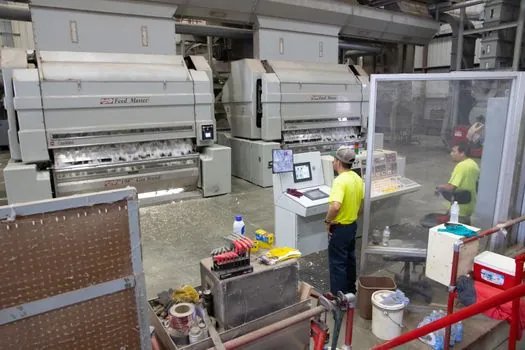
The cooling conveyor is almost never a standalone island. On a green-sand or no-bake high-volume line it sits between the mold dump and the shakeout machine, and on fast molding lines it can be pushed back upstream into the in-mold section to share retention time with the molding line [S4]. Carrier positions its mold dump and cooling conveyor as part of a vibrating equipment chain that also handles sand cooling, conveying, and screening, and the same vendor offers Delta-Phase® and Barrel Horse™ shakeouts immediately downstream so the retention-time setting on the cooler is matched to the shakeout's angle of attack and RPM [S1]. JOEST groups its products the same way, listing casting coolers and shakeouts as adjacent entries in the same feeding-and-conveying and separating product families [S2].
The practical integration point is the casting ladle and pour schedule on the upstream side and the shot blast on the downstream side. Didion ties the cooler's payoff directly to the melt department: when the gates, runners, and sprue leave the shakeout clean, the melt shop "faces excessive slag build up, reduced furnace lining life, and lower melting efficiency" if it has to re-melt dirty returns, so the cooler becomes a cost lever for the cupola or induction furnace as well as for the cleaning room [S3].
Selection criteria for a pre-shakeout cooling conveyor
Specification should be driven by four concrete numbers, not by brand. First, required retention time at peak molding rate, which on a fast flaskless line is the dominant constraint and points toward in-mold cooling or a longer post-mold conveyor [S4]. Second, peak bulk casting temperature at the mold dump, which sets the cooler length and whether a secondary cooler is needed after the shakeout [S7]. Third, sand carryover target at the shakeout exit, because each percentage point of carryover translates into shot blast, dust collection, and silica-exposure cost on the cleaning side [S3]. Fourth, the alloy and section thickness, since castings that are prone to galvanizing embrittlement or to metallurgical damage on rapid cooling impose a lower bound on the time the casting can spend in cold ambient air after shakeout [S6].
For an iron foundry with an existing shakeout cell, the cheapest path is usually a retrofit post-mold vibrating cooling conveyor with adjustable stroke and RPM, since it preserves the existing shakeout machine and slots in front of it [S1]. For a greenfield fast flaskless line, in-mold cooling with a steel-pan belt and integrated de-dusting hood is the higher-capex but lower-footprint option, and one German iron foundry case showed it "boosted the in-mold cooling process and reduced maintenance costs" while removing the standby rubber belt [S4]. For foundries where sand carryover and shot blast cost dominate, a combined drum unit such as the VIBRA-DRUM® or the Didion Mark 5 collapses the cooler, the shakeout, and the pre-cleaner into one machine, with General Kinematics claiming a 2/3 reduction in drive energy versus direct drive and Didion quoting paybacks in "four to five months" on early Mark 5 installations [S3][S5].
Standards, sourcing, and where to verify the spec
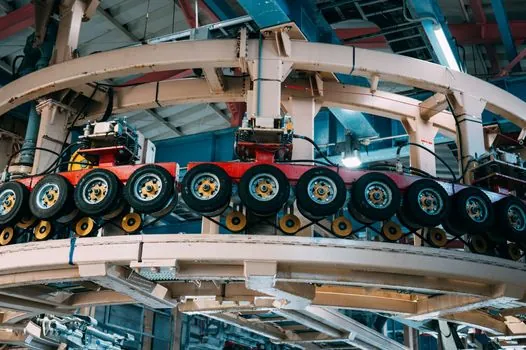
There is no single ISO or ASTM standard that fixes retention time on a foundry cooling conveyor, so the spec is set per alloy and per part. What is verifiable in the public record is the equipment builder's stated duty: Carrier describes its mold dump and cooling conveyors as equipment that "remove sand from hot castings and allow them to cool evenly for the required retention time, ensuring consistent metallurgical results" [S1], and Magaldi describes its Superbelt® as extending the in-mold cooling line to give "more effective cooling, less space for traditional cooling equipment, and no need for additional flasks" [S4]. For foundries that need a published case to anchor a capex request, the German iron foundry Superbelt® installation (24 m belt, hydraulic pusher loader, top covers and suction hoods tied to a de-dusting system) is the most fully described public reference [S4]. The original equipment references for vibrating coolers, in-mold cooling conveyors, and combined drum units are also a more reliable procurement signal than generic cycle-time claims, since each builder publishes its own duty profile, drive type, and sand-handling layout [S1][S2][S3][S4][S5].
Two trackable signals to watch in the next planning cycle: the wider roll-out of integrated in-mold cooling on fast flaskless molding lines, where the constraint is line length rather than shakeout capacity [S4], and the steady displacement of older rubber-belt mold transfer conveyors by steel-pan or wire-mesh belts on the same duty point, which is the clearest published indicator that foundries are buying retention time rather than just belt area [S4]. For related coverage of how upstream pouring and downstream shakeout cell choices interact on the same kind of high-volume line, see this article on Auto Ladle Volume vs Shot Weight on Cold Chamber Die Casting.