A 16-cavity injection mold cycling in 22 seconds produces 2,618 parts per hour, versus 164 parts per hour for a single-cavity tool at the same cycle time, so cavity count dominates throughput planning [S2].
Total parts per run = Cavities × Shots per hour × Run hours, and cycle time on standard injection work falls between 10 and 90 seconds depending on wall thickness and part complexity [S3]. Foundry automatic molding lines are typically rated at 250 molds per hour, with 100,000 lb of automatic molding capacity per day listed by one US foundry [S4].
High-Volume Tier Thresholds and Why They Drive Equipment Selection
Production runs above 100,000 parts are classified as high-volume by the Plastics Industry Association, while short-run work covers roughly 100-10,000 parts and medium-run sits between 10,000-100,000 [S3]. The tier dictates mold class, machine tonnage, and material choice: a 500-part order and a 1,000,000-part order are not scaled versions of the same job, they require different tooling, different presses, and different unit economics [S3].
High-volume production also changes the cost arithmetic around an automatic molding line, because the per-part cost spread between a 1-cavity and a 16-cavity tool is what finances the mold in the first place [S2]. Molds below 10,000 parts rarely justify multi-cavity tooling, while runs past the 100,000-part threshold almost always do.
Cycle Time, Cavitation, and the Real Molds-per-Hour Math
Freeform Polymers gives a worked example: a 2-cavity mold at a 30-second cycle over an 8-hour shift yields 2 cavities × 120 shots per hour × 8 hours = 1,920 parts gross, which falls to about 1,824 usable parts after a 5% scrap allowance [S3]. That formula is the only reliable way to convert a cycle spec into a daily quote, because cycle time on real parts sits in a 10-90 second band rather than a single number [S3].
User Solutions extends the same logic: a 16-cavity tool at 22 seconds clocks 2,618 parts per hour, and the gap to 164 parts per hour on a single-cavity tool at the same cycle illustrates why mold base layout, hot runner balance, and clamp tonnage are upstream decisions for any high-volume line [S2]. Scrap on a multi-cavity tool is also more punitive: if one of 16 cavities shorts, 15 good parts are scrapped alongside the bad one, which is why automated defect detection matters more as cavity count climbs.
Foundry Automatic Molding: A Different Molds-per-Hour Curve
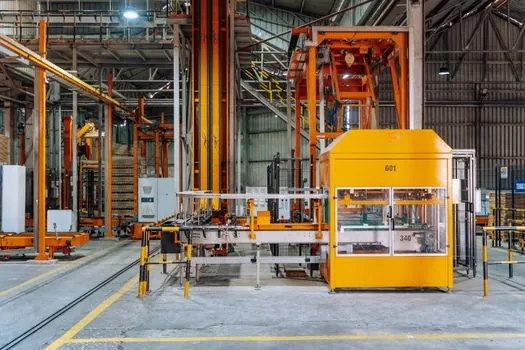
Sand foundry automatic molding lines rate at 250 molds per hour, paired with 100,000 lb of automatic molding capacity per day, and these systems deliver consistent mold quality at high production rates that hand pouring cannot match [S4]. The molds-per-hour metric here counts flask events, not plastic parts, and the bottleneck is sand conditioning, pattern draw, and flask indexing rather than injection fill and cooling.
The matching cycle rate for plastic vs foundry work is one of the topics covered in the side-by-side automatic molding line cycle rate comparison vs manual lines, where the labor and cost differentials of removing operators from the loop are quantified.
Where the Real Ceiling Lives: Maintenance, Changeover, and Lights-Out Hours
Maintenance on high-volume production molds consumes 30-40% of capacity, which is the single largest hidden drag on output once tooling is running at design rate [S5]. Robot-tended cells cut cycle times by removing operator variation from the part-removal step, and they enable lights-out production windows that effectively extend run hours without adding shifts [S8].
Material purging adds a second hidden tax: transitioning from black to natural resin can cost 5-15 kg of purge compound and 20-40 minutes of press time, and that overhead is not visible in a steady-state molds-per-hour spec [S2]. Pattern changeover on foundry lines carries the same logic, and the SMED numbers and pitfalls for 2026 are broken down in pattern changeover 2026 SMED numbers.
AI Monitoring, Cavity Pressure, and Where Defects Are Caught
A 2025 Koç University and Beko Corporate study deployed a CNN baseline that hit 98% accuracy in lab conditions and 95% accuracy on two industrial production lines, learning optimal cavity pressure profiles over hundreds of cycles and flagging pressure spikes, temperature drift, and fill-time deviations that correlate with short shots, sink marks, flash, and weld lines [S5]. In one Fortune 500 medical-vial deployment, the system isolated two defect types driving 20%-above-average scrap and delivered a 25% scrap rate reduction plus six-figure annualized savings within 90 days [S5].
The same study recorded an 18% cycle time reduction and an 800 PPM scrap decrease on a dishwasher component after six months, and visual defects on a refrigerator part were eliminated entirely [S5]. These results matter because the molds-per-hour number on a spec sheet assumes zero defect loss, and on a 16-cavity tool that assumption is rarely true. Digital twin simulation before steel is cut is the upstream lever that keeps the casting mold design itself from capping the achievable cycle.
Selection Criteria: When a High-Volume Line Pays Back, and When It Does Not
A high-volume automatic molding line is the right call when the run exceeds 100,000 parts, the part geometry supports multi-cavity layout, the resin family is stable across the production window, and the downstream process can absorb the rated throughput [S3][S5]. It is the wrong call below 10,000 parts, when resin changes are frequent, when changeover-to-runtime ratio is high, or when the part design is still iterating, because tooling cost and changeover losses dominate short-run economics [S3][S2].
Maintenance overhead of 30-40% of capacity is the threshold to model before signing off on a high-volume cell [S5]. Robotic mold-tending with simplified programming reduces labor dependency and supports lights-out windows, which is the only way to push past a single-shift molds-per-hour ceiling [S8]. Use the molding line reference for the full machinery vocabulary, including high-voltage tester checks for hot-runner leak detection on plastic lines.