
Coriolis flowmeters from ABB's CoriolisMaster FCB400 line cover nominal sizes DN 15 through DN 150 with flow ranges from 0 to 8,000 kg/h up to 0 to 860,000 kg/h, paired with ATEX zone 0/1/2 and cFMus Div 1/2 hazardous-area approvals [S1]. This single frame of bores and ratings is the practical reference grid for most general-purpose liquid and gas duties the typical process plant encounters.
For a Custody Transfer Engineer specifying Coriolis meters in oil and gas, accuracy class, fiscal certification, and stream compatibility outrank price, because the cost of measurement error is paid back many times over the life of a fiscal meter [S4]. Selecting a Coriolis flowmeter is therefore less about chasing the lowest %FS number and more about lining up the sensor's tube geometry, flow range, pressure rating, and wetted material against the real operating envelope of the process.
Tube Geometry and Flow Range: Single-Tube vs Dual-Bent
Tubes divide into single straight, single bent, and dual bent (often called "rainbow" or U-shape). Endress+Hauser's Promass A 100/200/300/500 family is a single-tube design rated for 0 to 450 kg/h, -50 to +205°C, and pressures up to 430.9 bar (6250 psi) at ±0.1% accuracy, built for very low flow rates and clean services [S3]. Endress+Hauser's Promass F 300/500 reach 0 to 2,200,000 kg/h and -50 to +350°C with ±0.05% (opt) accuracy, the upper end of mainstream industrial Coriolis performance [S3].
OVAL's VRmass uses two rainbow-shape flow tubes sized from 10 mm (CV006) through 50 mm (CV050), with a combined flow range of 0.4 to 1,600 kg/min and SUS316L wetted parts rated to a maximum 7.9 MPa operating pressure at ambient temperature [S2]. Single-tube designs drain more easily and handle slurries with less clogging risk, but trade off zero stability and vibration immunity; dual-bent designs give better zero stability at the cost of more complex cleaning, which is why VRmass and similar dual-bent meters are positioned for general liquids, foods, and slurries rather than sanitary CIP-heavy service [S2].
Accuracy, Zero Stability, and %FS vs % of Rate
Premium industrial Coriolis meters land in the ±0.05% to ±0.20% of rate band for liquid mass flow; Jade Ant's sizing guide cites ±0.05–0.2% as the achievable premium range for a correctly sized liquid meter, with errors widening to ±0.25–1.0% of rate if the meter is misapplied (2026-05) [S5]. The same guide warns that operating a dual-bent-tube meter at 8% of its rated full-scale flow can degrade the effective error to roughly twelve times the datasheet figure, because %FS error inflates disproportionately as flow falls below the linear zone.
For selection purposes, % of rate (or % of reading) is the more meaningful spec for custody transfer and batching, while %FS is acceptable only for narrow, near-full-scale services like a fill-line dosing nozzle. SmartMeasurement's portfolio cites delivered accuracy of 0.1% to 0.5% across its Coriolis range, framing 0.1% as the highest available commercial grade and 0.5% as the typical cost-optimised tier [S6]. When the spec sheet gives only a %FS number with no zero-stability figure, that is a red flag: the zero-stability term dominates the small-flow error budget and is what determines whether the meter can actually hit its accuracy claim at 5–20% of full scale.
Maximum Allowable Pressure, Surge Pressure, and Pressure Drop
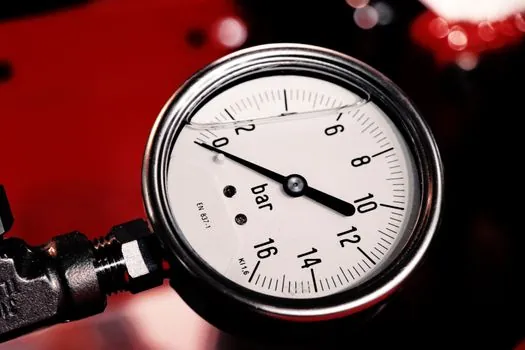
Maximum Allowable Pressure (MAP) is the most safety-critical figure on a Coriolis datasheet, because exceeding MAP even briefly during a water-hammer event can permanently deform the flow tubes and shift the meter's zero reading for the rest of its life (2026-05) [S5]. Surge pressure, not the steady-state line pressure, is what kills Coriolis tubes; the rule of thumb on most nameplates is that MAP is set at roughly 1.5× the design working pressure, but this multiplier must be checked against the pump shut-off head, the worst-case trip of a downstream block valve, and any relief valve setpoint that allows transient spikes through the meter.
ABB's CoriolisMaster FCB400 datasheet publishes nominal sizes and flow ranges, but the actual MAP depends on the process connection chosen: flanged variants inherit the flange pressure class, while hygienic ferrule joints are usually limited to lower pressures regardless of sensor strength [S1]. Pressure drop across a Coriolis meter is also non-trivial at high velocities, because the flow has to negotiate the bends; at design flow, expect 0.3–1.5 bar depending on tube geometry, which has to be reconciled with the available pump head.
Wetted Materials, Density Range, and Temperature Limits
Wetted material selection tracks the process chemistry: SUS316L is the default for food, beverage, pharma, and most chemicals, with Hastelloy, tantalum, or PTFE-lined options reserved for aggressive acids, chlorides, and sour service. OVAL's VRmass specifies SUS316L wetted parts and SUS304 case as standard, with a density operating range of 0.3 to 2.0 g/mL and process temperatures from -40°C (separate type) or -25°C (integral type) up to +125°C [S2]. Endress+Hauser's Promass F extends the temperature envelope to +350°C, which is the band needed for hot oil, steam injection, and high-temperature chemical feeds [S3].
Density range is a quietly important spec: Coriolis density accuracy typically degrades at the edges of the calibrated band, so a meter calibrated for 0.8–1.2 g/mL will perform poorly on a 1.5 g/mL slurry. For two-phase or aerated services, a Coriolis meter will still report a mass total, but the density channel becomes a useful entrained-gas diagnostic, because the reported density will collapse toward zero well before the meter stops flowing. That diagnostic capability is one reason Coriolis flowmeters are increasingly specified over differential-pressure alternatives on crude and multiphase hydrocarbon duty, where the loss of a Coriolis density reading is itself a process alarm.
Ex Approvals, Custody-Transfer Certification, and Communications
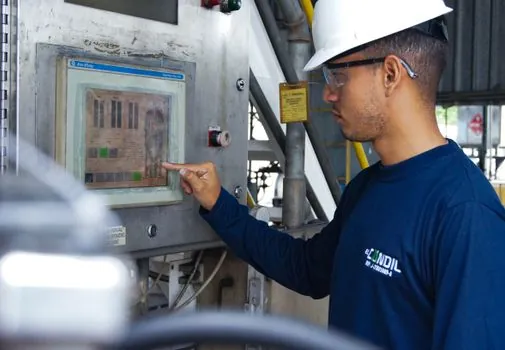
Hazardous-area approvals vary widely: ABB's CoriolisMaster FCB400 carries ATEX zone 0/1/2 plus cFMus Div 1/2 and zone 0/1/2 ratings, which covers most refinery, chemical, and offshore platforms worldwide [S1]. For fiscal and custody transfer, the meter body is only part of the equation; the metering skid as a whole has to satisfy OIML R117/R137, API MPMS, and the local weights-and-measures authority, with Micro Motion Elite CMF/CMFS, Endress+Hauser Promass, KROHNE Optimass, Yokogawa, Mocon, and Elster among the brands most commonly named in oil-and-gas tender documents [S4].
On the comms side, HART remains the dominant 4–20 mA + digital protocol for legacy DCS integration, with Foundation Fieldbus, PROFIBUS PA, and increasingly Ethernet-APL specified on greenfield projects. Niaar's Coriolis supply scope for oil and gas emphasises that the meter, the proving report, and the approval documentation have to ship together, because a custody-transfer order that arrives without a valid calibration certificate cannot be put into fiscal service regardless of how good the sensor is [S4]. For more on protocol-level DCS integration in the broader process-instrument landscape, the flowmeter selection reference for power generation covers a closely related spec-discipline pattern that translates directly to Coriolis procurement.
Sizing Decision Comparison: Which Coriolis Variant Fits Which Duty
For a real spec sheet, the choice between single-tube, dual-bent, and bent vs. straight reduces to four gates lined up against the duty: flow range, viscosity/slurry loading, pressure rating, and cleanability. The summary below is a working shortlist logic drawn from the data in [S1]–[S6].
<strong>Coriolis variant vs. duty comparison (representative, drawn from ABB, Endress+Hauser, OVAL, SmartMeasurement data):</strong>
Variant | Typical flow range | Accuracy | Best fit | Avoid when
Single straight tube (e.g. Promass A 100–500, 0–450 kg/h) | Very low flow, clean liquid | ±0.1% [S3] | Dosing, additive injection, micro-batching | Flow > 2,000 kg/h, heavy slurries
Single bent / dual-bent mid-range (Promass E 100–500, 0–70,000–180,000 kg/h) | General process | ±0.10–0.25% [S3] | Chemical feed, water-for-injection, custody transfer of refined product | Service needs >240°C or extreme viscosity
Premium dual-bent (Promass F 300/500, ABB FCB400 DN 100–150) | 0 to 860,000–2,200,000 kg/h | ±0.05–0.10% [S1][S3] | High-temperature oil, LNG, large-line custody transfer | Budget meters where ±0.5% would have been enough
Compact / hygienic low-cost (OVAL VRmass, SmartMeasurement general line) | 0.4–1,600 kg/min on small bores | ±0.4% (factory) [S2], 0.1–0.5% portfolio [S6] | Food/beverage, slurries, OEM skids | Custody transfer, high-temp, high-pressure
The takeaway: a single-tube meter on a 2 t/h dosing skid is over-spec'd only on price; the same meter on a 200 t/h crude line is impossible by flow range. A premium dual-bent meter on a hygienic 2 t/h beer line is wasted money, because the cleanability of the dual-bent tube is worse and the accuracy gain is below the line's measurement need. Pick the variant whose worst-case gate (flow, pressure, temperature, cleanability) is the binding constraint, not the one with the best datasheet headline number.
Who Should NOT Default to Coriolis (and Why)
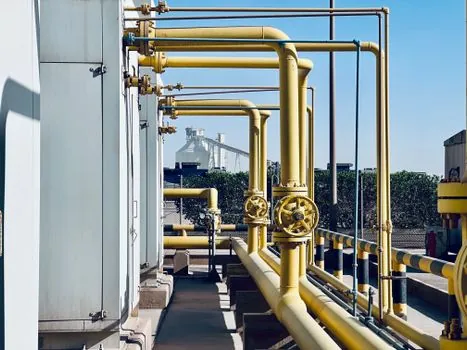
Coriolis is not the right default for every flow service, and a senior spec will rule it out as quickly as they rule it in. Three cases where Coriolis is the wrong tool: large-line, low-accuracy water service (magnetic flowmeters cost a fraction and have effectively zero pressure drop), steam and high-temperature gas above the meter's temperature rating (where the density channel is no longer useful and a vortex or ultrasonic meter wins on lifecycle cost), and very large bores above DN 250 where Coriolis becomes uneconomical per inch of line size. For aerated slurries above 10–15% gas void fraction, a Coriolis meter can lose the density reading entirely and start drifting on mass total, which is one of the few failure modes unique to this technology. [S5]
For Custody Transfer Engineers, the practical floor for Coriolis specification is set by fiscal accuracy requirements, not by process accuracy; if the line is not fiscal and the budget is tight, a well-sized magnetic or vortex meter is a defensible choice. The encyclopedia entry on Coriolis flowmeters covers the principle and limitation set in more depth and is a useful cross-check when a project's specification tries to push Coriolis into a service where the maintenance burden and tube-deformation risk outweigh the accuracy benefit.
Trackable Signals and Next Procurement Nodes
Two practical signals to monitor before locking a Coriolis spec on the next project: (1) the published MAP and surge rating on the shortlisted vendor's current datasheet revision, because suppliers revise pressure envelopes after field failures, and (2) the calibration certificate's reported zero-stability figure in kg/h, not just the % of rate headline, since the zero term dominates the small-flow error budget on any meter that will operate below 20% of full scale. The broader flow-meter market is projected to grow from USD 11.31 billion in 2025 to USD 15.17 billion by 2030 at a 6.0% CAGR, with Coriolis among the fastest-growing segments, which is a useful benchmark when justifying premium-meter spend on a CapEx review (2026-05) [S5].
For sister-discipline specs in adjacent process areas, the VSD selection map for automotive plants and the gas suppression selection logic for chemical plants follow the same five-gate spec discipline (range, environment, certification, accuracy, lifecycle) and are good templates for any future instrument-procurement workflow that has to defend a meter choice on both technical and commercial grounds.
Spec-level background on the components involved: linear guide, and crossed roller guide.