
A carton box is a corrugated fiberboard container whose performance is set by four interacting variables: flute profile (A, B, C, E, F), ply count (single-wall, double-wall, triple-wall), Edge Crush Test rating, and box style (RSC, die-cut, five-panel folder, etc.) [S1][S6]. Selecting the right combination starts with the product's weight, the stacking load it will see in transit, and the ISTA or ASTM D4169 drop sequence it must survive [S6].
Corrugated packaging is a USD-multi-billion commodity with at least 1,500 active B2B machinery suppliers globally, ranging from 7-year-old Chinese OEMs to 40+ year American converters offering turnkey lines [S1][S2][S3]. The buyer's real task is to filter a saturated catalog down to a box whose Edge Crush Test, Mullen burst and flute combination actually matches the load, the climate, and the print surface the SKU demands.
Flute Profiles and Their Mechanical Trade-Offs
Flute profile sets stacking strength, cushioning and print surface flatness, and the five standard profiles are A (5 mm flute height, 36 flutes/ft, best cushioning and stacking), B (3 mm, 50 flutes/ft, best puncture resistance and die-cut crush), C (4 mm, 42 flutes/ft, the most-shipped general-purpose profile), E (1.5 mm, 90 flutes/ft, the retail-print/consumer-box standard) and F (1.2 mm, 128 flutes/ft, used for small cosmetics and software boxes) [S1][S6][S8].
The trade-off is direct: thicker flute = more column strength and more cushion, thinner flute = smoother print surface and tighter box tolerances. C-flute is the workhorse for parcel shipping because it stacks well and accepts flexo print; B-flute dominates canned-goods and die-cut applications where the flute must not telegraph through the die-cut edge; E- and F-flute are the retail-shelf boxes where high-resolution litho or digital print matters more than stacking height [S1][S6].
Ply Count and ECT Rating Match the Load
Ply count is the second decision axis, and the typical industrial ladder is single-wall (3-ply, 1 liner + 1 flute + 1 liner) for product weights up to roughly 20 kg, double-wall (5-ply, 2 liners + 2 flutes + 1 liner) for 20-45 kg palletized loads, and triple-wall (7-ply) for heavy industrial or export containers above 45 kg [S1][S6].
ECT (Edge Crush Test, measured in lb/in according to TAPPI T811) is the load-bearing metric, and a 32 ECT single-wall C-flute box is the typical entry-level shipping spec while 44 ECT and 48 ECT single-wall, 51 ECT and 61 ECT double-wall, and 67 ECT-80 ECT triple-wall are the common industrial grades [S6]. The relationship is roughly: stacking strength (lb) ≈ ECT × perimeter (in) × a geometry factor, so a 32 ECT RSC with 60 in perimeter will stack roughly 1,000 lb before compression failure, while a 48 ECT same box will hold close to 1,500 lb [S6]. For storage totes that cycle repeatedly on a line, an industrial turnover box is often a more durable answer than a single-wall shipper.
Box Styles Map to Distribution Logic
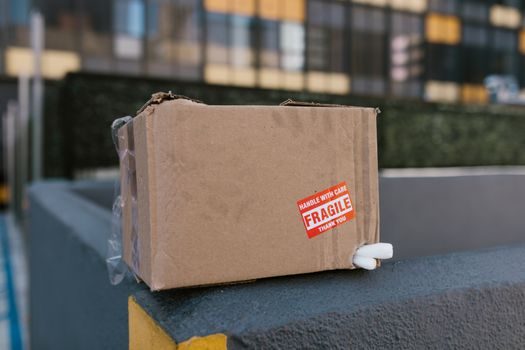
Box style determines how the box is built, opened, filled and closed, and the most common production styles are RSC (Regular Slotted Container, flaps meet in the middle, the lowest-cost default), HSC (Half Slotted Container, open top for line loading), FOL (Full Overlap Slot, top and bottom flaps fully overlap, top compression strength), 5-panel folder, telescope, die-cut, and partitions/dividers [S1][S6].
The right style is set by filling method, not by aesthetics: a hand-packed warehouse uses RSC, a conveyor-fed packing line uses HSC or FOL with auto-tape, a die-cut mailer trades cheaper shipper cost for a customer-facing unboxing experience, and a parts packer uses partitions to separate small components [S6]. Alliance Corrugated Box's published style-reference chart covers 8 production styles (RSC, 5 panel folder, 1 piece folder, die cut, bin box, partitions, bulk box, 2 piece) and is a clean practical taxonomy to brief a converter against [S6].
Standards and Spec Discipline
The governing spec family is ASTM D642 (box compression), ASTM D4169 (transport simulation), TAPPI T811 (ECT), TAPPI T810 (Bursting Strength / Mullen), and ISO 2234 (stacking), and the fiber must come from an FSC or PEFC chain-of-custody supplier if the box carries an eco-claim [S9]. For static-sensitive or high-value product in-plant handling, anti-static coating or ESD-rated storage totes often replace plain corrugated altogether.
Yantai Xiangyu Packaging, a manufacturer/Factory and Trading Company with ISO 9001, ISO 20000 and FSC certifications on its Made-in-China profile, illustrates the typical compliance stack now required for export corrugated buyers (seafood boxes, pizza boxes, fruit boxes) [S9]. A procurement clause should name the ECT grade (e.g. 32 ECT, 44 ECT), the Mullen minimum, the flute, the box style code from the supplier's reference guide, and the FSC/PEFC certificate number; without those four anchors in the PO, the order will drift to whatever the plant runs fastest.
Comparing the Main Box Families on Decision Criteria

The four most commonly specified box families in B2B catalogs are RSC single-wall C-flute (the default shipping box), die-cut mailer (the e-commerce retail box), HSC/automated line box (the warehouse conveyor box) and double-wall bulk (the heavy industrial / pallet bulk box), and the cleanest selection rule is to line each up against cost, print quality, stacking strength and pack-and-ship speed [S6][S7].
RSC single-wall C-flute is the cheapest and stacks acceptably but its print surface is rough; die-cut mailer carries 5-color flexo or digital print, costs 2-3× the RSC, and stacks modestly because the side walls are scored; HSC is the line-rate optimum because the open top feeds cleanly into an auto-bagger, but it needs a separate lid; double-wall bulk (44 ECT-48 ECT) stacks 2-3× an RSC at 3-4× the unit cost and is the only sensible answer above 20 kg product weight or 4-high warehouse stacking [S6]. For a per-kg cost and MOQ breakdown, the corrugated box price 2026 cost map lays the same family against current 2026-07 pricing.
Common Failure Modes and Limits
Three failure modes account for the bulk of in-transit damage: edge crush (the box wall buckles under stack load because ECT was undersized), flute shear (the medium delaminates from the liner under humidity because the adhesive was starch-only and not moisture-resistant) and box-style mismatch (an RSC was used where a die-cut insert or partition was needed) [S6][S7]. Gurez's consumer catalog shows single-wall 3-ply brown boxes at 7-15 in typical sizes shipping in the sub-INR-700 retail range, which corresponds to roughly 32 ECT single-wall C-flute commodity grade and is appropriate only for sub-2 kg product [S7].
Forced lower-cost substitution breaks at three points: stacking over 4-high, export humidity cycles above 80% RH, and any drop test over 1 m on a hard surface. The converter-side selection check is simple: target ECT × perimeter must exceed maximum anticipated stack load by at least 20% safety margin, and the flute must be the next-bigger profile if the box travels through a humid leg or sits in unconditioned storage. Specialized heavy-duty service conditions (chemical, food-contact, static-sensitive, pharma) are not the corrugated box's job; they are the decade resistance box or ESD cabinet category.
Columbia Corrugated Box's 1967-vintage US converter footprint (Tualatin, OR) lists Quick Turn, Corrugated, Specialty Corrugated, High Color Graphics, Displays, Protective Packaging (Foam), Custom Crating and Vacuum Form as the production stack that has steadily absorbed former "just ship it" corrugated SKUs into higher-value custom packaging, especially for healthcare, high-tech, food/beverage, agriculture, footwear/apparel and industrial accounts [S3]. Two trackable signals to watch into late 2026: a further shift of small e-commerce SKUs from 3-ply C-flute to thinner E-/F-flute litho mailers, and a parallel rise in double-wall 44 ECT RSC demand from industrial shippers as pallet-tier heights climb.