
Welded crane rail clips deliver higher load capacity for a comparable clip size and can be installed entirely from above the runway beam, making them the stronger choice for heavy-duty cranes [S1].
The fastening decision depends on crane capacity, rail section, dynamic loading, installation access, adjustment requirements, and maintenance strategy, not simply on the lowest purchase price [S1][S2][S3].
Welded and Bolted Clips Compared
Welded-base clips are the stronger size-for-size option and suit heavy-duty industrial applications; bolted clips are generally more economical, convenient, and appropriate for light-to-medium duty installations [S1].
One published comparison assigns welded-base systems to light-duty monorails and fixed equipment tracks, while bolted adjustable forged clips serve heavy-duty gantry, port, steel-mill, and high-cycle applications [S2]. That classification is not absolute: a welded assembly can be engineered for demanding service, while a bolted clip remains viable when structural load, rail size, and duty are within its rating.
Load Capacity and Crane Duty
Gantrail identifies welded clips as suitable for heavy-duty industries because they carry high forces from rails with relatively small clips [S1].
Gantrail states that Grade 8.8 bolts offer good resistance to forces from rails [S1]. Published clip-system data identifies M20 to M30 bolts for crane rail fastening [S5].
These capacity statements belong to particular clip and plate designs, not to the generic names “welded” or “bolted.” The project specification must use the selected manufacturer’s drawings, allowable horizontal force, vertical restraint, fatigue class, and installation procedure rather than assigning capacity from the fastening label alone.
Installation Access, Alignment, and Adjustability

Crane rails depend on fine alignment, and adjustable clipped systems can be set to close positional tolerances while restraining transverse forces from crane wheels [S1].
Welded clips suit installations where operators can complete all work from above the runway beam [S1]. Welded clips allow all work to be performed from above the runway beam [S1].
Bolted clips provide more convenient adjustment and permit individual clip replacement without removing the rail [S2]. Their compromise is mechanical: tightening force depends on specified torque and bolt integrity, so inspection is required. A related design principle is to specify crane rail clips and pads as one system, because the pad controls bearing, vibration, and fretting behavior that the clip alone cannot provide.
Thermal Movement and Dynamic Loading
A crane rail fastening must restrain uplift and lateral movement while allowing controlled longitudinal movement from thermal expansion; an excessively rigid restraint can transfer stress into the rail and support [S2].
Gantrail states that an elastomer nose applies a controlled force to restrain excessive rail movement [S1].
These figures establish a selection boundary, not a universal geometry. Outdoor runways, high-cycle routes, crane-wheel impact zones, and exposed temperature ranges require the clip supplier to verify restraint, fatigue life, corrosion protection, and thermal movement for the complete rail section and support arrangement.
Material and Maintenance Requirements
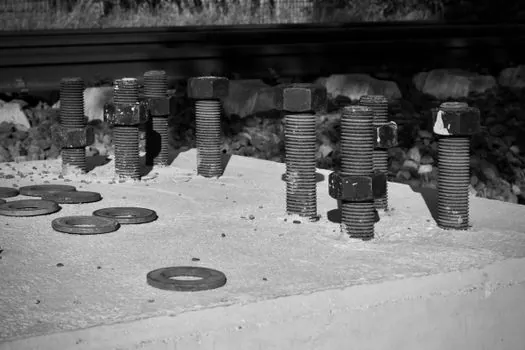
Gantrail states that Grade 8.8 bolts offer good resistance to forces from rails [S1]. Adjustable forged systems also require periodic torque inspection [S2].
Welded assemblies shift maintenance toward weld quality and fatigue.
Procurement and Acceptance Criteria
A complete crane rail system includes the rail, clips, rail pad, bearing plates, bearing-plate bolts, and grout, so fastening clips should not be procured as isolated washers or brackets [S3].
For a welded system, require clip drawings, weld material compatibility, qualified welding procedures, dimensional inspection after welding, and acceptance of fatigue-critical details. For a bolted system, require the clip series, bolt grade, size, quantity per position, spacing, and tightening procedure to appear in one coherent schedule.
Do not mix welded and bolted families on one runway unless the designer has evaluated the difference in toe load and load progression, because a mixed system can produce nonuniform restraint [S5]. Verify that the selected assembly matches the actual rail profile, support steel, crane capacity, wheel loads, and required lateral restraint.
Recommended Selection by Application

Use welded clips when the runway carries a heavy or high-cycle crane, a bolted option would have insufficient size-for-size capacity, or installation access is limited to the top of the beam [S1][S2].
Use bolted clips when the crane is light to medium duty, the beam is accessible, installation adjustment or economical rail replacement has greater value than maximum clip capacity, and the fastening load remains within the manufacturer’s rating [S1].
For electrified, insulated, or mixed-duty systems, specify the complete fastening stack rather than treating the clip as a universal steel bracket. The closing checks are traceable: confirm clip model and capacity, rail section, support material, pad type, bolt grade and torque, spacing, welding procedure, and inspection interval before approving the installation.