
DIN 536 A-type profiles span A45 to A150, while ASCE crane rails extend through ASCE 85; selection must follow wheel geometry, load, support design, and fastening requirements rather than unit mass alone [S1][S2].
This guide compares profile geometry, dimensional data, application fit, and installation constraints for overhead, gantry, workshop, and port cranes. It also distinguishes crane rails from railway profiles and identifies where flat or square bar may be acceptable.
Profile Systems and Dimensional Basis
DIN 536 is among the standards used for crane rails, whose specifications can include profile geometry, dimensions and tolerances, material properties, unit weight, and manufacturing and inspection requirements [S1]. The A designation is followed by a number corresponding to nominal head width, with the series extending from A45 to A150 [S1][S8].
ASCE crane rails use a T-shaped profile. Their dimensions and mass must be checked against the selected ASCE designation rather than inferred from an AREMA railway profile. AREMA 115RE, for example, is a railway designation and not an ASCE crane rail; the ASCE crane series ends at ASCE 85 [S2].
The DIN dimensions above provide a useful screening table, not a complete crane design [S1]. Final selection also requires wheel flange geometry, maximum wheel load, impact factor, support spacing, joint arrangement, and the limits of the selected steel grade.
ASCE and DIN 536 Compared by Decision Criteria
On profile geometry, DIN 536 Type A is a flat-bottom crane section, while ASCE is a taller T-section with a relatively narrow head and a pronounced web [S5][S7]. On regional fit, DIN A-series is conventional for European crane applications, including ports, steel mills, and shipyards, whereas ASCE serves the North American crane-rail market [S1][S8].
Profile dimensions and properties must be checked when comparing crane rails across standards, and similar rail mass does not by itself establish equivalence [S5]. That comparison does not establish equivalence between standards: similar mass does not mean equal head width, wheel fit, section modulus, or fastening compatibility.
Use DIN 536 A-type when the crane design, wheel, rail support, clips, pads, and regional supply chain are built around the flat-bottom system. Use ASCE when the crane manufacturer or runway design specifies the T-profile. Do not substitute one for the other solely because nominal mass is close.
Capacity, Wheel Load, and Application Fit
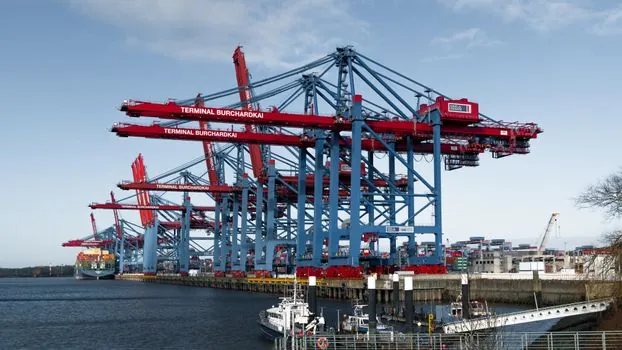
These are broad application associations, not proof that a rail can carry a specified crane: wheel load, travel speed, impact, span, and runway stiffness can govern before gross crane capacity.
For light industrial overhead cranes, an ASCE 30 profile is identified as a common light-duty option, while heavier ASCE sections serve heavier systems [S6].
Port cranes require a separate infrastructure review because their travel loads, dynamic effects, corrosion exposure, and long runway requirements can dominate profile choice. PEMA’s crane-rail guidance treats rail selection together with soft mounting, clips, supports, anchor bolts, grout, trench infill, installation, welding, expansion joints, and alignment [S4]. A rail profile alone does not define a compliant runway system.
Where DIN, ASCE, and Flat Bar Fit
DIN 536 A-type is suitable for conventional overhead and gantry crane runways where a wide-head, flat-bottom profile matches the wheel and support design [S1]. ASCE is suitable for American-style T-section crane tracks, subject to matching the crane wheel and rail fastening system [S6][S7]. These are system decisions, not merely cross-sectional geometry choices.
Flat bar can serve some light-duty bridge cranes, electric hoists, and trolley tracks when wheel load, contact width, support spacing, mounting, and operating frequency are compatible. Square bar can serve some guiding or running components, but its guiding capacity depends on wheel geometry and lateral restraint. Neither square nor flat bar automatically replaces a QU or DIN 536 crane rail [S3].
Do not use flat or square bar when the crane requires a defined crane-rail contact geometry, high wheel loads, frequent operation, heavy wear exposure, or a standardized wheel-rail interface. The supporting structure, fastener arrangement, alignment tolerance, debris exposure, and surface wear must be evaluated as a complete assembly [S3].
Fastening, Installation, and Failure Controls
Rail failure can begin with deformation or local wear caused by undersizing, poor wheel matching, or inadequate support. Excessive rolling resistance, wheel wear, rail grinding, and unplanned downtime are warning effects, so profile selection must include wheel compatibility and support stiffness rather than nominal crane capacity alone [S5].
Fastening is equally critical. PEMA identifies rail clips and pads as parts of the rail system and separately addresses soft mounting, rail supports, anchor bolts, grout, trench infill, rail welding, expansion joints, and alignment [S4]. For an existing runway, record rail spacing, base width, head width, total height, web and base geometry before ordering replacement material. A visually similar section can still be incompatible with the installed wheel, clip, pad, or support.
Installation controls include rail welding, expansion-joint design, alignment, protective treatment, and the interface with the civil works [S4]. These items must be specified with the rail. Purchasing only the correct profile, without compatible clips, pads, supports, and joint details, leaves the runway system incomplete.
Procurement and Specification Checklist
Specify the governing profile standard and edition, exact size designation, steel grade, mass, head width, overall height, base width, web thickness, mechanical requirements, tolerances, and delivery length. DIN 536-1:1991 is the applicable dimensional reference for hot-rolled flat-bottom Type A crane rails [S4]. For ASCE, state the crane-rail designation rather than an AREMA railway designation [S2].
Require mill certification tied to the ordered profile and grade, then verify dimensional tolerances, straightness, end condition, surface condition, and length before installation [S1][S2]. Check that the wheel tread and flange geometry match the rail head, and confirm that clips, pads, welds, or other fastening components are designed for the selected section.
For brownfield projects, retain a dimensioned survey showing at least 3 key measurements: rail height, head width, and base width. Add wheel make and type, support spacing, and fastening details. For greenfield projects, confirm the selected wheel-rail combination with the crane supplier before releasing the rail schedule.
Next, obtain the crane manufacturer’s wheel-load table and the runway support spacing, then match both against candidate rails. The decisive procurement record is the profile designation, grade, dimensions, and compatible fastening package, not a generic reference to ASCE or DIN.