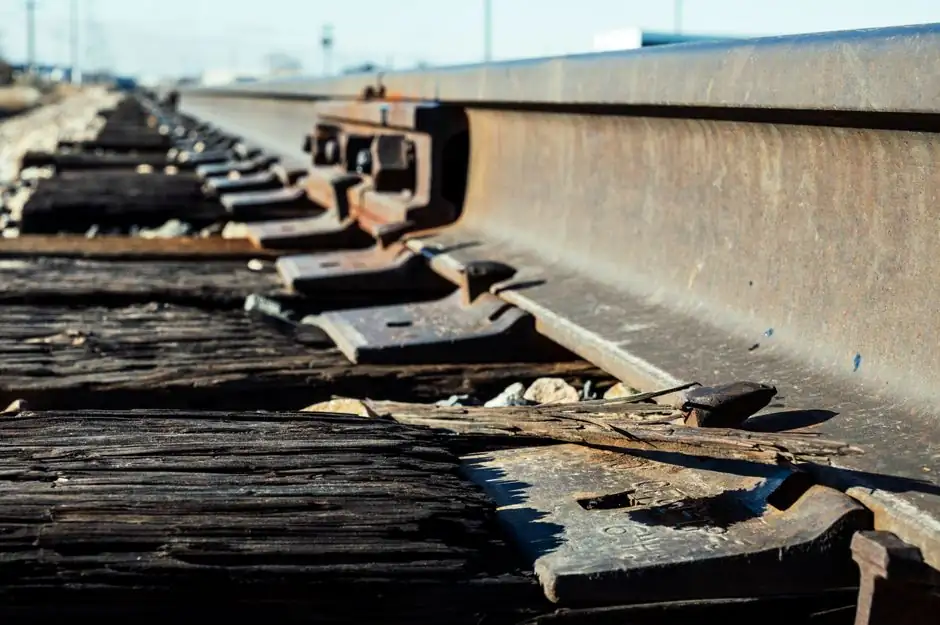
The rail, clips, pads, sole plates, anchors, and grout in a crane runway package are designed to work together as one system.
For a gantry crane, clip selection must accommodate the support structure and lateral crane-wheel forces, while the pad arrangement must control shock, vibration, rail rotation, wear, and stress transfer into the runway beam or girder [S2][S1].
Rail clip and pad load path
The complete crane runway package comprises the crane rail, clips, pads, sole plates, anchors, and non-shrink grout.
Rail clips secure the rail while resisting lateral and uplift forces generated by crane-wheel loads. Clip selection should fit both the supporting structure and the rail profile, with bolted and welded-lower-component versions selected according to industry practice and project preference [S2][S8].
Rail pads perform a different function from clips. The clip retains the rail, while the pad provides a resilient bearing interface that spreads wheel loads, reduces shock and vibration, permits small rail rotation, and limits wear at the rail-to-support contact [S2][S1].
For a new assembly, the measured installed rail height and crane wheel-to-rail relationship must be checked after pads and sole plates are included. A pad-thickness change alters the final rail elevation, and a clip base designed for a different rail-foot width can prevent proper fit despite each component passing its own inspection [S5].
Continuous and individual pad arrangements
Continuous rail pads are intended for rails with continuous structural support, while individual or discontinuous pads suit rails mounted on separate sole plates. Gantrail identifies Mark 2 elastomer pads for discontinuous support and Mark 7 and Mark 8 steel-reinforced pads for continuous support [S1].
Gantrail offers a Mark 2 elastomer pad for discontinuously supported rails and Mark 7 and Mark 8 steel-reinforced continuous pads for continuously supported rails. A Meritus package specification likewise identifies steel-reinforced elastomer pads at approximately 7 mm thick [S5].
These dimensions are selection data, not universal installation instructions. Pad thickness, width and stiffness must still be checked against the selected rail profile, clip geometry, sole plate, crane wheel load and runway design [S1][S5].
Profile matching and clip selection

Crane rail is produced in different sizes, lengths, weights, profiles, and material properties, so clip selection cannot be reduced to a generic fastener size. The clip must match the rail foot and the supporting steelwork while carrying the lateral forces imposed by the crane wheels [S2].
Gantrex states that its rail-clip range has 16 different nose and clip-upper combinations for each clip type, providing accommodation across 70 rail profiles available in the market. This illustrates why rail profile, clip nose, upper clip component, and support detail must be checked as one set [S6].
Meritus specifies weldable crane rail clips with a 300 kN admissible side load, plus 25 mm hot-dip-galvanized sole plates, M24 Grade 8.8 anchor bolts, M16 leveling screws, and non-shrink grout. Its rail package covers CR80 through CR140 to IS 3443, KR70 through KR140, and QU70 through QU120 to YB/T 5055 where the design permits [S5].
Stress distribution and rail movement
A resilient crane rail pad improves load distribution and reduces fatigue failure. Resilient crane rail pads allow the rail to move and rotate by small amounts, helping distribute stress more evenly between the crane wheel and rail and between the rail and its supporting surface.
Soft-mounted rails reduce noise and vibration compared with direct metal-to-metal support. Individual rail pads reduce rail wear and eliminate fretting corrosion.
That value is a product test statement, not a universal safety factor, and it does not replace project-specific load verification [S1].
The mechanical chain must remain consistent: wheel load enters the rail, the pad spreads the reaction across the sole plate or continuous support, and the sole plate transfers it into the runway beam or girder. Changing any layer can alter stiffness, rail elevation, local stress, or clip behavior [S5][S1].
Material and environmental durability
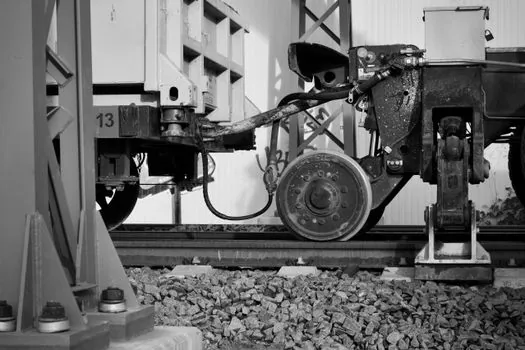
Pad material selection must address compression, resilience, service temperature, contamination, and the exposure conditions of the runway. Gantrail offers elastomer Mark 2 construction for discrete support and steel-reinforced Mark 7 or Mark 8 construction for continuous support, demonstrating that pad architecture is tied to mounting method [S1].
Metallic components also require project-specific protection. A documented package example uses 25 mm hot-dip-galvanized sole plates, M24 Grade 8.8 anchors, and non-shrink grout; this is one documented configuration rather than a mandatory universal detail [S5].
Documentation should connect each pad and clip to the runway drawing. Meritus uses dimensional inspection of clips, pads, and sole plates against that drawing, with EN 10204 3.1 certificates and optional third-party witness where specified [S5].
Appropriate projects and exclusions
The clip-and-pad system is appropriate for gantry, overhead, port, and industrial rail runways where repeatable wheel loading, fatigue control, vibration reduction, and resistance to lateral and uplift forces are design concerns [S3][S8]. It is also relevant where rails require continuous resilient support rather than direct steel-to-steel contact [S1].
The system is not a stand-alone wheel-rail replacement. The crane, wheel, rail, clip, pad, sole plate, anchors, runway beam or girder, foundation, and grout remain connected in one load path. Failure at an interface can occur even when each purchased component satisfies its individual inspection requirement [S5].
Special applications require additional checks. Quay and ship-to-shore systems may involve higher impact loads and marine exposure, while rail-mounted equipment and automated storage and retrieval cranes can have different duty cycles, travel speeds, and buffer requirements [S4][S2].
Procurement and inspection checkpoints

Procurement should require one coordinated bill of quantities covering rail, clips, pads, sole plates, anchors, welding requirements, installation tolerances, and inspection records. Meritus states that a combined package allows the rail profile, clip, pad, sole plate, and anchor pattern to be checked against the same runway drawing before production [S5].
Inspection should include rail chemistry, hardness, profile, and straightness; dimensional checks of clips, pads, and sole plates; and property-class verification for anchor bolts. EN 10204 3.1 certificates and third-party witness can be incorporated where required by the project inspection plan [S5].
One documented supply configuration uses crane rails in 6–12 m lengths, approximately 7 mm steel-reinforced pads, 25 mm galvanized sole plates, M24 Grade 8.8 anchors, M16 leveling screws, and non-shrink grout [S5]. Meritus reports that its clip package includes a 300 kN admissible side load, which gives procurement teams a concrete load value to compare against the runway design [S5].
For a single-girder crane, the same interface logic applies, but the rail system must be matched to that crane’s runway beam, wheel loads, travel configuration, and available anchor positions rather than copied from a heavier gantry installation [S4][S8].
The trackable procurement signal is interface compatibility: verify that clip geometry, pad thickness, sole-plate holes, anchor positions, and installed rail height match one approved runway drawing before ordering individual components [S5].