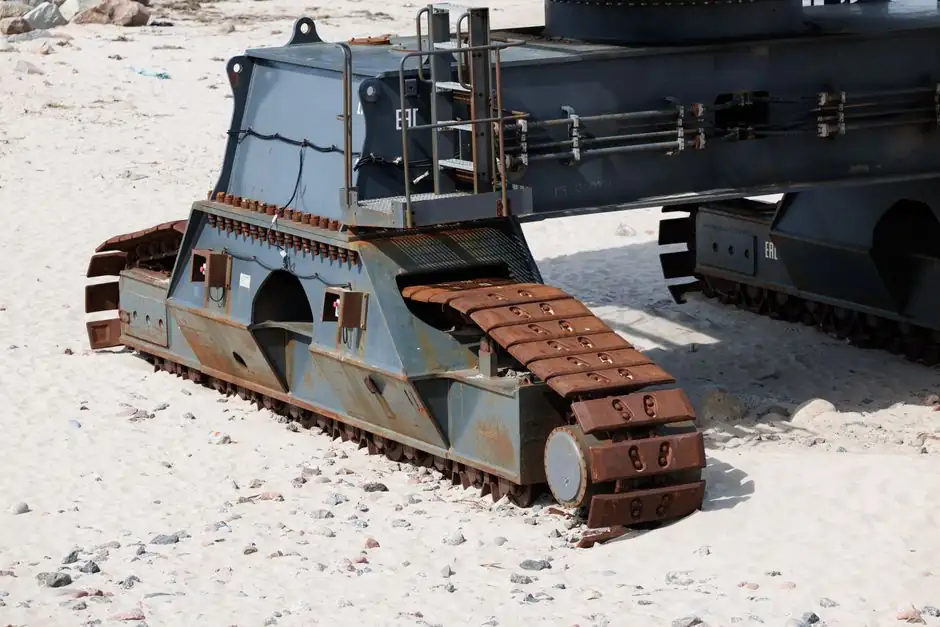
Counterweight selection controls crawler crane lift capacity more than any other single variable, with mass, rear offset radius, and stacked configuration jointly defining the load-moment envelope the machine can sustain without tipping.
Operators chasing maximum capacity typically start with the load chart radius, then build the heaviest counterweight package the site, transport regulation, and ground bearing pressure will allow, while watching the carbody and track spread as integral parts of the same counter-balancing system.
How counterweight mass, radius, and carbody weight interact with the load chart
A crawler crane is a class 1 lever: lift moment about the slewing centre must be balanced by counterweight moment on the opposite side, and every kilogram of counterweight at a given offset radius buys a proportional kilogram of payload at a given load radius [S1]. Crawler units carry that mass on an integrated carbody, so the undercarriage is part of the ballast. Kobelco's CKE3000G heavy-lift configuration, for example, lists 120 t of counterweight paired with 40 t of carbody weight, delivering 189.8 t of capacity at an 8.8 m operating radius on a 54 m main boom [S6].
Maximising capacity therefore means treating counterweight and carbody as a single stackable system. Standard stacking, maximum stacking, and (on Manitowoc MLC models) a VPC-MAX attachment each add measurable tonnage: the MLC650 jumps from 650 t to 700 t maximum capacity when the 36 m fixed-mast beam plus 100,000 kg of additional counterweight is fitted [S4]. Operators should always read the chart for the exact stack used, not the headline brochure figure, because capacity varies 15 to 50 percent across equipment packages even on a single crane model such as the Liebherr LTM 1650-8.1 [S2].
Variable Position Counterweight (VPC) and VPC-MAX: moving the weight along the bed
Fixed-radius counterweights force the operator to choose between minimum counterweight for light lifts and maximum counterweight for heavy lifts; the Manitowoc Variable Position Counterweight system eliminates that trade by sliding the stack along the rotating bed, automatically repositioning as boom angle, boom length, jib length, and load radius change [S4]. The VPC-MAX variant extends the principle with a 36 m (MLC650) or 30 m (MLC300) fixed-mast beam plus an extra 100,000 kg or 40,000 kg of counterweight, raising max load moment without the stack ever touching the ground, a property that opens barge and restricted-footprint lifts that were previously impossible [S4].
The economic effect is significant. The MLC300 ground-preparation footprint with VPC-MAX is roughly one-tenth that of a comparably rated competitive crane, because the counterweight mass is mobilised mechanically instead of being spread across a wide outrigger mat [S4]. For wind-energy tower erection the MLC650 with VPC-MAX installs 120 m and taller towers, and can raise 140 m of main boom or a 205 m boom-plus-luffing-jib combination [S4]. Operators specifying new equipment should ask OEMs for VPC-style positioning rather than static ballast, because capacity gain on a given transport envelope is larger than any gains from a heavier base block. Selecting the right crane platform ties directly to wider crawler crane selection logic, where transport axle load, ground pressure, and counterweight package are co-equal design variables.
Stack geometry, transport envelopes, and ground pressure trade-offs
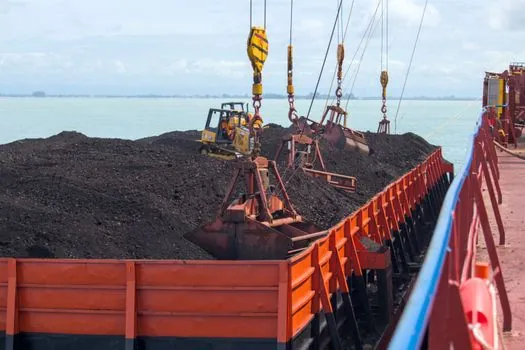
Adding counterweight buys capacity, but it costs transport loads, ground bearing pressure, and rigging time. A full counterweight stack on a 3,000 t-class lattice-boom crawler can weigh more than the boom it balances, and the assembled ground pressure under the tracks still limits where the machine can set up. Counterweight boxes on the MLC300 and MLC650 are designed to be common across multiple platforms, which reduces the number of separate trailer loads shipped to site [S4].
Track width and counterweight work in series: hydraulically extendable tracks widen the support polygon, which permits higher capacities without additional counterweight mass, and this lever is most useful on soft ground where increasing ballast mass would exceed soil capacity [S5]. Counterweight radius is the other underused lever: a smaller-radius stack with the same mass produces a lower restoring moment, so a 50 t rear-radius-3 m block is not equivalent to a 50 t rear-radius-5 m block. On the Liebherr LTM 1650-8.1, the 80 m telescopic boom and 112 m maximum radius define the load-moment envelope that the variable counterweight system must resolve, since the same crane shows a 15 to 50 percent capacity swing across equipment packages at the same radius [S2].
Selection rules: matching counterweight strategy to lift profile
Specifying a counterweight configuration is a four-step exercise: read the load chart for the actual radius and boom length, then add the heaviest counterweight package the ground bearing pressure and the transport envelope will accept, then verify that the chosen configuration sits inside the LMI envelope, and finally confirm the rigging crew can self-erect the stack within the site time budget [S3]. Counterweight configuration is not a procurement decision: it is a lift-planning decision, and the same crane can swing from a half-stack light-tower pick to a full-stack turbine nacelle pick on the same day, provided the chart is re-read for each radius change [S3].
Counterweight is one of three load-chart variables, alongside boom configuration and outrigger or track spread, so the lift planner should treat them as a coupled set. For projects with repetitive picks at the same radius, the highest-capacity VPC-MAX-style configuration pays back through fewer crane moves, even though transport and assembly time per move is longer [S4]. For projects with widely varying radii, a standard counterweight stack with VPC repositioning avoids the productivity penalty of repeatedly rigging and de-rigging a maxed-out stack.
Limits, failure modes, and what counterweight cannot fix
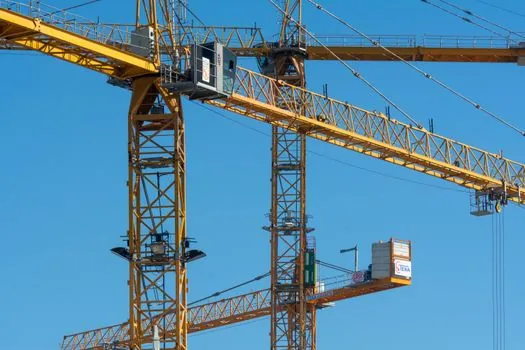
Counterweight does not correct a wrong boom length choice, a miscalculated load radius, or a soft pad under one track. Ground bearing pressure is the silent limit: a fully ballasted 3,000 t-class crawler on unprepared subgrade can punch through a weak layer even with a perfectly chosen stack. Load Moment Indicators and integrated telematics enforce the chart in real time, but they only enforce the configuration the operator selected, so an over-rigged crane with the wrong chart selected is still a wrong lift [S5].
Counterweight is also not a substitute for ground preparation. Mats, pads, or engineered cribbing remain mandatory where soil bearing capacity is below the chart's assumed value, and counterweight selection must be re-validated any time the supporting surface changes [S3]. For routine lift planning on stable pads, the limiting factor is usually transport rather than ground pressure, and modular counterweight boxes that nest inside boom inserts during shipping reduce trailer count enough to change the cost equation on remote sites [S4].
Standards, sourcing, and trackable signals
Crawler crane counterweight selection is governed by the OEM's load chart, the LMI/rated-capacity-indicator envelope, and the site-specific ground-bearing calculation; ASME B30.5 and the corresponding regional standards (ASME B30.5 in the US, EN 13000 for crawler cranes in the EU) cover mobile and locomotive cranes including counterweight-stability requirements, while transport is constrained by axle-load and gross-vehicle regulations on the route surveyed. Counterweight radius, stack mass, and VPC position are documented in the crane's operating manual and verified by the LMI calibration record, both of which should be on file before any lift above 75 percent of chart capacity. Counterweight and ground-pressure trade-offs echo wider mobile crane selection logic, where transport envelope, ground pressure, and lift chart drive the same three-way decision. [S4]
Trackable signals to watch through 2026: OEM releases of next-generation VPC-style positioning on smaller tonnage classes (below 300 t), broader adoption of common counterweight boxes across multiple crane platforms to cut transport loads, and incremental updates to ASME B30.5 and EN 13000 interpretations around VPC-MAX-style attachments that do not contact the ground during the lift. For projects on soft ground or restricted sites, request the OEM's specific ground-bearing pressure curve for the proposed counterweight stack rather than the brochure number, and confirm whether the proposed configuration is rated for the boom-plus-jib combination being rigged.
The underlying component specifications are covered under vertical lift module.
Background reading: Specifying a Conveyor: Bulk Density, Lump Size, and Lift Inputs.