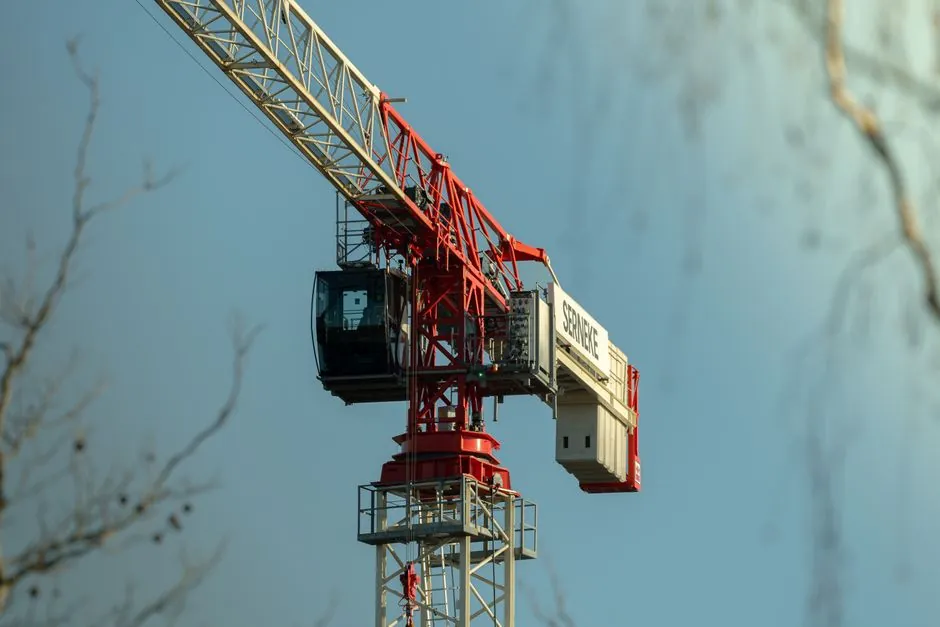
Crawler cranes are mobile lifting machines on tracked undercarriages; the OSHA definition 29 CFR 1910.180(a)(1) describes a rotating superstructure with power plant, operating machinery, and boom, mounted on a base, equipped with crawler treads for travel, whose function is to hoist and swing loads at various radii [S1].
Specifying a crawler crane on a project reduces to two independent axes: lifting capacity (rated from about 1 t for mini units to 3,000 t for the largest heavy-lift models [S4]) and boom type (lattice or telescopic), with boom length, jib configuration, and counterweight package applied as modifiers on a given chart [S5][S8].
Capacity tiers: mini, mid-range, heavy-lift, super-lift
Capacity brackets map to deployment scenarios rather than to manufacturer designations. Mini crawler cranes cover approximately 1–8 t and are used for indoor mechanical-room work, glazing, and confined-area steel erection where ground-bearing pressure from full-size tracks would damage the surface [S7]. Mid-range machines, the workhorses of bridge, commercial-building, and small-wind-farm work, sit roughly in the 35–300 t band that IspatGuru uses as the baseline range for crawler cranes [S4].
Heavy-lift units start around 300 t and run to roughly 3,000 t, used for power-plant stator lifts, offshore-module yards, and 3 MW+ wind turbine erection; the article's source range of "around 35 tons to 3,000 tons" is the commonly cited industry spread [S4]. A representative mid-heavy model, the North American CK3300G-2, lists a standard maximum lifting capacity of 661,300 lb (about 300 t) at 18.1 ft radius, with standard maximum boom length of 295 ft [S3]. The 2352 kN·m basic-boom lifting moment quoted in a 2025 OEM guide corresponds to a much smaller 80–100 t class machine [S2].
Boom architecture: lattice versus telescopic
The boom is defined under 29 CFR 1910.180(a)(13) as a member hinged to the front of the rotating superstructure, with the outer end supported by ropes leading to a gantry or A-frame, used for supporting the hoisting tackle [S1]. By construction, two families dominate: lattice (pin-connected structural sections, usually tubular steel) and telescopic (multi-stage hydraulic sections that extend within each other).
Lattice booms deliver a higher capacity-to-weight ratio, can be lengthened or shortened by adding or removing sections, and are standard above 300 t because a telescopic boom of equivalent reach would be impossibly heavy and unstable. A lattice boom can also be paired with a fixed or luffing jib, which is how wind-farm and petrochem hook heights above 100 m are reached. Telescopic-boom crawlers trade peak capacity for setup speed: the machine can arrive, extend the boom, and pick in a single lift without a separate boom-assembly crew, which suits rental fleets, smaller infrastructure jobs, and pick-and-carry duties [S6].
Configuration modifiers: boom length, jib, counterweight

Within a given crane model, capacity at radius is governed by the load chart, a matrix whose top row is boom length and whose left column is operating radius, with the "Gross Capacity" read at their intersection [S5]. Adding a 24 ft or 40 ft jib re-routes the operator to a separate jib-capacity table, since the added top mass and reeving change both the line pull and the load-moment envelope [S5].
Gross capacity is never the hook capacity. The load chart subtracts capacity deductions (main load block weight, jib weight whether stowed or erected, headache/overhaul ball weight, all rigging weight, and hanging cable weight) to arrive at Net Capacity, which is the maximum that may be applied to the hook [S5]. Pinned boom extensions are variously called jib, fly, or boom extension across Link-Belt, Grove, Terex, and other charts, but they all carry the same load-chart treatment [S5].
Selection criteria: ground, travel, lift pattern, and pick height
Ground condition is the first filter. Crawler tracks spread load across a long contact patch, which is why crawler cranes are the contractor's high-capacity choice for soft, muddy, or uncompacted surfaces, and they also support pick-and-carry (lifting while slowly slewing and tracking) without outriggers, a duty that mobile truck cranes cannot perform on outriggers alone [S6]. Travel distance and permit weight then decide whether a lattice machine can be economically walked to the lift or must be broken down and hauled on lowboys.
Maxim Crane's 2025 guidance lists crane configuration, boom length and angle, working radius, and counterweight/stabilizer setup as the four primary variables that move a load chart, with rigging weight and number of lines on the hook block as secondary modifiers [S8]. For project planners, that translates into a decision tree: (1) pick the capacity tier to clear the heaviest single lift at the worst radius; (2) choose lattice or telescopic based on peak height, repeated-cycle count, and mobilization cost; (3) select boom length and jib combination from the OEM's range table (the CK3300G-2 example goes to 295 ft main boom [S3]); (4) check pick-and-carry duty, transport envelope, and ground-bearing pressure before signing the lift plan.
Comparison of options on four decision criteria

The four crawler-crane archetypes line up against typical selection criteria as follows. (a) Mini crawler, 1–8 t: lowest ground pressure, indoor/outdoor confined sites, telescopic boom only, no jib, lowest mobilization cost; not for repetitive heavy picks [S7]. (b) Telescobic mid-range, 35–150 t: fast setup, one-piece travel, pick-and-carry, limited jib options, mid ground pressure, suited to commercial and small infrastructure work [S6]. (c) Lattice mid-heavy, 200–600 t: high capacity-to-weight ratio, modular boom length, jib options for 80–150 m hook height, longer assembly time, high mobilization weight; the 300 t CK3300G-2 sits in this band with 295 ft main boom [S3]. (d) Lattice super-lift, 800–3,000 t: wind-farm, petrochem, offshore-module duty, multiple crawler-tray configurations, ring-derrick or super-lift attachment common, very long mobilization cycle, very high ground-bearing requirement despite the tracks; the upper end of the 3,000 t industry range is here [S4].
Limitations, failure modes, and standards anchors
The hard constraints on crawler crane selection are ground bearing capacity, transport envelope (axle load, height, width on the haul route), wind on the lifted load and on the boom itself, and the structural limit of the load chart at the worst-case radius and boom angle. Operator-side failure modes include capacity-deduction errors (omitting the jib weight, headache ball, or hanging cable in the Net Capacity calculation [S5]), applying a chart for the wrong boom length or jib status, and exceeding the chart's structural-slewing limits on out-of-level pads.
On the regulatory side, OSHA 29 CFR 1910.180 governs crawler, locomotive, truck, and wheel-mounted crane definitions and operational rules in U.S. jurisdictions, including boom-stop devices, angle indicators, and operator qualification requirements [S1]. The definitions matter operationally: the angle indicator (boom) is defined as an accessory that measures the angle of the boom to the horizontal, and the boom angle is measured between the longitudinal centerline of the boom and the horizontal, taken from the boom foot pin to the boom point sheave pin [S1]. For a working reference on machine families, see the crawler crane encyclopedia entry and the broader construction machinery and equipment overview; for comparison with truck and wheel-mounted variants, the lifting vehicle entry lays out the parallel definitions in 29 CFR 1910.180(a)(3) and (a)(4) [S1].
Two trackable signals to watch: the publication of revised OEM capacity charts that absorb the next generation of variable-position counterweight systems, and any update to the 2352 kN·m-class baseline as Chinese mid-range crawlers continue to push the entry-level tonnage upward [S2].
Background reading: Concentric vs Double Offset vs Triple Offset Butterfly Valves: Spec Map and Selection.