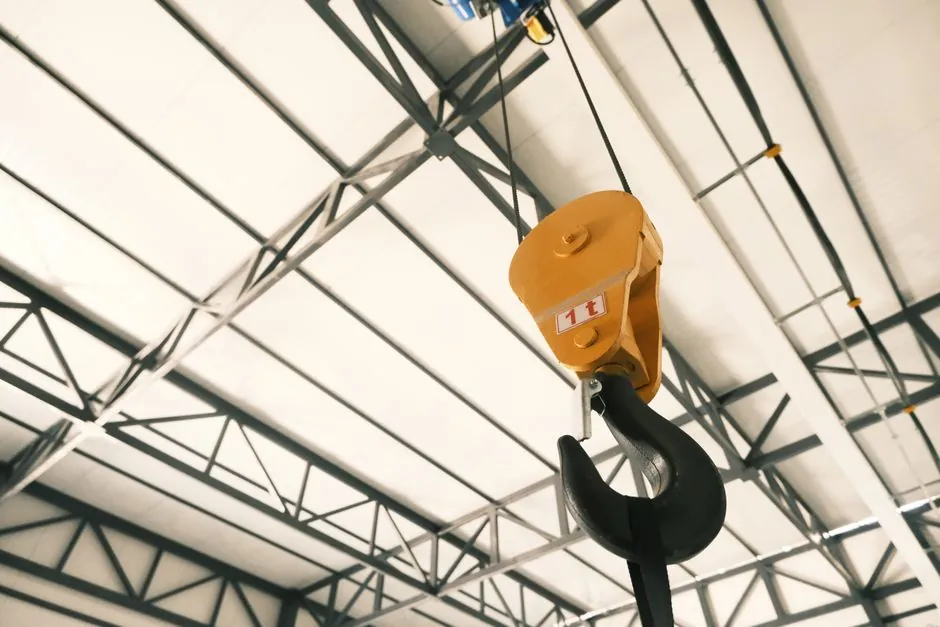
A crawler crane hoist rope’s working capacity depends on more than diameter: the SCX400-C3 combines 22 mm main and auxiliary hoist ropes with a 40 t maximum lifting load at 3.7 m radius [S5].
The correct sizing chain starts with the machine load chart, then verifies rope strength, reeving, sheave pitch diameter, speed, wear, and manufacturer approval before replacement or modification [S1][S4].
Separate boom rope from load hoist rope
Boom-hoist rope and main load-hoist rope perform different jobs, so their diameters cannot be compared directly. The SCX400-C3 specifies 16 mm wire rope for boom hoisting with a rope speed of 60 m/min, while its main and auxiliary hoists use 22 mm wire rope with a rope speed of 74 m/min [S5].
A larger diameter does not automatically mean greater lifting capacity. Main-hoist capacity also depends on the number of rope parts, drum diameter, load radius, boom geometry, and the machine’s rated load moment. The SCX400-C3 has a 10 m basic boom, a 46 m maximum boom, and a 40 t maximum lifting load at 3.7 m radius [S5].
What diameter changes in a crawler crane
Rope diameter changes both installed strength and the machine’s operating envelope.
Construction must be selected for bending and abrasion rather than diameter alone. A 6×19 construction has fewer, thicker outer wires and generally provides better abrasion resistance but reduced flexibility, while 6×36 has more, thinner wires, reduced abrasion resistance, and increased flexibility and kink resistance [S3].
For a crawler crane, the practical conclusion is to preserve the OEM’s specified diameter, construction, core, lay, grade, and termination arrangement. A different rope may fit geometrically yet still reduce fatigue life or invalidate the machine’s rated-capacity basis.
Compare capacity through load-path reeving
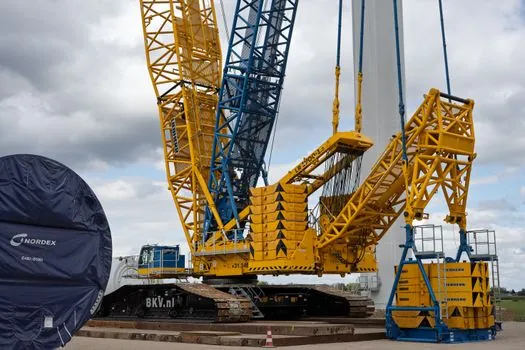
For a direct comparison, consider a single rope part, two rope parts, and four rope parts under the same rope grade and load condition. Doubling the parts can increase force-sharing, but every sheave, drum, wedge, and termination must remain compatible; the governing capacity is the weakest component plus all applicable derating factors [S1].
Angle and bending losses can erase the apparent advantage of larger rope. For 6×19 and 6×36 EIPS IWRC slings with pressed splices, a 1/2 in rope has a vertical single-leg rating of 2.5 tons, but a two-leg bridle falls from 4.3 tons at 60° to 3.5 tons at 45° and 2.5 tons at 30° [S2]. Those sling values are not crawler-crane hoist ratings, but they demonstrate why line angle cannot be ignored.
Boom reeving also imposes a hard geometry limit.
Use the crane load chart as the governing document
For a crawler-crane capacity check, record rope diameter, grade, construction, core, number of parts, load radius, boom length, jib configuration, hoist speed, and the crane’s rated load. Then select the load-chart intersection and apply the manufacturer’s restrictions. The SCX400-C3 demonstrates why: its 40 t value applies at 3.7 m radius, while a 46 m boom alone is not a capacity statement [S5].
Do not transfer a wire-rope-sling chart to a crawler hoist. The sling figures in the comparison data use pressed splices, a 5:1 design factor, and specified hitch assumptions; hand-tucked splices, fiber cores, and other grades have different ratings [S2]. The crane’s load chart, rope certification, and OEM requirements govern.
OSHA 29 CFR 1926.1414 requires original and replacement rope to be selected and installed under the section’s requirements, with replacement selection based on the wire-rope manufacturer’s, equipment manufacturer’s, or a qualified person’s recommendations [S1].
Identify the correct service for each rope
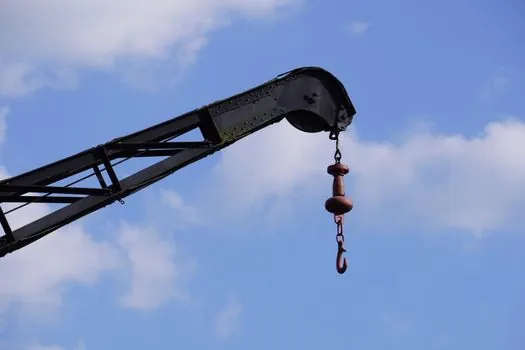
Main and auxiliary ropes are suited to load hoisting, while the smaller boom rope is intended for raising and lowering the boom. The SCX400-C3 specification assigns the 22 mm ropes to main and auxiliary drums and the 16 mm rope to the boom drum, each with distinct line pull and speed [S5].
This rope-size selection is also unsuitable for substituting slings used to lift an attached load. Machine stability, drum capability, reeving and chart limits can govern below rope strength.
Check sheave, drum, temperature and fatigue constraints
Diameter compatibility is not sufficient because groove profile and bend geometry govern rope life. Incorrect diameter matching can produce uneven wear, crushing and reduced fatigue life, so OEM D/d and groove recommendations must be followed [S4].
Core construction carries a material temperature constraint. Lift-All states that IWRC rope must not be used above 400°F, while fiber-core rope must not be used above 180°F; fiber-core ropes should also avoid degreasing solvents [S3]. At approximately 1% extension at rated capacity, wire-rope slings remain deformable components whose inspection and wear allowance remain critical [S3].
Rotation resistance is controlled by construction, not diameter alone. OSHA 29 CFR 1926.1414 defines Type I rope with at least 15 outer strands and Type II with at least 10 outer strands; rotation-resistant boom-hoist ropes must meet the section’s operating-design-factor conditions [S1].
Specify a replacement with traceable criteria

A replacement-rope request should state the crawler-crane model, original rope diameter, construction, core, grade, lay, length, drum and sheave data, line pull, speed, number of rope parts, and duty cycle. It should also identify whether the rope is for the main hoist, auxiliary hoist, or boom hoist, because the SCX400-C3 uses three distinct service and dimension combinations [S5].
Verification should include minimum breaking force, operating design factor, drum and sheave compatibility, groove fit, corrosion protection, lubrication, and inspection acceptance criteria. For boom reeving, document at least the 18:1 sheave pitch-diameter ratio and the applicable rotation-resistant-rope requirement [S1].
The next trackable record is the crawler crane’s rated load chart and rope specification sheet: if they do not provide an approved match for the proposed diameter and reeving arrangement, the crane supplier or a qualified person should resolve the selection before installation [S1].