
A 100–150 ton class lattice-boom crawler crane requires 6–10 trailers, while a 300–500 ton machine can require 15–25 trailers or more [S3].
Planning should cover component disassembly, oversize or overweight permits, trailer scheduling, escorts, route surveys and field reassembly before dispatching a crawler crane to site [S3].
Why Lattice Boom Sections Complicate the Route
A lattice-boom crawler crane must be separated into the upper house, carbody, crawler tracks, boom sections and counterweights because the assembled machine is too wide, tall and heavy for ordinary public-road movement [S3]. The transport plan therefore treats each package as a separate heavy-haul load with its own dimensions, weight, permits and delivery sequence.
The boom is not one indivisible component in every case. Some designs use a base section suitable for single-piece transport, while other configurations divide the boom into multiple sections for handling and assembly [S4]. This distinction affects the trailer count, crane-support requirements and field labor needed before lifting can begin.
For international deliveries, the route extends beyond the factory gate. A 2025 USITC investigation on lattice-boom crawler cranes from Japan examined ocean freight, customs clearance, inland transport to Lexington and domestic work required for final assembly [S1]. This demonstrates why import planning must include port handling, customs release and inland delivery rather than treating transport as a single factory-to-site movement.
Trailer Counts by Crane Size
A mid-size 100–150 ton crawler crane generally requires 6–10 trailers, compared with 15–25 trailers or more for a large 300–500 ton crane [S3]. These figures include the principal upper house, carbody, tracks, boom sections and counterweights, but an exact quotation requires a component inventory with shipping dimensions and weights.
Individual examples illustrate the planning scale. A Link-Belt 138 HSL or Kobelco CK1100 may occupy 5–10 trailers [S3]. Fleet data cited for Bigge identifies a product range from 110 to 1,200 tons, demonstrating that transport packaging must be selected against the machine configuration rather than assigned from nominal capacity alone [S4].
The traffic is usually a convoy, not an isolated oversized load [S2]. Deliveries may require separate trailers for the boom sections, upper structure and crawler undercarriage, with pickup and delivery dates sequenced so that the correct section reaches the assembly pad before the crane needs it [S2][S3].
Permit and Route-Survey Thresholds
Most crawler crane components require oversize or overweight permits.
A route survey is not a paper-only check. Engineers must identify restrictions involving bridge capacity, roadway geometry, overhead lines, tight turns, grade limits and local access before the loads enter the permit process [S3].
Permit responsibility also varies by jurisdiction, so the carrier should identify the permitting authority for each state or locality before equipment is committed [S3]. A practical tender needs component-level drawings rather than only the crane’s rated capacity, because the upper house, carbody, individual boom sections and counterweight packages can impose different route constraints.
Disassembly, Transit and Reassembly Time
A mid-size crawler crane move can require weeks of planning for permit applications, trailer scheduling, escort coordination and utility-line lift arrangements. Road transit adds a separate distance-dependent period rather than a fixed national duration.
This capability must be verified for the exact model and configuration. If self-assembly is unavailable, the method statement must add a mobile crane, lifting frames, rigging personnel and a larger laydown area.
Modular design still affects site handling. Tadano describes lattice-boom crawler cranes as using optimized dimensions and modular components intended to simplify transport and shorten setup times [S6]. Transport savings are not interchangeable with assembly savings, however. A compact package that fits one trailer can still require multiple boom sections to be connected and checked before the crane is ready for work [S4].
Transport Selection Against a Telescopic Crane

Lattice-boom and telescopic cranes differ materially in transport and setup: a lattice crane uses interconnected steel sections and generally requires multiple loads, while a telescopic crane uses a hydraulic nested boom and is easier to transport [S5]. The trade-off is capability and operating flexibility, since a lattice boom generally provides higher maximum lifting capacity and longer-radius configurations at the cost of longer setup and lower mobility after assembly [S5].
The comparison is straightforward for procurement: a 100–150 ton lattice crawler typically requires 6–10 trailers, and crane transport can require weeks of planning. A telescopic crane usually arrives closer to operating configuration and can change boom length hydraulically, reducing both road-package count and field assembly [S5].
For a plant shutdown, modular power installation, or fabrication project requiring repeated radius changes, the telescopic crane usually wins on logistics efficiency [S5]. For a heavy lift requiring exceptional capacity or a long lattice boom, the added transport and assembly burden may be justified [S5]. The governing criterion is therefore not trailer count alone, but transport and setup burden relative to the required lift chart.
Field Assembly, Access and Failure Modes
A fully assembled lattice crawler cannot pass normal public-road restrictions, so a missing boom section, failed permit, unsuitable trailer or inaccessible assembly pad can stop the delivery before crane setup begins [S3]. The principal failure modes are dimensional misidentification, load-weight errors, route restrictions, utility conflicts and an assembly sequence incompatible with the available ground cranes [S3].
Remote-site freight can carry a major cost penalty because multiple trailers, escorts and route work must be coordinated through the same delivery window [S4]. Large industrial projects, data centers, petrochemical plants, power facilities and energy projects can justify crawler capacity, but those same job sites may have constrained approaches that make transport planning more difficult [S4].
The assembly area needs enough room for the complete boom, upper house, carbody, tracks and counterweights, plus cranes, rigging and staff [S3]. The crawler crane selected for the lift must also arrive with a complete load list that matches the crane model, serial configuration and actual component dimensions.
International Delivery Adds Customs and Port Control
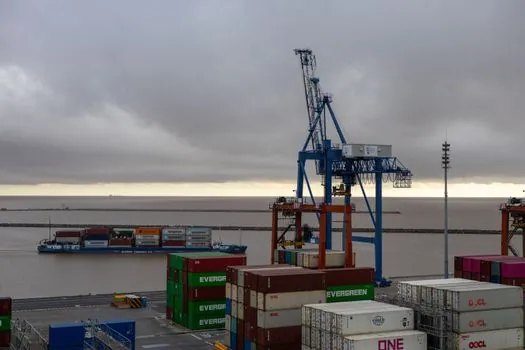
International shipment of lattice-boom crawler cranes requires a planned chain covering factory release, ocean freight, customs clearance, inland transport and final domestic assembly [S1]. The USITC investigation identifies ocean transit to the United States, customs clearance and movement to Lexington as distinct stages that can involve different documents, handlers and schedules [S1].
Disassembly must preserve the relationship between sections, pins, fittings and assembly documentation. Customs descriptions should identify the equipment and component quantities consistently, while the freight plan must verify port handling capacity for long boom sections and heavy upper structures. Damage or missing hardware during ocean transit can add much more delay than the original port-to-site travel time.
The transport package is a direct extension of the machine’s lattice-boom crawler crane design. Modular dimensions can reduce trailer count and handling time, but every package still requires controlled identification, securement and inspection before it becomes part of the assembled crane [S6].
A transport-ready tender should list every boom section, upper house, carbody, track package and counterweight with dimensions, weight and handling requirement, followed by route permits, trailer assignments, escorts, delivery dates, assembly equipment and an exclusion list for work not included in the quoted move [S3].