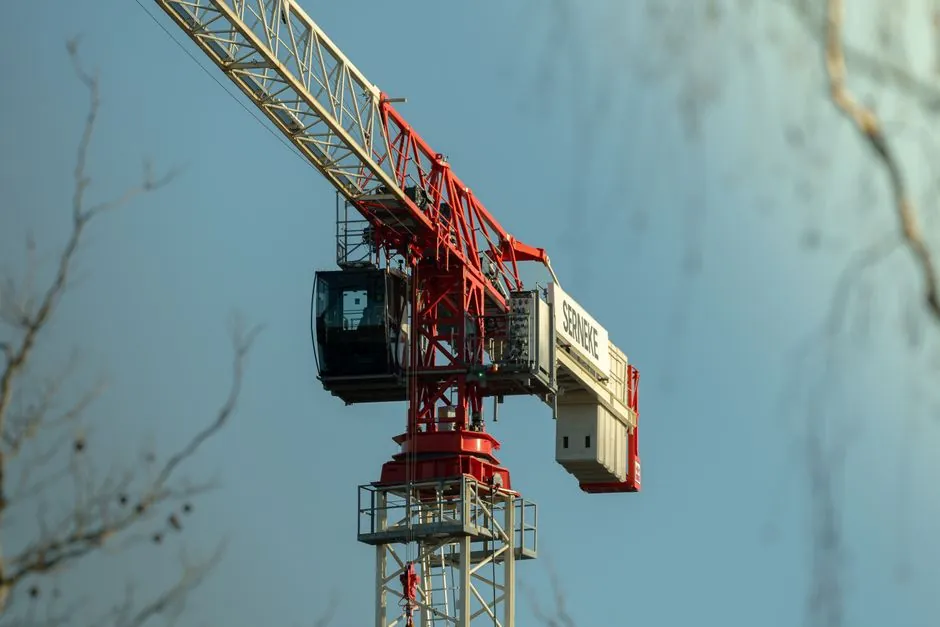
Crawler cranes use continuous tracks that provide traction and stability on rough, uneven or soft ground.
The tracks spread crane weight over a larger contact area than wheeled undercarriages, making crawler cranes suitable for soft, muddy and unstable ground where a mobile crane may sink or lose traction [S3][S7].
What Sets Crawler-Crane Travel Speed
Crawler cranes use continuous tracks instead of wheels, allowing them to operate on rough, uneven or soft ground.
The crawler crane therefore fits fixed or semi-fixed lifting zones where stability and capacity matter more than repeated travel between distant lift points.
Crawler Versus Rough-Terrain Mobility
Crawler cranes trade travel speed for a lower and more evenly distributed ground pressure, while rough-terrain cranes use four-wheel drive, all-wheel steering and large off-road tyres to reposition more rapidly [S1][S2][S5].
The comparison is operational, not promotional. Use a crawler crane when the load and ground conditions demand a stable base; use a wheeled rough-terrain crane when lift points are frequent and access routes permit faster repositioning [S1][S5].
Uneven-Ground Selection Criteria

Continuous tracks distribute crane weight across a much larger area, enabling crawler cranes to operate on soft or uneven ground where wheeled vehicles may fail [S7]. The broad track footprint also supports precision control during heavy-duty operations [S5].
Slope capability is model-specific. A published equipment-industry discussion places typical crawler-crane operating slopes at approximately 1.5–4 degrees, while advising users to consult the manufacturer guidelines and load chart [S4].
A forum participant stated that most crawler cranes can safely operate on slopes up to 1.5 to 4 degrees and advised consulting manufacturer guidelines and the load chart.
Where Crawler Travel Makes Sense
Crawler cranes are appropriate for heavy lifts at one developed work area, particularly where the machine must remain in position for an extended period. Their track systems are used for bridge construction, industrial installations and foundation work where capacity, stability and sustained control dominate the selection [S5].
These machines are also a practical choice for heavy materials at sites with poor roads, muddy surfaces or ground that cannot support repeated wheeled traffic. A crawler base allows the crane to work in difficult ground conditions where traditional vehicles can become stuck [S3].
Crawler travel is less suitable when crews need to cross a large site repeatedly. The rough-terrain crane category addresses that operating pattern with four-wheel drive, all-wheel steering and self-propelled movement between lift locations [S1][S2].
Limits and Failure Modes
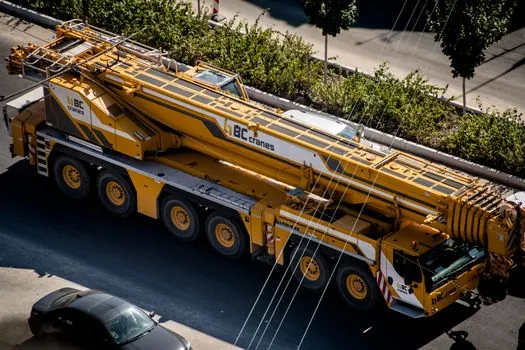
Excessive travel speed can reduce control when tracks encounter ruts, soft shoulders or abrupt changes in elevation, even though the crawler undercarriage handles uneven ground better than wheeled equipment [S3][S7]. Uneven terrain can also make a visually minor slope unsafe by allowing the ground to shift under the machine [S4].
The safe operating angle depends on the crane model, and operators should consult manufacturer guidelines and the load chart. Operators must also account for boom geometry, counterweight position, ground firmness and local depressions.
Operating Plan and Trackable Signals
Operators should consult the manufacturer's guidelines and the load chart for the crane model. The operator should consult the manufacturer's guidelines and the load chart to determine the applicable operating limits.