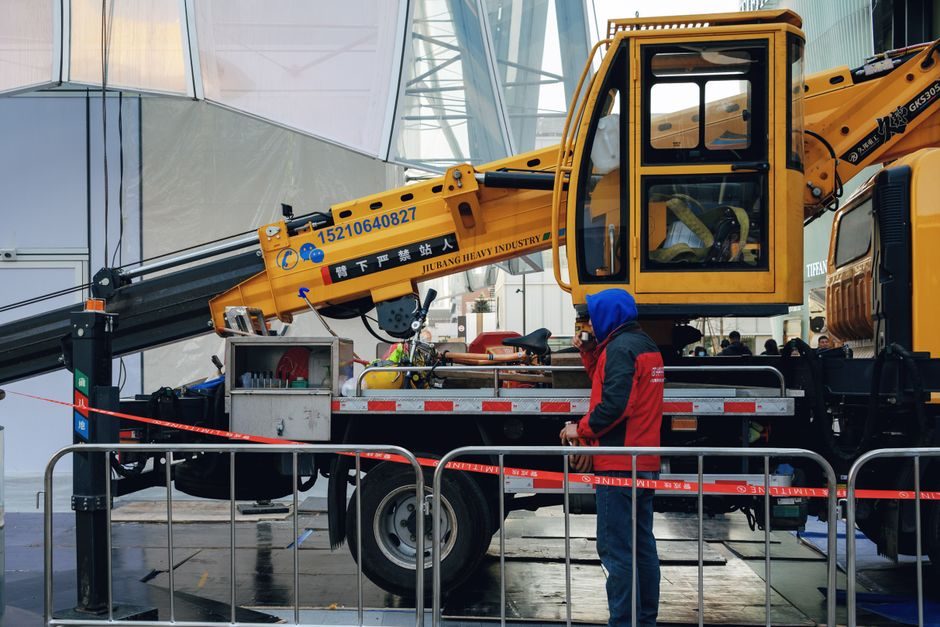
Crawler cranes and truck-mounted cranes solve different lifting problems, and the 2026 China-supplier market lists them in clearly separated price bands: truck-crane units from US$6,000 (5-tonne stiff-boom) up to US$218,181 (knuckleboom with fly jib) [S7], and crawler units clustered around US$150,000 for a 50-tonne QUY50 electric-class machine [S9].
Buyers comparing the two families should anchor the decision on three measurable axes: ground-bearing pressure, lift-class envelope, and inter-site relocation time. The 25-tonne QY25K / QY25V / XCT25L5 truck-crane models appearing across Beijing Wellsee Trade's 2026 catalogue [S1] all share a roadable chassis, while crawler units from Union Construction Machinery and Juyi International sit on tracked undercarriages rated for soft pad work [S2][S6].
Undercarriage and Ground Pressure
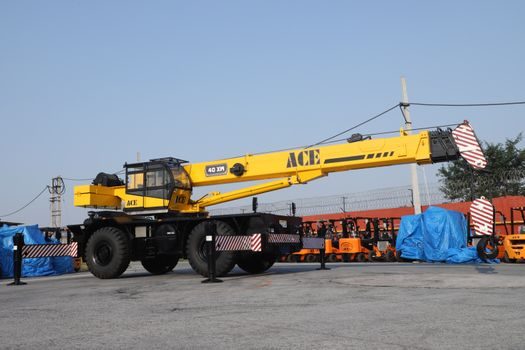
Tracked undercarriages on a crawler crane typically distribute 50–80 kPa ground-bearing pressure across a 4–6 m track length, letting a 50-tonne class machine work on compacted soil, gravel, or graded clay without outriggers mats. The QUY50 50-tonne crawler from a Hunan OEM weighs roughly 45–50 t including counterweight and relies on its tracks for stability rather than deployable outriggers [S9].
A truck-mounted crane uses outrigger pads on all four corners to stabilise the upper structure, with the chassis itself contributing nothing to lift stability. Road-legal axle loads cap at 12 t per axle in most jurisdictions, which is why 25-tonne truck-crane offerings (XCMG QY25K, SANY QY50C, Zoomlion QY25V) cluster at gross vehicle weights of 28–34 t [S1].
Lift Capacity and Boom Configuration
Crawler crane capacity in 2026 supplier listings is dominated by mid- to heavy-duty classes: the QUY50 sits at 50 t, Juyi International's catalogue carries 318 crawler-crane models plus 103 mobile units, and Chinese OEM families extend upward into 600–800 t lattice-boom classes for wind-energy erection [S6][S9]. Boom length on telescopic crawlers typically spans 30–90 m, with lattice-boom jib configurations adding another 30–60 m.
Truck-crane capacity tops out lower because the chassis is the limiting factor: 5-tonne mini units (US$6,000–30,000) handle light material handling, 25-tonne teleboom units (XCT25L5, QY25K) cover general construction, and 50-tonne units (Changjiang LT1050, SANY QY50C) push toward bridge-beam and pre-cast erection [S1][S7]. Above 50 t the truck-crane market is replaced by all-terrain crane classes, not by heavier truck-crane models.
Mobility and Site Relocation
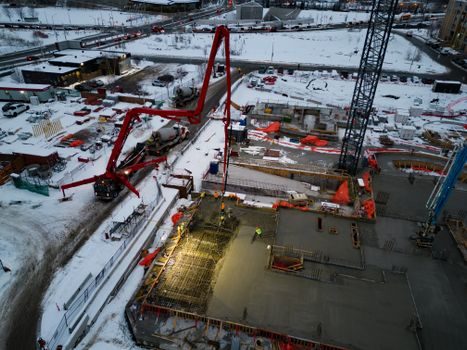
A truck-mounted crane drives itself between sites at 70–90 km/h on highway, with setup time of 15–30 minutes for outrigger deployment and counterweight rig. The 25-tonne mobile crane from Wellsee Trade quotes a 1-piece MOQ and 8 pieces per month supply, reflecting demand for fast-relocation fleet use [S1].
A crawler crane must be disassembled for road transport on low-bed trailers: tracks, boom sections, counterweight slabs, and the upper are typically split into 4–6 loads for a 50-tonne class machine. Travel between adjacent job sites without disassembly is limited to short winched moves, which is why crawler-crane contracts price mobilisation as a separate line item.
Cost Bands and 2026 Pricing
Supplier pricing across July 2026 listings shows a clear cost gradient: 2–3 tonne spider/mini crawlers at US$2,600–5,600 per piece on OEM/ODM factory pages [S8], 50-tonne electric-class crawlers like the QUY50 around US$150,000 per unit with 20 units/month supply [S9], and used heavy crawlers traded by Shanghai-based Union Construction Machinery to Europe and the Mideast [S2].
Truck-crane pricing spans a much wider envelope: US$10,200–10,250 for entry-level 5-tonne stiff-boom units, US$142,700 for a 25-tonne mobile unit at 2-piece MOQ, and US$218,181 for a 2026 knuckleboom truck crane with fly jib at 1-set MOQ [S7]. The 10x price spread within truck cranes reflects boom type (stiff, telescopic, knuckle) more than lift class.
Operating Surface and Site Constraints
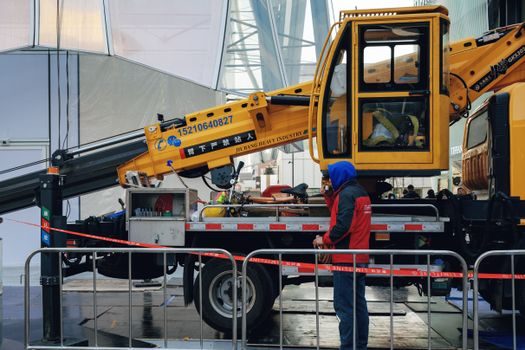
Choose a crawler crane when the work surface is soft, uneven, or where repeated outrigger re-positioning would damage the pad. Crawler undercarriages from Juyi's 318-model line include telescopic crawlers designed for narrow access with extended track frames, plus heavy-lift configurations for wind-turbine and petrochemical erection [S6].
Choose a truck-mounted crane when the site is paved, time-bounded, and the lift is under 50 t. Stiff-boom 5-tonne units at US$6,000 entry price suit repetitive yard loading, while 25-tonne QY25V/QY25K teleboom units cover general building construction and HVAC placement. The economic crossover where a crawler becomes cheaper than a truck crane is around the 50–80 t lift class, where truck-crane chassis costs rise faster than crawler disassembly overhead.
Decision Criteria Comparison
Four-criterion comparison for procurement teams: (1) Lift capacity — crawler wins for 50 t and above, truck crane wins for sub-50 t repetitive work. (2) Ground preparation — crawler tolerates unprepared subgrade; truck crane requires level paved surface plus outrigger pads. (3) Relocation speed — truck crane drives itself at highway speed, crawler requires low-bed trailer and 4–6 load splits. (4) Purchase price — truck-crane 25-tonne class averages US$140,000–220,000 [S7]; 50-tonne crawler QUY50 around US$150,000 with no road chassis cost [S9].
For a fleet operator running 5–10 jobs per week on urban building sites under 50 t, truck cranes deliver lower total cost of ownership because the chassis is the transport. For a wind-farm or bridge contractor running 2–3 sites per quarter at 100–600 t lift, crawlers are the only category with the structural rating and ground-clearance envelope. Related B2B comparison coverage of this segment is mapped in the 2026 spec map of overhead bridge cranes versus truck cranes, and fleet buyers running mixed lifts often pair crawler choices with rough-terrain forklift selection logic for site support equipment.
Standards, Compliance, and Audit Trail
Chinese OEM crawler and truck-crane shipments to Europe and the Mideast from Union Construction Machinery are documented as Diamond Member Audited Suppliers on Made-in-China, with verified business licenses and on-site audit reports [S2]. Juyi International operates an OEM parts business (318 crawler SKUs, 105 universal accessories) supplying long-term cooperation contracts to overseas end users [S6].
Buyers specifying new units should request the OEM load-chart book, the EN 13000 / ASME B30.5 compliance statement, and the supplier's verified manufacturing license; these three documents together cover the EU machinery directive, US OSHA crane standard, and the supplier due-diligence layer required for cross-border procurement. Track the supplier's average response time (Union Construction reports ≤4.6 hours [S2]) and third-party audit date as forward signals of order-tracking reliability.
Detailed specification references: dump truck.