An overhead bridge crane rides on fixed runways inside a building or covered bay, with typical capacities of 1-30 t for single-girder units and 3-500 t for double-girder units at working duty M3-M7 per FEM/ISO classification [S7].
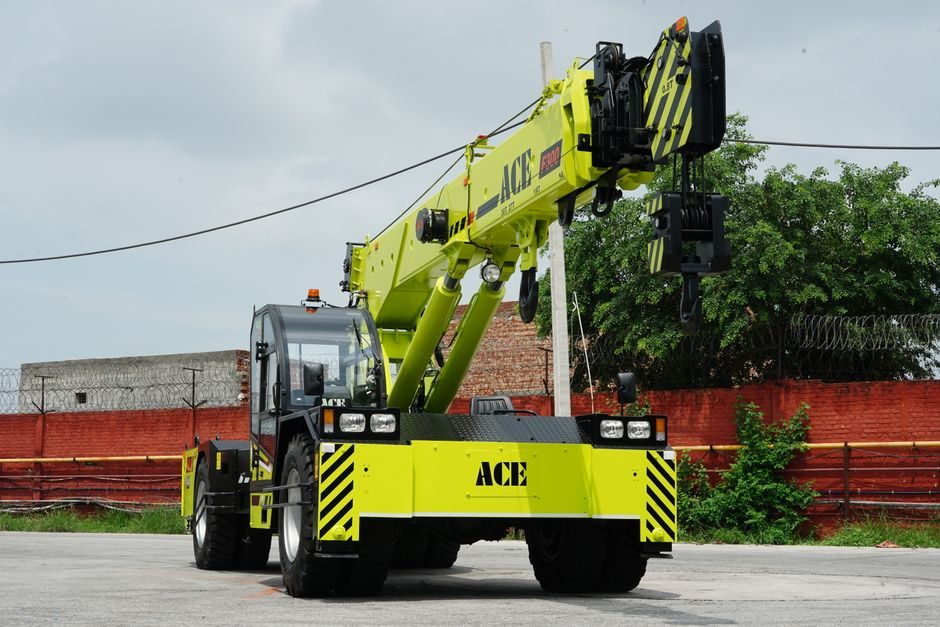
A truck-mounted crane bolts to a commercial carrier chassis and is road-transportable, suited to construction sites, equipment delivery, and short outdoor lifts where no fixed runway exists. Buy the first when a facility runs repetitive indoor cycles; buy the second when lifts are scattered and mobility outranks utilisation hours.
Operating envelope and structural class
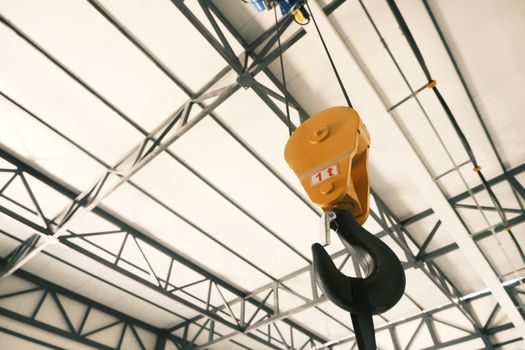
An overhead bridge crane (OBC) consists of one or two girders spanning a fixed runway, with a hoist trolley traversing the bridge and the whole bridge traversing along runway rails supported by the building columns or a freestanding gantry structure [S5]. Capacities reach 150 t and above in custom welded plate-box girder builds from established OEM lines [S3].
Truck cranes carry their own outrigger matrix and a telescoping or lattice boom. The crane arrives under its own power or on a lowboy, sets stabilizers, and is rated by chart for each boom length and radius — capacity drops sharply as radius grows, a behaviour fundamentally different from the constant-radius load envelope of a bridge crane on a fixed runway.
For applications that require lifting inside an existing building footprint without altering the floor, the overhead conveyor concept uses the same runway principle and is a useful adjacency when comparing fixed-path indoor solutions.
Duty cycle, standards, and regulatory anchors
Bridge crane duty is classified by working class / number of operating cycles per FEM 1.001 or CMAA 70/74, and the OEM offering from Chinese suppliers maps single-girder OBC to M3-M5 and double-girder OBC to M5-M7, with IP54/IP65 enclosure ratings for standard industrial environments [S7]. Compliance work for North American shops tracks CMAA, NEC, OSHA, and ASME, with welding per AWS D1.1 and D14.1 when fabrication is in-house [S3].
Truck crane design follows mobile-crane standards (ASME B30.5 in the US, EN 13000 in Europe) and load-chart rules, with the chart itself serving as the spec — every configuration (boom length, counterweight, outrigger spread) is a separate rated lift. This is why two truck cranes with identical maximum capacity can have very different real-world productivity at typical working radii.
Capacity alone is rarely the deciding spec. On an OBC, a 10 t CMAA Class C crane and a 10 t CMAA Class E crane differ by a factor of roughly 4 in design fatigue life; on a truck crane, two 50 t units can differ by a factor of 2 in chart capacity at 12 m radius depending on boom configuration. The duty rating, not the headline tonnage, is where the engineering decision actually lives.
Decision matrix: OBC vs truck crane on five criteria

Five criteria separate the two technologies cleanly. (1) Utilisation hours: OBC wins above ~1,500 hours/year of indoor lifting; truck cranes are designed for intermittent, single-shift site duty. (2) Coverage: OBC lifts along a fixed rectangular envelope (runway × bridge); a truck crane lifts in a 360° arc around the carrier but only where ground bearing and outrigger spread allow. (3) Lead time: a pre-engineered single-girder OBC ships in weeks from Chinese OEMs at FOB US $10,000-class pricing for entry units [S2]; truck cranes are vehicle-dependent, with lead time dominated by chassis availability. (4) Footprint: OBC needs runway steel and clear headroom; a truck crane needs approach roads, outrigger pads, and overhead clearance for boom elevation. (5) Labour model: OBC is operated from a pendant or cab fixed to the crane; truck cranes need a certified mobile-crane operator and a rigger/signaller team for most jurisdictions.
The matrix is summarised below for quick reference:
Criterion | Overhead bridge crane | Truck crane | Better choice. Indoor utilisation hours | designed for high cycle M3-M7 [S7] | designed for intermittent site lifts | OBC. Coverage shape | fixed rectangular runway | 360° around carrier | depends on facility. Civil works | runway steel, columns | outrigger pads, road access | depends on site. Lead time (entry unit) | weeks, FOB ~US $10,000 [S2] | chassis-dependent, often longer | OBC at low capacity. Operator model | in-house trained pendant/cab | certified mobile-crane operator + rigger | depends on in-house skill.
Use cases the OBC handles cleanly
Inside a steel fabrication shop feeding a dump truck loading bay, a 20 t double-girder OBC on a 30 m runway will out-cycle any mobile alternative because the crane is always in position, always energised, and the operator can stay on the pendant for an entire shift. The 70-year-old North American OEM segment sells into exactly this profile and quotes 150 t-plus custom capacity as a routine upper bound [S3].
Inside a warehouse where pallets need to move in and out of racking, a 1-10 t under-running (under-hung) OBC uses the building's own roof structure as the runway support, avoiding new column foundations — a layout Dearborn's product line specifically calls out for existing-building retrofits [S1]. For workstation-scale picks under 1 t, jib and workstation bridge cranes fill the same fixed-path role at lower capacity and lower installed cost.
Use cases the truck crane handles cleanly
Construction-site steel erection, HVAC rooftop unit replacement, tower-crane assist lifts, and infrastructure jobs where the lift point moves daily are the truck crane's home territory. Mobility is the whole point: the crane drives to the load at road speed, sets up on outriggers, lifts, and drives to the next job — work that is impractical to serve with any fixed-runway crane, including a reach truck stacker in a warehouse aisle. [S3]
For weighbridge-and-load-out operations where a truck-mounted crane also interfaces with a truck scale for in-bound/out-bound mass verification, the combination is common at scrap yards, timber terminals, and container depots — a configuration where neither pure indoor fixed-path nor pure road-mobile equipment works alone.
Limits, failure modes, and what the spec sheet won't tell you
The OBC's hard limits are runway length, building headroom, and runway alignment tolerance. A runway out of level by more than the rail-to-wheel spec (commonly a few millimetres per metre for top-running OBC) produces trolley tracking drift, wheel flange wear, and eventual derailment — failure modes that don't show up on a vendor's headline capacity chart. Pre-engineered OBC frames solve the alignment problem at the factory; custom gantries do not. [S3]
The truck crane's hard limits are ground bearing pressure, outrigger spread, wind speed on the load, and chart capacity at the working radius. A frequent over-spec mistake is sizing the crane for maximum capacity and then discovering the working-radius capacity is half the headline figure. The second is ignoring wind — mobile-crane charts assume a sheltered lift, and a 30 t unit can derate to a fraction of its chart capacity in open-terrain wind above the chart's stated limit.
For the broader heavy-lift comparison space, crawler crane vs stacker crane selection maps and rough-terrain forklift vs forklift spec maps use the same duty-and-cycle-first decision logic that governs OBC vs truck crane.
Sourcing and price band reality check

FOB prices for entry-level single-girder OBC from Chinese OEM showrooms start near US $10,000 per piece (MOQ 1 piece) for a wire-rope single-girder workshop unit under ISO9001:2000 certification, with custom double-girder gantry configurations reaching roughly US $100,000 per piece at the same supplier [S2]. Domestic North American OBC suppliers price custom-engineered 150 t builds by tonnage and runway length rather than per piece, and lead times stretch into months for engineered units.
Truck crane pricing is dominated by carrier chassis, boom length, and emissions tier, and is usually quoted per unit on a chassis-specific build sheet rather than a per-piece FOB line item. Cross-checking the boom chart and the outrigger matrix matters more than the headline maximum capacity when comparing two truck crane quotes.
When weighing single-girder vs double-girder OBC specifically — the most common sub-decision inside the OBC family — the rule of thumb is single-girder up to roughly 20 t at M3-M5 duty, double-girder above 20 t or at M5-M7 duty, with the weld procedure on the box girder following AWS D1.1 for North American deliveries [S3][S7].
For sustained indoor production, specify OBC and book the runway survey before the building is enclosed; for mobile site lifts, specify truck crane and verify the working-radius chart matches the actual lift envelope.