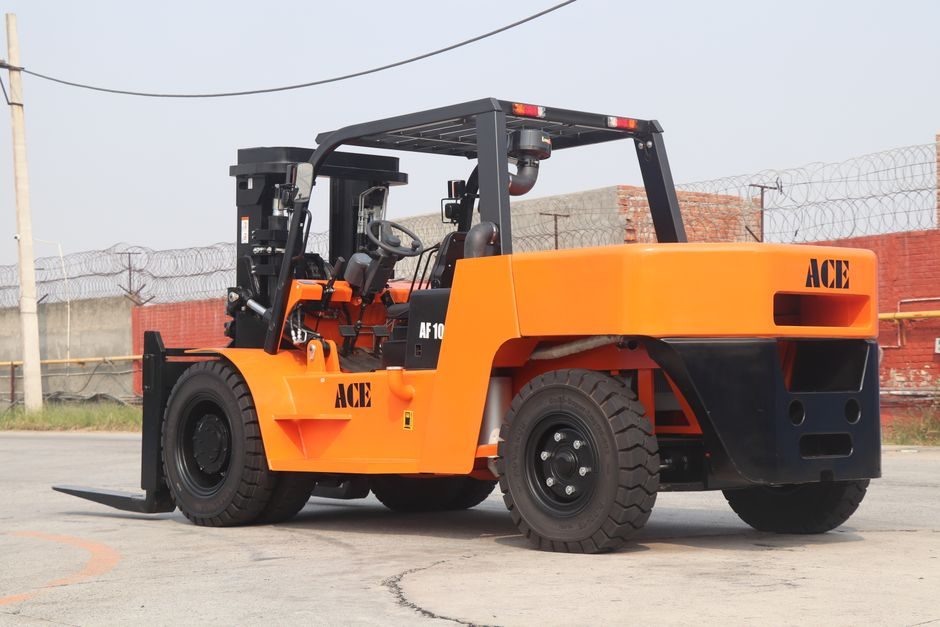
A rough terrain forklift is a 4WD, high-clearance IC-powered lift truck built for off-road surfaces, with manufacturer published load ratings spanning 1.5 t to 10 t in the Hangcha XF series and 1.5 t to 3.5 t in the high-voltage XH line [S4].
A standard forklift — by contrast — is engineered for flat, paved warehouse floors in capacities typically from 1.5 t to 4 t (with electric/LPG/diesel power options) and is the default indoor handling tool, while a rough terrain forklift only enters the picture once the job moves outside onto broken ground.
Defining the Two Categories
Standard forklifts fall into the Internal Combustion (IC) class for outdoor/yard work or the electric class for indoor warehouse work, riding on cushion or smooth pneumatic tires with low ground clearance [S1]. A rough terrain forklift sits in the IC subclass, but with deep-tread pneumatic tires, lifted chassis, and 4WD as standard equipment [S1][S5].
JCB defines a rough terrain forklift (or "all-terrain forklift") as a machine built specifically for outdoor, uneven-ground work, "as opposed to those used inside a factory or warehouse" [S5]. That functional split — indoor paved vs. outdoor unpaved — is the line every spec sheet eventually traces back to.
Load Capacity and Lift-Height Bands
Hangcha's XF series currently publishes three rough-terrain capacity bands: 1.5–1.8 t at 3.0–6.0 m lift, 2.5–3.5 t at 2.7–6.5 m lift, and 5.0–10.0 t at 3.0–7.0 m lift, with the XH high-voltage variants covering 1.5–3.5 t [S4].
By comparison, a general-purpose 1.5–4 t forklift from mainstream Chinese OEM/ODM output — diesel, gasoline/LPG, and electric — clusters in the same 1.5–4 t window with 3-stage masts to ~4.5 m, the segment where most Made-in-China suppliers list their standard product lines [S2][S6].
Harlo's rough-terrain-only US line up-scales that ceiling: HP5000, HP6500, HP8500, 10-FIVE, 12-FIVE, and H4 Compact give 4,000 lb / 5,000 lb / 6,500 lb / 8,500 lb / 10,500 lb / 12,500 lb lift capacities respectively — roughly 1.8 t to 5.7 t in metric terms [S3]. The 4,000 lb H4 Compact is their smallest, hydrostatic-attachment-ready model, and the 12-FIVE is the largest at 12,500 lb [S3].
Tire, Drivetrain, and Ground Clearance
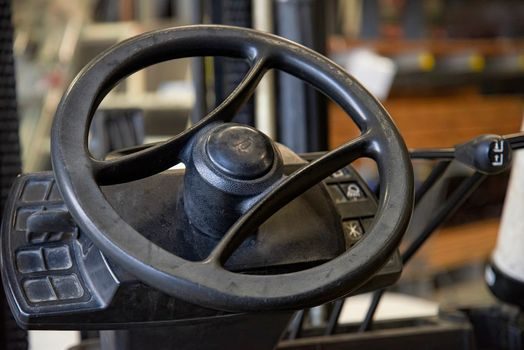
Large, deep-treaded pneumatic tires are the defining feature of a rough terrain forklift, giving "superior traction on uneven surfaces like mud, gravel, and slopes" along with high ground clearance and often 4WD [S1]. Standard indoor forklifts use smooth cushion tires or low-profile pneumatics with minimal clearance because they never leave the slab.
Large pneumatic tire forklifts — a third category worth flagging — sit in between: larger pneumatic tires than indoor trucks but "lack the extreme ground clearance and 4WD capabilities of rough terrain forklifts," fitting duty on packed dirt, asphalt, and scrapyards rather than true off-road terrain [S1]. For a yard that is bumpy but not broken, large pneumatic is the cheaper compromise; for mud, slopes, or ungraded ground, only the rough-terrain class will do.
Decision Matrix: Rough Terrain vs Standard Forklift
On the four criteria that drive the buy decision — ground surface, drivetrain, typical capacity, and operating environment — the comparison is clean. A rough terrain forklift handles unpaved/mud/gravel/slopes with 4WD and lift heights to 7 m in 5–10 t sizes, suited to construction, lumber, farm, and landscaping sites [S1][S4][S5].
A standard forklift handles flat concrete/aisle-warehouse duty with 2WD (or 3-wheel electric), 1.5–4 t typical capacity, and electric/LPG/diesel power options, optimized for indoor logistics and container loading on paved aprons [S2][S6]. The two classes overlap in the 1.5–4 t capacity window, but never on drivetrain or ground clearance — that is the structural reason both exist rather than one cannibalising the other.
Quick rule of thumb: if the average work surface is unbroken concrete or asphalt, spec a standard forklift; if it is mud, crushed rock, or graded dirt that sees rain, spec a rough-terrain unit. Rough terrain is overkill (and a higher tire-wear cost) on a smooth yard, while a standard forklift will bog down or tip on a wet construction pad.
Real Use Cases and Industry Fit
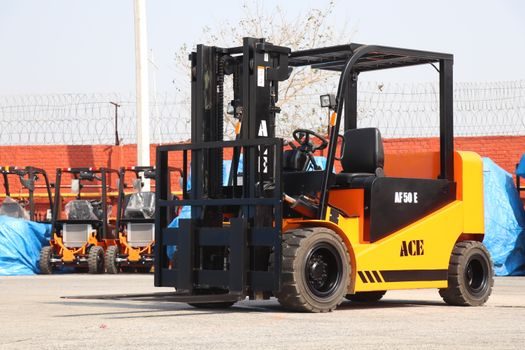
Rough terrain forklifts are documented as ideal for "construction sites, lumberyards, landscaping and farm industries," with JCB positioning them as a solution for "any challenging rehandling environment" and Hummerbee extending that to tree care, landscaping, dairy farming, and beekeeping [S1][S5][S7].
Standard forklifts dominate palletised warehouse work, container stuffing, and last-yard truck loading on paved aprons — exactly the duty cycle that Made-in-China OEM/ODM output and MASTER-type product catalogues list as their core offer: "Forklift, Diesel Forklift, Gasoline Forklift, Lpg Forklift, Electric Forklift, Work Platform, Rough Terrain Forklift, Pallet Stacker" [S2][S6]. For a freight forwarder with 95% indoor work and 5% outdoor on tarmac, a standard forklift plus a single rented rough-terrain unit is usually the lowest-TCO mix.
Limitations and Failure Modes
Specifying the wrong class has measurable consequences. A standard forklift on muddy ground loses traction and can sink; a rough terrain forklift indoors is too tall, too wide, has excessive tire scrub on painted floors, and burns more fuel per pallet moved — a poor unit economics for high-throughput indoor cells. [S1]
Class fit also matters for safety: rough-terrain units are taller, narrower at the axle, and top-heavy on slopes, so operator training and load-chart discipline matter more than for indoor cushion-tire trucks, where the dominant failure mode is tip-over from cornering at speed on smooth floors rather than ground-condition loss of traction [S1][S5]. Always check the OEM load chart against actual lift height and whether the work involves slopes before selecting the larger of two adjacent capacity bands.
Sourcing, Standards, and Total Cost
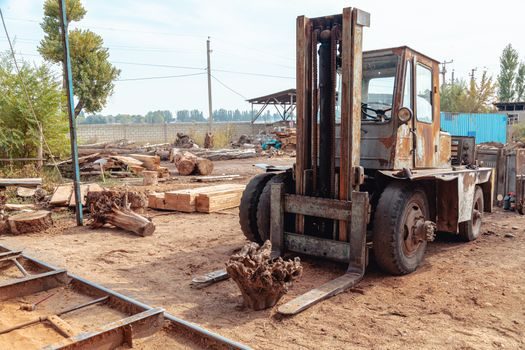
Mainstream sourcing for the standard forklift class runs through Chinese OEM/ODM factories offering 1.5–4 t electric, diesel, LPG/gasoline, and rough-terrain variants, with sample service available and 10,000 unit/year supply ability published by at least one Hebei-based supplier [S2][S6]. Rough-terrain-only specialists such as Harlo (US) and JCB (UK) hold the upper end of the off-road segment, while Hangcha (China) covers the 1.5–10 t XF band and the high-voltage XH band [S3][S4][S5].
For a complete indoor fleet, the pallet jack types, spec ranges, and 2026 application map is a natural complement, since pallet jacks handle the low-capacity end that forklifts feed. For yard-to-truck handling on rough ground, the crawler crane vs stacker crane selection map covers a different but adjacent problem set worth cross-referencing when lift height exceeds 7 m.
Track two signals before the next spec cycle: Hangcha's XH high-voltage line — confirming whether 1.5–3.5 t electric rough-terrain units are reaching EU/North American sites, and OEM list-price movements on 5–10 t XF-class machines, since that 5–10 t band is where the standard indoor forklift can never compete and the rough-terrain class is consolidating capacity [S4].
Spec-level background on the components involved: pressure transmitter.