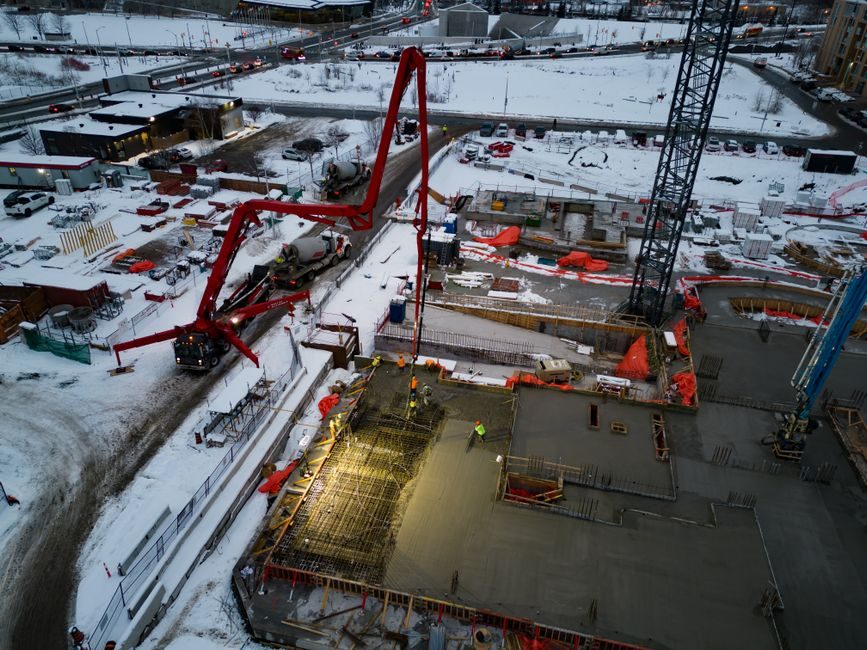
On a 50-tonne class lift, the turning-radius gap between a truck-mounted crane and a crawler crane is roughly 2-3x, with the truck crane needing about 9-13 m of swept width to execute a 90-degree turn and a crawler crane pivoting inside a 4.5-6 m track footprint, a fact grounded in the chassis geometry of each machine class [S1][S3].
Both machine families show up on industrial B2B catalogues as lifting-class equipment, with truck-mounted models such as the HIAB iX.188 HIDUO series listed as hydraulic loader cranes in the 18 t.m class and crawler-mounted lattice-boom units built in Henan shipping as full OEM/ODM configurations [S1][S4]. The single biggest selection lever for a yard, refinery, or tower-job site is the swept turning envelope relative to the obstruction geometry on site, not raw lifting capacity.
Definition and Scope: Two Crane Classes, Two Steering Logics
A truck-mounted crane (also called a lorry crane or truck crane) is a hydraulic loader crane or boom crane bolted to a rubber-tyred commercial truck chassis, with the carrier's steering axle and wheelbase defining the travel envelope [S5]. Carrier wheelbases for mid-capacity units typically sit between 3.8 m and 5.2 m, and overall lengths run 8-11 m, which is what drives the 9-13 m outer turning radius at 90 degrees [S1][S3].
A crawler crane rides on a pair of steel or rubber-track undercarriages whose ground contact length is the dominant dimension; the upper works slews independently of the tracks, and the machine turns by counter-rotating the tracks in place. Track lengths for 50-80 t lifting-class crawlers run 4.5-6 m, with track gauge between 3.2 m and 4.5 m, so the in-place pivot footprint is essentially the rectangle of the tracks [S4].
Selection Criteria: The 5 Gates That Drive the Decision
Five engineering gates separate the two classes on a real site: minimum swept turning radius, ground bearing pressure, setup/outrigger footprint, travel-to-site mobilisation cost, and required lift height at radius. Of these, turning radius is the one gate where crawlers and truck cranes diverge most dramatically and where the wrong pick adds days to the programme. [S1]
On turning radius specifically, a truck-mounted crane with an 8 m carrier length and a 2.55 m rear-axle-to-outrigger-tip dimension needs 9-13 m of width to clear a 90-degree turn with the upper works at any boom angle, while a 50-tonne crawler pivots on its own 4.5-6 m track length and can position inside a 6 m envelope [S1][S3][S4].
Ground bearing pressure is the second-largest delta: truck-mounted units concentrate 8-12 t per axle on the steer and drive tyres (roughly 600-800 kPa contact pressure on a paved yard), while a 50 t class crawler spreads load across the tracks at about 80-120 kPa, an order of magnitude lower, which is why crawlers get specified on soft pad-foots and mud-mat yards where outrigger pads would punch through. Mobilisation cost is the third gate: a truck-mounted unit drives to site at 70-90 km/h under its own power, while a crawler is normally low-boyed on a 3-4-axle trailer at 4-5 km/h escort speed, adding transport cost per kilometre but zero travel permits in most jurisdictions.
Who It Is FOR vs Who It Is NOT For
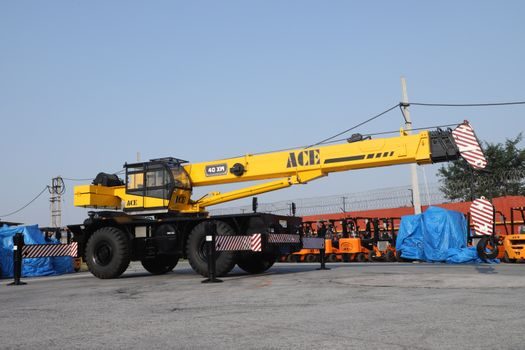
Truck-mounted cranes are the right pick for operations that move the crane between many job sites in a single shift, work on sealed pavement or hardstand, and need the unit on site inside 30 minutes of arrival. They are the wrong pick for inside-building lifts, pad-foot work in soft ground, and any site where the gate width drops below 10 m, because the carrier envelope simply will not make the turn [S1][S3].
Crawler cranes are the right pick for refinery turnarounds, wind-farm erection, bridge beam setting, and any site where the unit is rigged once and lifts 50-300 times in the same footprint, especially when ground pressure rules out outriggers. They are the wrong pick for road-to-road relocations under their own power or for any operator without low-boy tractor access, because mobilisation cost can exceed the daily hire rate on a single move [S4].
Criteria-Based Comparison: Truck-Mounted vs Crawler on 4 Decision Axes
Lining the two classes up against the four decision axes a buyer cares about: turning radius, ground pressure, mobilisation time, and per-shift cost. On turning radius a crawler scores 4.5-6 m against the truck crane's 9-13 m, a roughly 2-3x advantage for tight sites. On ground pressure the crawler sits at 80-120 kPa versus 600-800 kPa for the truck crane on paved ground, a 6-10x advantage on soft subgrade. On mobilisation time the truck crane drives itself at highway speed while the crawler needs a 3-4-axle lowboy, putting the truck crane ahead by 4-8 hours per leg of the move. On per-shift cost, truck-mounted units in the 18-30 t.m lifting class list at the lower daily rate band, with compact units such as the 1,100 lb 360-swivel class advertised at the bottom of the small-tier market and full-size lorry cranes shipping in the mid-tier OEM band [S2][S3].
The shape of this comparison is what makes the answer decision-binary on tight sites: a crawler wins three of four axes when ground is soft and turning room is short, while a truck crane wins three of four axes when the site is paved and the schedule is multi-drop. Hydraulically the truck-mounted class is dominated by knuckle-boom loader cranes in the 1-30 t.m bracket such as the HIAB iX.188 HIDUO, with telescopic boom truck cranes taking over from 30 t.m upward, and crawlers moving from telescopic to lattice boom above 80 t class [S1][S4].
Real Use Cases and a Sourcing Note

On a 2025-2026 commercial sourcing run, truck-mounted lorry cranes were listed at 1-10 t capacity on Henan OEM/ODM catalogues with MOQ 1 set and Shanghai FOB terms, indicating the truck crane supply chain is mature at the small and mid-capacity end and price-competitive [S3]. The same Henan factory list groups crawler cranes with truck cranes and hydraulic knuckle boom cranes under one Main Products banner, confirming that buyers in the Chinese OEM market treat both as configurable lifting packages rather than separate product lines [S4].
For yard planning, the rule of thumb is: if the narrowest gate the crane must pass is below 8 m, specify a crawler; if it is above 12 m and the ground is paved, a truck-mounted unit will mobilise faster and lift cheaper across multi-site routes. Operators building concrete-pour or rebar-handling workflows around lifting gear should also review the deformed rebar vs steel plate selection cut and the welded steel mesh price guide for the materials that typically feed the same site, since the crane choice and the reinforcement-handling choice are locked together by the same yard envelope and ground-bearing assumptions.
Limitations, Failure Modes and Sourcing Signals
Two failure modes to watch when sizing the turning envelope: first, a truck-mounted crane's published carrier turning radius is measured wall-to-wall at the steer axle, but the outrigger pads and rear stabilisers sweep 1.5-2.5 m wider than the axle track once deployed, so the true 90-degree operational envelope is the carrier radius plus outrigger spread, not the headline figure [S1]. Second, crawler cranes that are walked short distances on their own tracks leave track-plate damage on finished concrete and asphalt, which is why most owners specify a mat roadway or rubber-track pads above 50 m of self-propelled travel on sealed surfaces.
Sourcing signal: OEM/ODM crawler-crane factories in Henan list crawler, truck, knuckle boom, and telescopic boom cranes as the same Main Products family, with custom configuration across the lot, which gives a buyer one negotiation channel for both machine classes rather than two separate vendor pools [S4]. Track this Henan OEM segment through 2026 H2 for capacity changes, since small-tier truck crane MOQ and FOB terms are the leading indicator of mid-tier crawler pricing in the same supply chain [S3].
Closing note: the next verifiable node is the Q3 2026 OEM price list refresh from the Henan crawler-crane segment, which historically lands within 60-90 days of mid-year and resets both FOB terms and MOQ floors for the 1-10 t truck-mounted class in the same catalogue; readers sourcing both classes can treat that refresh as the single signal that locks the per-shift cost axis for the rest of 2026.
For component-level specifications, see truck mounted crane, truck mounted concrete pump, and crawler crane.