
Welded steel mesh factory-gate quotes in 2026 split into three main bands: hot-rolled carbon panels at roughly USD 0.30–0.80/kg, ribbed reinforcing sheets (3–22 mm wire diameter, 50–250 mm mesh opening) at USD 1.20–2.50/kg, and stainless welded panels at USD 2.00–4.50/kg, with minimum order quantity listed as "Negotiable" on most China-origin export offers [S1][S3].
The spread is driven almost entirely by wire chemistry, panel format, and surface finish rather than by welding cost itself; a single CO₂ resistance-weld pass on a 4 mm wire costs almost nothing in kilowatt-hours compared to the steel that flows through it. Buyers comparing apples-to-apples on the same drawing will still see a 3–6× spread across vendors because of how those three levers stack, and that spread is exactly what this guide maps out.
Three Price Tiers and What They Buy You
Entry-tier hot-rolled carbon welded panels, 1000–12000 mm long × 1500–3600 mm wide [S3], typically run USD 0.30–0.55/kg and are what 80% of construction-grade buyers actually receive when a "welded mesh" line item lands on a quote. Wire diameter 3–6 mm, mesh opening 50×50 to 200×200 mm, and a mill scale finish that disappears the day a trowel hits it [S1]. The mill-issued mark on these panels is usually "GB" plus the project reference [S3].
Mid-tier ribbed reinforcing mesh (cold-rolled ribbed steel wire) sits in the USD 1.20–2.50/kg band and is the spec engineers reach for when crack-width control matters: bridge decks, slab-on-grade, shotcrete linings, ferrocement tanks [S3][S6]. Wire diameter climbs to 8–12 mm, mesh tightens to 100–250 mm, and the rib profile adds bond to the cement matrix [S3]. For weight-based pricing, a 6 m × 2.4 m panel at 8 mm wire 150×150 mm weighs about 19.9 kg, so a USD 1.50/kg quote lands near USD 30 per panel before crating.
Stainless welded panels (304 / 316 grades) carry the third band, USD 2.00–4.50/kg, because the alloy surcharge — not the welding — dominates the cost stack. Common builds go into food-grade trolleys, architectural grilles, gabion-style cages, and process-facility screening where neutral leachates rule out carbon [S2]. The same vendor pool also quotes plastic-coated welded mesh, which effectively layers a PVC skin over the carbon substrate and prints in the lower-mid band at USD 0.90–1.60/kg [S5].
Selection Criteria That Move the Quote More Than Steel Itself
Wire diameter and panel format dominate the cost equation. For ribbed sheets the spread is wider: a 12 mm × 100×100 mm panel weighs about 17.8 kg/m² and pushes the per-square-metre figure well past 3× a 6 mm sheet of identical layout [S3].
Aperture is the second lever. Engineers running slab reinforcement to GB spec are bound by minimum wire and maximum spacing clauses; the cost spread inside that envelope is the negotiation surface, not the spec itself [S3].
Surface finish quietly shifts tier. Hot-dip galvanizing after weld typically adds USD 0.25–0.45/kg to a carbon mesh quote; PVC coating adds USD 0.40–0.70/kg including the polymer skin and the pre-coat surface prep [S5]. Stainless upgrades — 304 vs 316 — move the quote by roughly 25–45% on the raw panel, and the gap widens when the order drops below MOQ because the alloy surcharge is paid on the full melt, not the partial bundle [S2].
Who Welded Mesh Is For — and Who Should Walk Past

Welded mesh is the right pick when the panel is flat, the wire is under 12 mm, and the count is above 200 m² per release — concrete slab and wall reinforcement, fence panels, machine guards, cage frames, gabion infill, and the pedestrian-side of architectural screens [S1][S2][S4]. At those volumes and geometries, resistance welding is faster and cheaper than weaving, and the rigidity gain from the fused joint is the whole point.
It is the wrong pick for vibrating screens, fine filtration under 2 mm aperture, or any panel that must flex repeatedly: weld zones fatigue under cyclic load, and a crimped or woven stainless steel crimped wire mesh panel outperforms welded in those duty cycles, including acid/alkali screening and oil-industry mud filtration. It is also the wrong pick for very light gauge (under 1.5 mm wire) at tight aperture, where welding burn-through makes yield unacceptable; that is the welded steel mesh selection gate engineers trip most often when substituting a woven spec for a welded one.
Criteria-Based Comparison of the Main Types
On a USD/kg basis against four decision criteria — minimum order flexibility, corrosion resistance, structural use, and lead time — the three main welded mesh types split cleanly. Hot-rolled carbon (USD 0.30–0.80/kg) wins on MOQ flexibility and lead time (stock panels ship in 7–10 days from most China mills) but loses on corrosion resistance and structural duty beyond light slab work. Ribbed reinforcing sheet (USD 1.20–2.50/kg) carries the highest structural load rating per kg because of the rib bond, takes 10–20 days, and is the default for shotcrete and ferrocement work [S3][S6]. Stainless welded (USD 2.00–4.50/kg) leads on corrosion and food-grade compliance but trails on MOQ and lead time, with 25–40 day mill runs common [S2].
Plastic-coated welded mesh, structurally a carbon panel with a PVC skin, lands between the carbon and stainless bands on price (USD 0.90–1.60/kg) and between them on every other axis: it is the workhorse of perimeter fencing and cage builds where galvanizing is overkill but bare mill scale is not acceptable [S5]. The same factory cluster also supplies welded bar grating and expanded metal grating, which are a different product class — pressed, not welded — and quoted per square metre on a different basis, typically USD 8–25/m² for load-bearing grating [S4].
Standards, Sourcing Channels and Lead Time
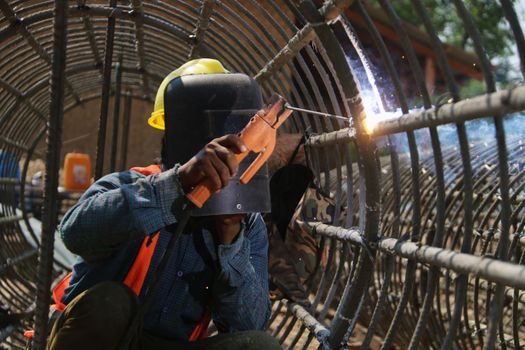
Three standards show up on the majority of 2026 export paperwork: GB/T 1499.3 for steel for the reinforcement of concrete — welded fabric (the Chinese national standard that aligns with ISO 6935-3 on the dimensional and weld-shear clauses), ASTM A1064 for carbon-steel wire and welded wire reinforcement, and BS 4483 for the UK-spec reinforcing mesh that crosses into Middle East and African projects.
For ribbed reinforcing sheets, the factory-direct channel is dominant because trading houses rarely stock 8–12 mm wire gauges; for stainless and PVC-coated mesh, stockists carry the standard 50×50 and 100×100 mm aperture panels and ship in 3–5 days [S2][S5].
Logistics from North China ports to North America adds roughly USD 0.08–0.14/kg on a 20-ft container; to West Africa and the Mediterranean, USD 0.10–0.18/kg; to Southeast Asia, USD 0.04–0.08/kg. Those figures sit on top of FOB quotes and should be added before comparing offers that quote CIF against offers that quote FOB. A welded steel mesh 2026 buying guide walk-through on format, finish, and documentation helps separate mill spec from project spec, and the related welded steel mesh vs prestressing strand spec frame is the right cross-check when a tender is floating between passive reinforcement and active.
Limitations, Failure Modes and Common Substitution Traps
Weld-zone fatigue is the first failure mode engineers underweight. Resistance-welded intersections do not flex: under cyclic loading — vibrating screens, rail-slab dynamic zones, conveyor deck panels exposed to start-stop cycles — the weld point is the crack initiation site and the panel fails before the wire does. Substitution of welded mesh for woven or crimped mesh in those duty cycles is the most common spec error, and the steel mesh encyclopedia entry is the cleanest place to start when sorting which geometry matches which duty cycle. [S1]
Coating damage at the weld is the second. Hot-dip galvanizing after welding is standard, but the weld nugget has a different silicon content than the parent wire and shows a darker, sometimes rougher, zinc film — visible on architectural panels and a real rejection trigger on food-grade jobs. For 304/316 stainless, weld discoloration must be removed by pickling and passivation, and a mill quote that does not list that step is quoting raw weld mesh, not finished mesh [S2].
The third trap is mesh aperture tolerance creep on wide-format panels. The 1500–3600 mm width band [S3] introduces measurable bow on 4 m sheets after welding; a panel that ships at 200×200 mm nominal can arrive at 198×204 mm in the middle, which is within GB tolerance but outside the tolerance of some Western rebar-cover calculations. Buyers running tight cover should spec panel width below 2400 mm or move to two narrower sheets spliced on site.
Trackable signals for the next 60–90 days: alloy surcharge trends on 304/316 (LME nickel), and the Q3 export duty position on Chinese steel-mesh HS code 7314.20 (woven) and 7314.30 (welded), which the Eurasian Economic Commission review window closes inside 2026-Q3. Both move the USD/kg bands quoted above by single-digit percentages before year-end.