
Hot-rolled deformed rebar is a ribbed bar (HRB335/HRB400/HRB500, diameters 6-40 mm) used to carry tensile load in reinforced concrete; mild steel plate is flat-rolled stock (typically 1.5-100+ mm thick) used in fabrication, liners, and welded assemblies [S1][S3].
The two products share an iron-and-carbon base but diverge sharply on geometry, mechanical profile, and intended load path. A rebar's transverse ribs and grade-stamped yield strength (335-500 MPa) target bond with concrete; a plate's flat gauge targets bending, welding, and impact service [S1][S3]. Specifying one in place of the other is a structural error: a bar embedded in concrete is not a substitute for plate stiffness, and a plate is not a substitute for ribbed bond.
What Each Product Actually Is and Where It Goes
Deformed rebar is hot-rolled round bar with transverse ribs that mechanically interlock with cured concrete. Standard lengths run 6-12 m and standard diameters from 6 mm up to 40 mm; the diameter ladder includes 6, 8, 10, 12, 14, 16, 18, 20, 25, 32, 36, 40 mm [S1][S3]. Standard designations split by region: GB/T 1449 series in China (HRB335, HRB400, HRB500), BS 4449 in the UK (B500A/B/C, G460B), and ASTM A615 in the US (GR40, GR60) [S1]. Plate, by contrast, is a flat-rolled product graded by thickness, width, and grade (e.g. ASTM A36, A516, A572) and is supplied as rectangular sheet or cut plate, not as discrete reinforcing bars. The two are complementary, not interchangeable: rebar lives inside the concrete; plate lives outside it as flange, web, base, or liner. For background on rebar as a category, see the rebar encyclopedia entry.
Geometry, Mechanical Profile, and Bond Behaviour
Rebar's defining mechanical feature is its rib pattern, which produces mechanical bond with concrete in addition to chemical adhesion. This is why the deformed-bar designation is the industry default for structural concrete: plain round bar without ribs is permitted only for stirrups and ties in many codes because smooth bar slips under load. The yield-strength ladder 335-500 MPa in the HRB series is engineered to give 1.15-1.25x safety margin over the concrete's characteristic compressive strength in beam design [S1]. Plate has no ribs and no bond mechanism: its mechanical profile is governed by thickness, width, and grade (yield 235-690 MPa for common carbon and low-alloy grades), with no rib-controlled bond capacity. A 10 mm plate is roughly 2.5x heavier per metre of length than a 16 mm rebar of the same length, but its moment of inertia scales with thickness squared, not diameter cubed - so the structural role is fundamentally different.
Selection Criteria: When You Pick Rebar and When You Pick Plate
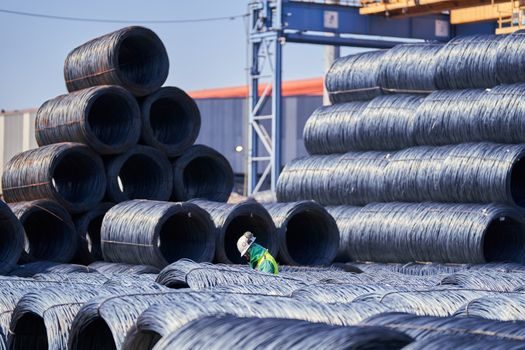
Pick deformed rebar when (1) tensile load must be transferred to surrounding concrete through mechanical bond, (2) the section is cast-in-place or precast, and (3) the design calls for distributed reinforcement (slabs, beams, columns, walls, foundations). Pick steel plate when (1) the load path is in-plane shear, bending, or bearing, (2) the structure is welded, bolted, or fabricated (gusset, base, flange, web, liner, tank shell, hopper), and (3) the section is exposed rather than embedded. Two material tests that drive the choice: tensile test (yield, ultimate, elongation) and bend test (180° mandrel, no cracking). Both are mandatory in rebar specifications because the bend test simulates rebar's ability to be field-bent without fracture [S1]. For plate, impact test (Charpy at -20 °C or -46 °C) and through-thickness Z-direction ductility often matter more because plate sees welded restraint stresses that rebar never sees.
Side-by-Side Comparison on the Four Decision Criteria
Lining the two products up against procurement and design criteria exposes the decision boundary: (1) Form: rebar is round with ribs, 6-40 mm diameter, 6-12 m length; plate is flat rectangular, 1.5-100+ mm thick, coil or sheet. (2) Grade: rebar uses HRB335/HRB400/HRB500 or B500B/GR40/GR60 grade stamped on the bar; plate uses ASTM/EN/JIS structural grades (A36, A516 Gr.70, A572 Gr.50, S355JR) certified per heat. (3) Length and supply: rebar is mill-cut to 6-12 m and bundled (typical MOQ 500 tonnes, monthly supply 5,000 tonnes per the dealer listing [S2]); plate is supplied as mill coil, cut-to-length plate, or quarto plate in tonnages driven by the order, not the mill standard cut. (4) Test regime: rebar requires tensile + 180° bend + rib-geometry verification; plate typically requires tensile + Charpy + ultrasonic on thicker gauges. If the load path needs bond, you must pick rebar; if the load path needs section modulus, you must pick plate. For tooling that prepares rebar on site, see the rebar cutter and rebar bender reference pages, and where bar-to-bar splicing is required the rebar coupler page covers mechanical and threaded options.
Real Use Cases: Slab, Beam, Tank, Hopper, Bridge Plate

Concrete slab on grade: a 150 mm slab is reinforced with HRB400 deformed bars at 12-16 mm diameter on a 150-200 mm grid, top and bottom, with chairs holding the bottom mat off the sub-base. Beam-column joint: HRB500 25-32 mm longitudinal bars through the joint, HRB400 10-12 mm stirrups at 100-150 mm centres for shear. Plate in the same structure: column base plate 20-40 mm thick, beam end-plate 12-25 mm thick, gusset plates 8-16 mm thick. Tank and silo: shell courses are rolled plate (A36 or A516 Gr.70) welded vertically, with stiffener rings and a rebar-reinforced ring beam foundation. Bridge: orthotropic deck plate 12-18 mm thick with U-rib stiffeners; rebar in the concrete deck slab 16-25 mm at 100-150 mm centres. Each product is doing what it is engineered to do: plate carrying wheel loads in bending, rebar distributing tensile and shrinkage stresses through the deck slab. [S1]
Limits, Failure Modes, and What Goes Wrong on Site
Rebar failure modes are well documented: (1) rib roll-over from poor rolling practice, (2) surface scale breaking the chemical bond until concrete cures, (3) bend test failure at 180° indicating excessive hardness or segregation, (4) yield-strength shortfall below grade stamping (typically caught by sample testing). Plate failure modes are different: (1) lamellar tearing in thick plates under restrained weld shrinkage, mitigated by Z-direction (through-thickness) ductility specification; (2) Charpy shortfall at low temperature in cold-service tanks, mitigated by fine-grain practice and impact-tested heats; (3) out-of-flatness on cut plate causing fit-up gaps; (4) mill scale and rust at delivery delaying paint or galvanising schedules. A rebar failure is almost always a structural problem in the finished concrete; a plate failure is almost always a fabrication or in-service problem in the steel. Treating plate like rebar (no bond, no distribution function) or rebar like plate (no section modulus, no compressive column function without ties) is a design error that field crews can detect only at the cost of pulling and re-pouring concrete or scrapping plate. [S2]
Standards, Sourcing Signals, and What to Verify on the Mill Test Certificate

Standards that govern each product are distinct: rebar is produced to GB/T 1449 (HRB series), BS 4449 (B500A/B/C, G460B), ASTM A615 (GR40/GR60), or ISO 6935-2 depending on jurisdiction; plate is produced to ASTM A36, A516, A572, A588, A633, EN 10025 (S235/S275/S355/S460), JIS G3101, or GB/T 700 / GB/T 1591 [S1][S3]. On a mill test certificate (MTC), the rebar entry will show heat number, grade, diameter, rib geometry, yield, ultimate, elongation, and bend test result; the plate MTC will show heat number, grade, thickness, yield, ultimate, elongation, Charpy (if specified), and ultrasonic test result. Two signals a procurement engineer can track right now: (1) minimum order quantity for export deformed bar is typically 500 tonnes with monthly supply capability of 5,000 tonnes from a Tianjin-based trading desk [S2], and (2) standard supply range covers 6-38 mm diameter with 6-12 m length, with grade options HRB335, HRB400, Q195/Q215/Q235B for general construction or export [S3]. For project context where rebar is one of several concrete-trades decisions, see the concrete fiber vs ready-mix concrete comparison and the concrete curing compound buying guide for the next two trade interfaces in the same pour.
Track these two signals next: (1) confirm rib-geometry tolerance per the GB or ASTM revision your project specifies before signing the PO - this is the field that catches counterfeit or sub-grade bar; (2) verify Charpy and ultrasonic test reports on plate when the structure is welded, cold-service, or thicker than 25 mm - these are the fields that catch the plate failures listed above. A steel plate purchase is incomplete without the test regime that matches the service environment.