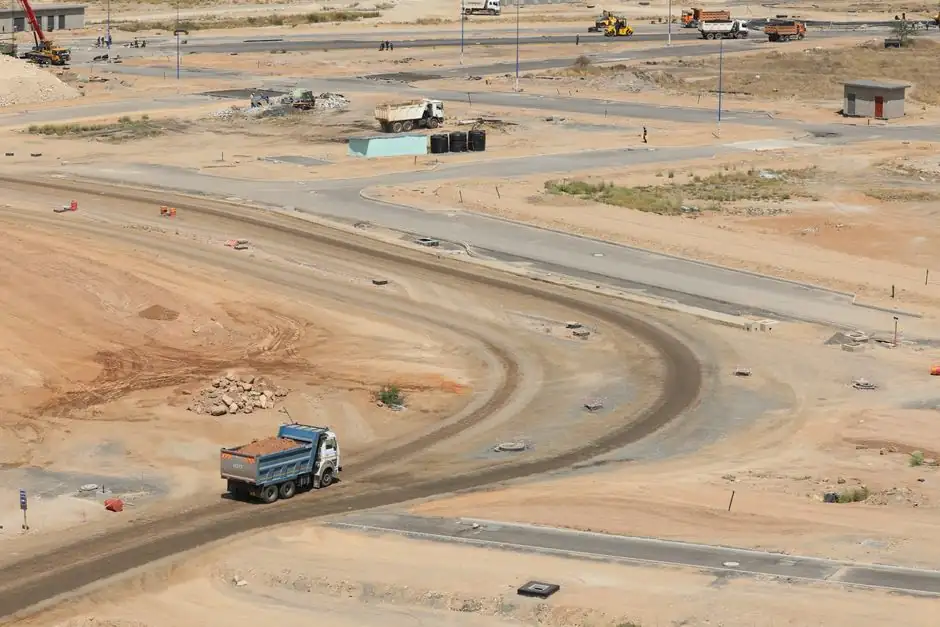
For intermittent hauling below roughly 15 tonnes, a crawler dumper usually performs better on soft or uneven ground because its tracks spread vehicle weight over a broader contact area and reduce sinkage [S4].
The decision depends on payload, access width, turning space, ground pressure, discharge position, and haul distance, rather than crawler tracks alone; compact site dumpers commonly fall within a 1–15 tonne loading range and may fit within 4 m of length [S4].
Decision Criteria: Ground, Access and Payload
A crawler dumper is the stronger choice for mud, soft soil, uneven ground, and restricted work areas where a wheeled machine may bog down or cannot maneuver. Track contact distributes weight more evenly than wheels, reducing ground pressure and the likelihood of sinking into mud, sand, or other soft terrain [S1][S2].
A small dump truck is preferable where the route is paved or hard-packed, the load exceeds approximately 15 tonnes, or bulk movement over a longer distance dominates the cycle. Truck bodies can provide substantially greater volume, reduce the number of trips, and are better suited to open-site bulk hauling; some dump trucks exceed 10 m in length and require wide access, strong roads, and ample turning radius [S4].
Crawler Dumper Mechanics and Operating Limits
Crawler dumpers use continuous tracks instead of road wheels, and most compact models combine a crawler chassis with a hydraulically tipped hopper or cargo body. They are intended for short-distance material movement within construction sites, farms, landscaping projects, and other off-road environments [S1].
Tracks do not make every operation suitable. Payload, hopper volume, material density, travel width, dumping direction, discharge height, and slope conditions all determine whether the machine can enter the work area, unload where required, and remain stable when loaded [S1]. A crawler dumper therefore should not be selected solely by its rated payload.
Its discharge method also matters. Standard forward tipping suits a clear dumping direction, while a rotating or swivel body permits more accurate placement without repeatedly repositioning the machine. A high-dump configuration is the relevant option where elevated placement is required [S1][S2].
Small Dump Truck: Speed and Bulk Capacity

A small dump truck is the rational choice on firm, continuous routes where the machine can maintain road speed, carry more per pass, and unload into a conventional bulk handling point. Compact dumpers typically carry 1–15 tonnes, while dump trucks use larger bodies and payloads to move greater volumes of loose material in fewer trips [S4].
The truck advantage is operational rather than absolute. One source describes dump trucks as better for movement along a freeway or highway, while dumpers perform better in off-road material movement [S6]. On a confined soft-ground site, however, road speed has little value if the truck cannot reach the excavation, turn at the stockpile, or discharge without ground failure.
Use a small dump truck when the route is hard, the loading area has room for its turning radius, and the operator must move substantial tonnage per cycle. Use a crawler dumper when access is narrow, reversing distance is constrained, or the material must be placed close to the excavation or stockpile [S1][S4].
Site Access, Surface Pressure and Productivity
Ground pressure should be calculated from machine mass and the actual contact area, not inferred from the word crawler. Continuous tracks provide broader contact and reduce sinkage on mud and sand, but deep mud can still overload the undercarriage, and soft ground can reduce tractive performance [S1][S2].
Width and layout must be checked before rental or purchase. Relevant constraints include the narrowest access gate, wall or trench clearance, machine width, turning space, reversing distance, hopper discharge height, and the dumping direction required at the stockpile. Compact dumpers are often under 4 m long, while large dump trucks can exceed 10 m and require substantially more room [S4].
Productivity depends on cycle time, not only speed. Divide usable haul distance by loaded travel speed, add loading, queuing, dumping, and return time, then multiply by a realistic payload. A truck may complete the route faster but lose time at access points; a crawler dumper may travel slower yet complete more cycles because it reaches the face and positions the load accurately [S1][S4].
Which Machine Fits Each Work Pattern
Crawler dumpers are commonly used in construction and renovation, landscaping, agriculture and orchards, utility and drainage work, and municipal maintenance, including where mud, soft soil, uneven ground, grass and landscaped ground, or snow and cold ground are concerns [S1][S2]. It also suits confined sites where a truck cannot turn or where the ground cannot tolerate concentrated wheel loads [S2].
A small dump truck does not fit soft, churned ground where flotation is poor, narrow access with a rigid turning envelope, or intermittent low-tonnage work that could be handled more economically by a compact machine. A crawler dumper is also a poor substitute for high-volume bulk removal when the required fleet size becomes excessive [S3][S4].
For articulated site dumpers, large tyres provide additional ground clearance, while articulation allows the tractor and trailer sections to flex independently and produces a tighter turning circle. Those features can outperform rigid wheel-based dumpers on uneven ground, but they do not reproduce the continuous contact area of tracks [S5].
Procurement and Safety Checks
ISO 20474-6:2017 covers safety requirements for wheeled and crawler dumpers, including compact machines with seated or standing operators [S1]. Before accepting a machine, verify rated payload in tonnes, hopper volume in cubic metres, material density, travel width, turning radius, discharge height, and the manufacturer’s slope limitations.
Check the undercarriage, track tension, final drives, hydraulics, hopper pins, and discharge system before each operating shift. Terrain, payload, and slope conditions must be assessed together because a machine rated for a nominal capacity can still be unsafe or unproductive when fully loaded on a cross-slope [S1].
For a wet site, specify the machine for the expected ground condition and measure access before delivery. If the crawler dumper must pass approximately 15 tonnes or travel mainly on roads, evaluate a small dump truck instead; if continuous off-road travel, low bearing pressure, and confined dumping locations dominate, specify the crawler dumper [S2][S4].
Trackable procurement signals are the measured payload per pass, cycle time from face to discharge point, sinkage depth after a loaded pass, and required access width. These four measurements expose whether the selected machine matches the real ground and haul cycle.