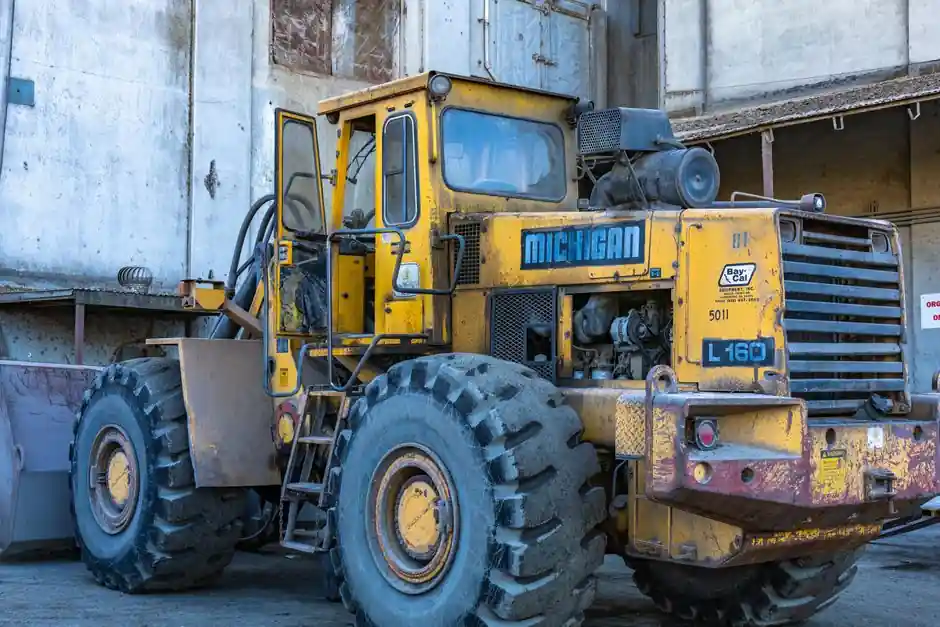
Crawler excavators trade speed for traction and stability, with 3–6 km/h travel speed and 4–6 psi ground pressure versus 25–40 km/h for wheeled excavators [S2].
Choose crawlers for soft ground, slopes, quarries and heavy digging; choose wheeled undercarriages for paved urban work, frequent relocation and reduced surface damage [S1][S2][S3].
Compare the Two Undercarriage Architectures
A crawler excavator carries the boom, arm, bucket and cab above a continuous steel or rubber track frame wrapping rollers, idlers and sprockets. A wheeled excavator uses a rubber-tyred chassis, commonly with four wheels, while retaining broadly comparable upper works, hydraulic functions and attachment interfaces [S1].
Tracks distribute load over a longer contact area than four tyre patches, reducing ground pressure and improving flotation on mud, sand and clay. Steel tracks provide a longer contact area and lower ground pressure than tyre patches, while rubber-tyred wheeled excavators can travel at higher speeds without a low-boy trailer [S1][S2]. The comparison is therefore not about excavation motion alone, but about how the machine reaches the work, supports the upper structure and interacts with finished surfaces [S1].
The practical decision matrix is clear: crawlers lead on traction, slope stability, flotation and hard-rock durability; wheeled machines lead on travel speed, pavement protection and redeployment time; wheeled machines generally carry lower replacement exposure for tyres than crawlers carry for tracks, rollers and idlers [S2][S3][S4].
Select by Ground Conditions and Workload
Crawler undercarriages are the defensible choice where bearing capacity is low, the surface is broken or wet, or the machine must work on a slope.
Quarries reinforce that case because the work combines uneven rock, abrasive debris, heavy attachment loads and repeated travel between excavation faces.
Wheeled excavators are better suited to asphalt, concrete, compacted hardstand and paved internal haul roads. A wheeled excavator can travel at speeds of up to 30 km/h and move directly between nearby work fronts or jobs without trailer loading, unloading and return transport [S2][S4]. Rubber tyres also reduce the risk of cutting finished pavement, subject to the machine mass and tyre pressure.
Match Undercarriage to Construction Machine Type
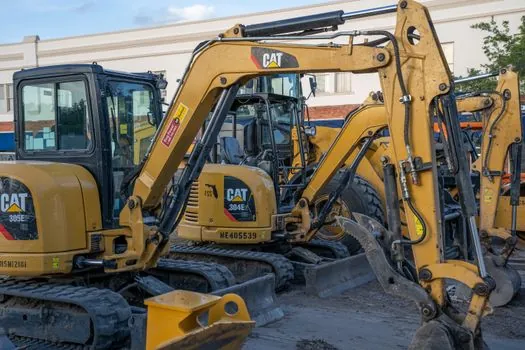
Excavators show the clearest split: use a crawler crane-style tracked base for deep excavation, foundations, rough terrain and heavy breakout, but use wheeled excavators for utility trenches, roadside maintenance and compact urban sites [S1][S2][S4].
For aerial work platforms, the governing issue is a stable, continuously supported base rather than earthmoving traction. Tracked platforms suit uneven or soft ground, while self-propelled wheeled platforms suit paved yards where lift-and-drive repositioning is required [S6]. The same distinction appears in aerial work platform procurement, where mobility, support footprint and surface access must be evaluated together.
For forklifts, wheel count, tyre construction and load stability govern the decision: solid tyres tolerate debris and abrasion, pneumatic tyres provide better ride compliance, and large pneumatic tyres improve traction on loose ground. A crawler undercarriage is not a general substitute for a forklift because the operating envelope, lifting geometry and industrial standards differ.
For tank-cleaning machines, access, containment and washdown exposure matter more than raw travel speed. Tracked units can cross soft ground and maintain low ground pressure, while wheeled units can move faster between paved process areas. Both require verification of the machine's working-at-height or confined-entry support arrangement before selection.
Control Stability, Transport and Operating Cost
Specify working-load limits, stabilizer deployment, lift geometry and permitted ground slope rather than relying on a general stability claim.
Crawlers usually need a low-boy trailer for road transport, adding loading, securing and permit requirements for relocation. Wheeled excavators can drive directly to many job sites, while crawler excavators provide a longer ground-contact area and lower ground pressure than wheeled machines [S1][S2]. The transport saving therefore applies to paved routes, not soft-ground access.
A quarry contractor should compare track-chain, roller, idler and sprocket replacement intervals against tyre replacement and repair exposure rather than assuming one undercarriage is universally cheaper.
Apply a Weighted Procurement Test
Score the undercarriage against four measured variables: travel speed, ground pressure, surface damage and redeployment dependence. A contractor requiring road movement of up to 30 km/h, operation on paved surfaces and frequent changes of site will place the greatest weight on wheeled travel, while a contractor working on loose, wet or uneven ground will prioritize crawler traction [S2][S4].
Include the actual duty cycle: percentage of time travelling, maximum slope, soil bearing capacity, surface type, attachment energy, lifting load, working radius and transport route. Do not mix a wheeled excavator's road-speed advantage with a crawler's off-road productivity advantage and treat them as equivalent products. The upper structure can be similar while productivity and cost per productive hour differ substantially [S1].
For mixed fleets, assign each machine a defined operating domain. A wheeled excavator can cover municipal utilities, roadside work and paved yards, while a crawler handles foundations, canals, quarry faces, forestry and soft-soil excavation. This allocation matches the undercarriage's design strengths and reduces the risk of buying one configuration for incompatible duties [S1][S3][S4].
Source and Validate Machine-Specific Data
The cited comparison values are selection ranges, not universal ratings: crawler travel is listed at 3–6 km/h, wheeled travel at 25–40 km/h, crawler ground pressure at 4–6 psi and wheeled ground pressure at 30–50 psi [S2]. A published example gives the SANY SY155W a maximum road speed of 37 km/h, demonstrating that model specifications govern where they are available [S1].
Request the OEM data sheet for the exact model, working weight, bucket, counterweight, tyres or track shoes, ground pressure, travel speed, gradeability, minimum turning radius, working ranges, lifting charts and undercarriage wear limits. Confirm whether stabilizers are required for rated loads and whether the machine is approved for the intended surface. For fleet comparison, the dedicated wheeled versus crawler travel-speed analysis provides a useful second screen before model review.
The first procurement action should be a documented duty-cycle table for one representative crawler and one representative wheeled machine, populated with OEM figures and contractor travel distances. A selection becomes defensible when the higher purchase price, if any, is reconciled with measured transport hours, surface-repair cost, utilization and undercarriage wear exposure.