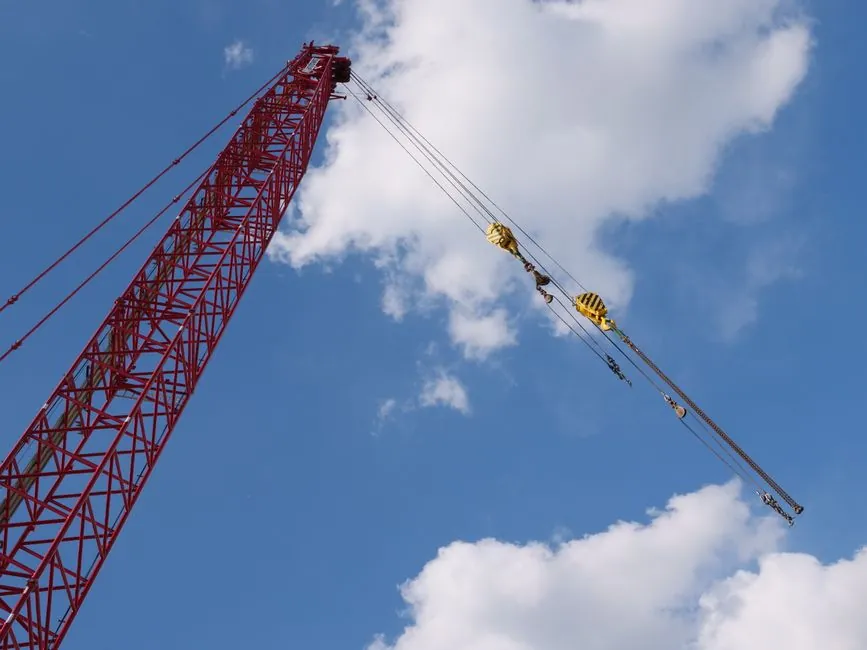
Use a crawler crane when the priority is a ground-level lift approaching 2,535 t, tracked access, or sustained operation on soft or rough ground [S1].
Use a tower crane when the work extends vertically through a high-rise project, requires repeated slewing and trolley movements, and can support a fixed installation for the construction duration [S1][S7].
Core Selection Variables
Crawler and tower cranes are selected against four linked variables: lifted load, working radius or height, ground condition, and job duration. A crawler crane spreads its weight over tracks and can transport itself across uneven ground, but it must be dismantled and hauled to the site; a tower crane is erected at a fixed base and moves the trolley and hook along a rotating jib [S1][S2].
Capacity figures must be treated as model-specific rather than generic. Maxim Crane's published fleet comparison lists tower cranes from 6 to 60 t and crawler cranes from 30 to 2,535 t, but actual performance changes with make, model, boom or jib configuration, rigging, radius, and attachments [S1]. The correct first check is the manufacturer's load chart for the proposed configuration, not the broadest capacity claim in a rental fleet.
For high-rise work, document the required hook height, maximum radius, largest load at each radius, number of lifts per shift, and planned operating duration. For ground-level heavy lifts, document gross load, rigging weight, minimum and maximum radius, pick-cycle duration, travel route, and bearing pressure imposed by the tracks or outriggers [S3][S5].
Tower Crane for High-Rise Work
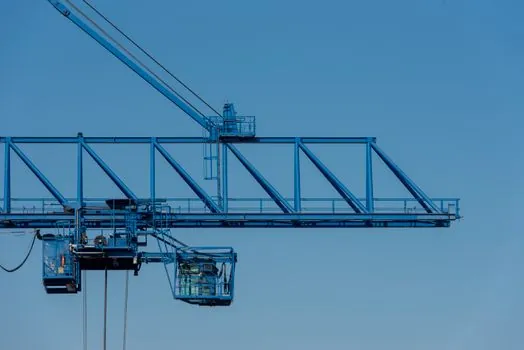
A tower crane combines a vertical mast with a horizontal jib that can rotate 360 degrees around the mast, while the trolley and hook travel along the jib [S2]. Its fixed geometry makes it suitable for repetitive vertical distribution of steel, concrete, façade components, and mechanical loads throughout a multi-storey construction programme.
Tower cranes suit long-duration urban projects because the equipment remains in one position and the work pattern follows a defined radius [S1][S4]. Static cranes stay fixed in one location during the project, while mobile cranes can move around the site or between different sites [S4].
Tower cranes are static cranes that stay fixed in one location and are commonly used for high-rise, long-duration urban construction projects [S1].
The tower crane is the right primary crane when construction repeatedly moves material upward and around one building, but it is a weak choice for an isolated low-level pick that must relocate several times within one shift.
Crawler Crane for Ground-Level Heavy Lifts
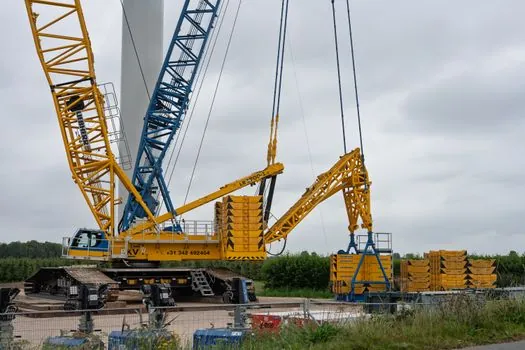
A crawler crane uses continuous tracks to distribute machine weight over a larger contact area than wheeled equipment, improving stability on uneven, muddy, or soft ground [S3]. Its published fleet range extends from 30 to 2,535 t, compared with 6 to 60 t for the cited tower-crane fleet [S1].
Crawler cranes are track-mounted machines that provide stability and mobility on rough, uneven, or muddy terrain [S3]. This configurational flexibility makes the crawler family suitable for power-plant equipment, industrial modules, transformers, structural steel, and other heavy objects placed near ground level.
The principal constraint is logistics: crawler cranes are tracked, transported disassembled, and are not highway-legal in the cited fleet comparison [S1]. Mobilization therefore includes disassembly, loadout, transport, travel, reassembly, and setup time. A crawler that has the required capacity is still a poor commercial choice if the route, crane pad, or assembly area cannot support that process.
The crawler crane is generally the stronger primary option for a single or intermittent heavy pick at ground level, particularly where ground pressure or uneven terrain rules out wheeled access.
Comparison by Decision Criterion
Against maximum cited fleet capacity, the crawler crane leads at 30–2,535 t against the tower crane's 6–60 t [S1]. Against vertical reach, the tower crane leads because its mast supports elevated hook heights and repeated jib-radius coverage, whereas crawler cranes have greater dependence on boom geometry [S2][S4].
Against site mobility, the crawler wins when tracked travel across soft or rough ground is required, but a tower crane cannot move to another pick point without dismantling [S1][S3]. Against duration and work-cycle fit, the tower crane wins for continuous high-rise material distribution, while the crawler crane wins for short-duration, high-capacity ground picks that can be dismantled after the lift [S5]. Against transport and setup, crawler cranes require special haulage and assembly, while tower cranes require site erection and a foundation; neither should be selected without including mobilization in the schedule.
Cost cannot be reduced to capacity alone. A lower-capacity tower crane with lower erection logistics can be more economical than an oversized crawler crane delivered to a remote site, while a single 2,000 t-class lift may justify a crawler despite heavy mobilization. The comparison must include rental duration, mobilization, assembly, engineered lift plan, rigging, ground preparation, operating labor, and schedule risk [S1][S5].
Ground, Weather, and Setup Constraints
Ground conditions can decide the selection before load charts are compared. Crawler tracks distribute weight over a larger area and can reduce sinking risk on soft or uneven surfaces, but ground-bearing capacity still requires verification; a crane that does not sink can still overturn if its setup geometry and loading are inadequate [S3][S5].
Tower cranes depend on a designed base, anchoring arrangement, and site coordination for erection, operation, and dismantling. Urban projects must also account for the crane's swept radius, adjacent structures, access routes, and the working area needed for mobile cranes used during installation [S2][S4].
Weather affects both options. Wind limits tower-crane operation and can restrict crawler-boom operation as well, while rain can reduce effective soil bearing capacity and make crawler travel or setup less predictable. Any planning document should carry the manufacturer's prohibited operating conditions, the lift plan, crane setup drawings, and an inspection and maintenance schedule rather than treating both machines as weather-independent assets [S5].
Primary Use-Case Recommendations
For a high-rise structure requiring hundreds of repetitive lifts over a fixed radius, select a tower crane first. Use a hammerhead configuration where site geometry permits its operating radius, or evaluate a luffing-jib configuration where multiple cranes, adjacent buildings, or a reduced envelope control the layout [S2][S4].
For a ground-level lift of heavy equipment, modular plant, or dense structural components, select a crawler crane first. Compare telescopic and boom configurations by required radius, available setup area, transport envelope, and lift duration [S3]. The crawler should be the primary lift where its rated chart supports the complete lift, including rigging and the selected boom or attachment.
Use both types when the work justifies it. Tower cranes can support repetitive building-cycle lifts, while crawler cranes can perform isolated foundations, heavy modules, or replacements that exceed the tower crane's working-radius limits [S1][S3]. For example, a luffing-jib tower crane's counter-jib versus a hammerhead's working-radius envelope can affect urban site fit, as detailed in Luffing Jib Counter-Jib vs Hammerhead Working Radius.
Standards, Load Charts, and Sourcing

Crane selection is a configuration-specific engineering exercise, not a comparison of headline tonnage. The rated capacity for the actual boom, jib, radius, lift height, counterweight, and rigging must be established from the manufacturer's crane-specific load chart and lift plan [S1][S5].
Tower-crane design and safety may be addressed through ISO 8686-3 load provisions and EN 14439 safety requirements, while crane operation and site safety require the applicable jurisdictional rules; the governing edition must be verified during procurement. For crawler cranes, the manufacturer's boom, attachment, counterweight, and load-moment limitations control selection, including the 30–2,535 t fleet range cited for the referenced supplier [S1].
Before rental or purchase, obtain the model-specific load chart, maximum hook height, minimum and maximum working radius, counterweight configuration, ground-bearing assumptions, erection method, transport dimensions, and mobilization duration. Confirm whether the quoted lift includes the hook block, lifting and below-hook rigging, spreader beam, tag lines, and other accessories; otherwise two nominally equal-capacity cranes may have materially different usable capacities [S5].
The decision record should preserve two trackable outputs: the approved lift-plan references, including the governing load chart and standards edition, and the confirmed transport, setup, and ground-preparation schedule. Any change to load, radius, terrain, or crane configuration should trigger revalidation before the lift.