
For short-stroke precision stages requiring sub-arc-minute bidirectional repeatability, a preloaded crossed-roller guide delivers near-zero mechanical play at the carriage, while a linear actuator introduces backlash from its drive element — rack-and-pinion, belt, or ball screw — that must be addressed separately per [S5] (linearmotiontips.com) and [S6] (lily-bearing.com).
For longer-travel axes, a linear actuator with a helical rack and split-pinion preload can hold tooth-pitch errors in the single-micron range per [S5], making the cross-roller-versus-actuator decision a travel-versus-stiffness tradeoff rather than a pure backlash fight. The decision rule of thumb, supported by the cited literature, is short stroke plus tight repeatability → crossed-roller guide; long stroke plus high speed → preloaded linear actuator.
Defining Backlash in a Linear Motion Train
Backlash is the measurable free play at the output when the input reverses direction, expressed as linear backlash at the pitch circle in millimeters or thousandths of an inch, or as angular backlash in arc minutes (1 arc-minute = 1/60°) per [S6].
In recirculating-bearing systems such as crossed-roller or profile-rail linear guides, applying preload removes the clearance between the rolling elements and the raceways, reducing or eliminating backlash as the dominant error source per [S8] (linearmotiontips.com). The rollers in a crossed-roller guide are oriented at 45° and 135° relative to the horizontal, alternating in a single row or stacked in perpendicular rows, which gives a larger line-contact area than similarly sized ball slides per [S3] (IQS Directory). Non-recirculating systems without caged rollers rely instead on springs or specially designed lead-screw nuts to take up clearance per [S8].
How a Crossed-Roller Guide Holds Position
THK's VR-type cross-roller guide places precision rollers orthogonally in a roller cage that rides a dedicated rail with a V-groove raceway, delivering high stiffness and travel accuracy in instruments such as PCB drill machines, optical stages, and X-ray apparatus per [S4] (THK, 2025).
The non-recirculating cage means there is no caged ball path to introduce periodic error, and IKO offers a C-Lube self-lubricating option that does not contact the rail surface, keeping rolling resistance low without the maintenance cycle of a grease-packed profile rail per [S9] (Tech Spec Inc. catalog, 2020-12). For a stage commanded by a servo motor through a PLC motion controller, the crossed-roller path lets the drive close the position loop on the carriage itself rather than compensating for lost motion downstream of the gearbox.
Where Backlash Creeps Into a Linear Actuator
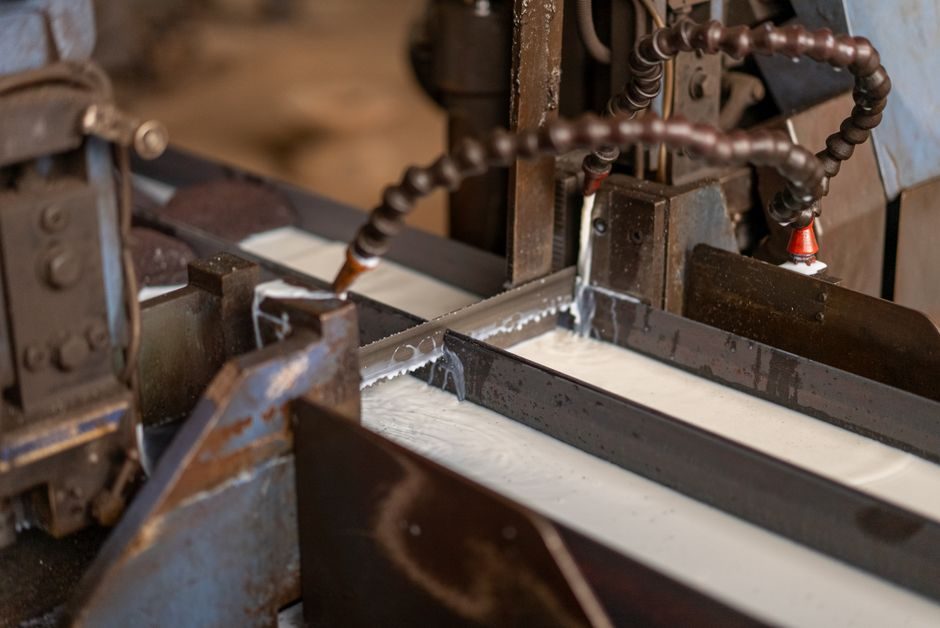
Linear actuators carry backlash from whichever drive element converts rotary to linear motion: rack-and-pinion systems have it from meshing tooth clearance, belt drives from tooth-to-tooth fit, and ball or lead screws from internal nut clearance per [S5] and [S7] (isel-us.com).
High-precision helical rack-and-pinion pairs reach tooth-pitch errors in the single-micron range, and the assembly can be preloaded against backlash using a split-pinion (two pinion halves mesh with opposite tooth flanks, one driven, one spring-loaded) or a dual-pinion design per [S5]. Preloading a profile-rail actuator such as the Rollon MGB produces a rigid, no-backlash assembly with reduced deflection under payload, a reference case Rollon published 17 June 2026 for precision positioning of light to heavy loads per [S2]. For planetary gearheads, precision-class backlash runs from under 1 arc minute (ultra-precision) up to tens of arc minutes in standard industrial grades per [S6], and that number stacks directly on top of the linear-actuator drive-element play.
Side-by-Side Comparison on Four Decision Criteria
On travel length, crossed-roller guides are commonly stocked up to a few hundred millimeters with custom rails going further, while belt-driven actuators routinely span 1–3 m and rack-and-pinion systems can scale to machine-tool lengths per [S1] and [S5].
On backlash, a preloaded crossed-roller guide reduces carriage-level play toward zero per [S8], whereas a rack-and-pinion actuator is limited by tooth clearance and a belt actuator by belt-to-pulley fit per [S5]. On load capacity, the line-contact rollers give crossed-roller slides higher load per package size than equivalent ball slides per [S3], but a profile-rail block with multiple recirculating rows can carry comparable or higher loads on long-stroke axes per [S1]. On maintenance, crossed-roller cages are typically greased and sealed for the life of the stage per [S4], while belt and rack systems expose the drive element for periodic tension or wear checks per [S7].
Application Fit and Where Each Approach Breaks Down

Crossed-roller guides suit diagnostic equipment, semiconductor inspection stages, and measurement instruments where travel is short, stiffness matters, and bidirectional repeatability is the headline spec per [S1] and [S4].
Linear actuators with preloaded rack-and-pinion or preloaded profile rails suit long horizontal traverses on gantries, machining centers, and cleanroom automation where the stroke-to-package ratio matters more than ultimate carriage stiffness per [S2] and [S5]. A hydraulic or pneumatic linear actuator carrying process-fluid loads will also have its own pressure sensor and flow-meter instrumentation loops, and backlash in the actuator then stacks on top of compliance in the rod-end coupling — a stack-up that preloading alone does not fix. The crossed-roller option is the wrong call for a multi-meter pallet-transfer axis, where the rail becomes a handling and shipping problem long before backlash does; the linear actuator is the wrong call for a microscope XYZ stage, where belt stretch and pinion clearance dominate the error budget.
Sourcing, Spec Checks, and What to Confirm on the Datasheet
When comparing OEM datasheets, ask for backlash stated in arc minutes at the input shaft and converted to linear backlash at the carriage, and ask whether the figure is measured with or without preload per [S6].
For belt- and rack-driven stages, request the pitch-error spec, the preload method (split-pinion, dual-pinion, or tensioned belt idler) per [S5], and the lubrication interval. For crossed-roller stages, confirm rail material, raceway profile (V-groove vs. gothic-arch), and whether the catalog figure assumes a cleanroom or a factory-floor environment, since contamination sensitivity is the practical limit on a non-recirculating design per [S4]. Quote pulled from the cited Rollon preloading article: "a more rigid assembly that operates without backlash and exhibits reduced deflection when supporting a payload" — language Rollon used 17 June 2026 to describe the MGB preloaded profile-rail family per [S2].
Trackable signal: the next time a crossed-roller-vs-actuator decision lands on your desk, pull the carriage-level repeatability spec from the stage maker and the input-shaft backlash spec from the actuator maker, convert both to the same unit (µm at the carriage), and sum them — that combined number, not the marketing headline, is what the servo motor drive will actually see inside the position loop.