A motion controller is the digital brain of a servo or stepper machine. It plans the path of one or more axes, computes the position and velocity setpoints thousands of times per second, and commands the drives that energize the motors. While a programmable logic controller (PLC) excels at sequencing and interlocks, a motion controller is purpose-built for coordinated multi-axis motion: point-to-point indexing, linear and circular interpolation, electronic gearing, and camming with microsecond determinism.
This guide separates the controller from the drive and the motor, decodes the spec sheet parameters that actually decide a project, and maps the standards (PLCopen, IEC 61131-3, IEC 61800-7, CiA 402) to the buying decision. It is written for procurement and design engineers who must commit to an architecture before the machine exists.
This guide is aimed at industrial purchasing engineers and design engineers. It covers 6 chapters from what a motion controller is, through controller architectures, control-loop and fieldbus technology, encoder feedback and motion standards, to spec-sheet decoding and selection decisions, with 7 selection FAQs and manufacturer comparisons. All parameters reference IEC 61131-3, IEC 61800-7, the CiA 402 drive profile, and PLCopen Motion Control public standards, cross-checked against published manufacturer datasheets.
Chapter 1 / 06
What is a Motion Controller
A motion controller is the specialized device that governs the precise movement of servo motors, stepper motors, and linear actuators. Its job is to regulate position, velocity, and acceleration along one or more axes, and to do so deterministically enough that multiple axes can move together along a programmed path. Motion control is a sub-branch of industrial automation concerned with moving individual machine components in a highly controlled way, and the controller is the element that turns a target trajectory into a stream of low-voltage command signals.
A complete motion system has three basic building blocks: the controller, the drive (sometimes called the amplifier), and the motor. The controller performs the path planning and trajectory calculation and sends command signals to the drive; the drive converts those low-power commands into the voltage and current that actually energize the motor; the motor produces torque and motion. Feedback from an encoder or resolver closes the loop, letting the controller correct error continuously. This chapter and the rest of this guide focus on the first block, the controller, and on the interfaces by which it talks to the other two.
The defining capability that separates a motion controller from a general-purpose PLC is the dedicated servo loop. A PLC scans its program and process I/O on a cycle of roughly 1 to 10 milliseconds, which is ideal for sequencing, interlocks, and discrete machine logic, but too slow and too jittery for tight position control. A motion controller runs its position and velocity loop at kilohertz rates, typically 1 to 20 kHz, with microsecond-level timing. That is why high-speed laser data, camera position capture, and synchronized multi-axis paths are handled by motion controllers rather than by the PLC alone. In practice the boundary is blurring: many modern platforms run IEC 61131-3 logic and a motion kernel on the same processor.
Historically, motion control evolved from dedicated CNC and indexing hardware in the 1970s and 1980s toward programmable multi-axis controllers and, more recently, toward software motion running on industrial PCs. The arrival of real-time industrial Ethernet around 2003, led by EtherCAT, Sercos III, and PROFINET IRT, let a single controller synchronize dozens of distributed drives over one cable pair with sub-microsecond clock alignment. This decoupled the count of controllable axes from the number of physical wiring channels and reshaped how machines are architected.
The commercial scale of this category is substantial. Independent market research places the broader motion control market at roughly USD 18 billion in 2025, with forecasts to around USD 23 to 25 billion by 2030 at a compound annual growth rate near 5 percent, driven by the migration from hydraulic and pneumatic actuation to electric servo motion that allows precise positioning, high-speed synchronization, and real-time data capture. The motion controller itself is a smaller but strategic slice of that total, because the controller choice locks in the toolchain, the fieldbus, and the drive ecosystem for the life of the machine.
Chapter 2 / 06
Controller Types and Architectures
Motion controllers are classified along several axes at once: by physical form factor, by where the control loops are closed, and by the motion functions they expose. Choosing the wrong form factor early, for example a PCI-bus card when the plant standardizes on EtherCAT, forces an expensive re-architecture later. The table below summarizes the main families by form factor.
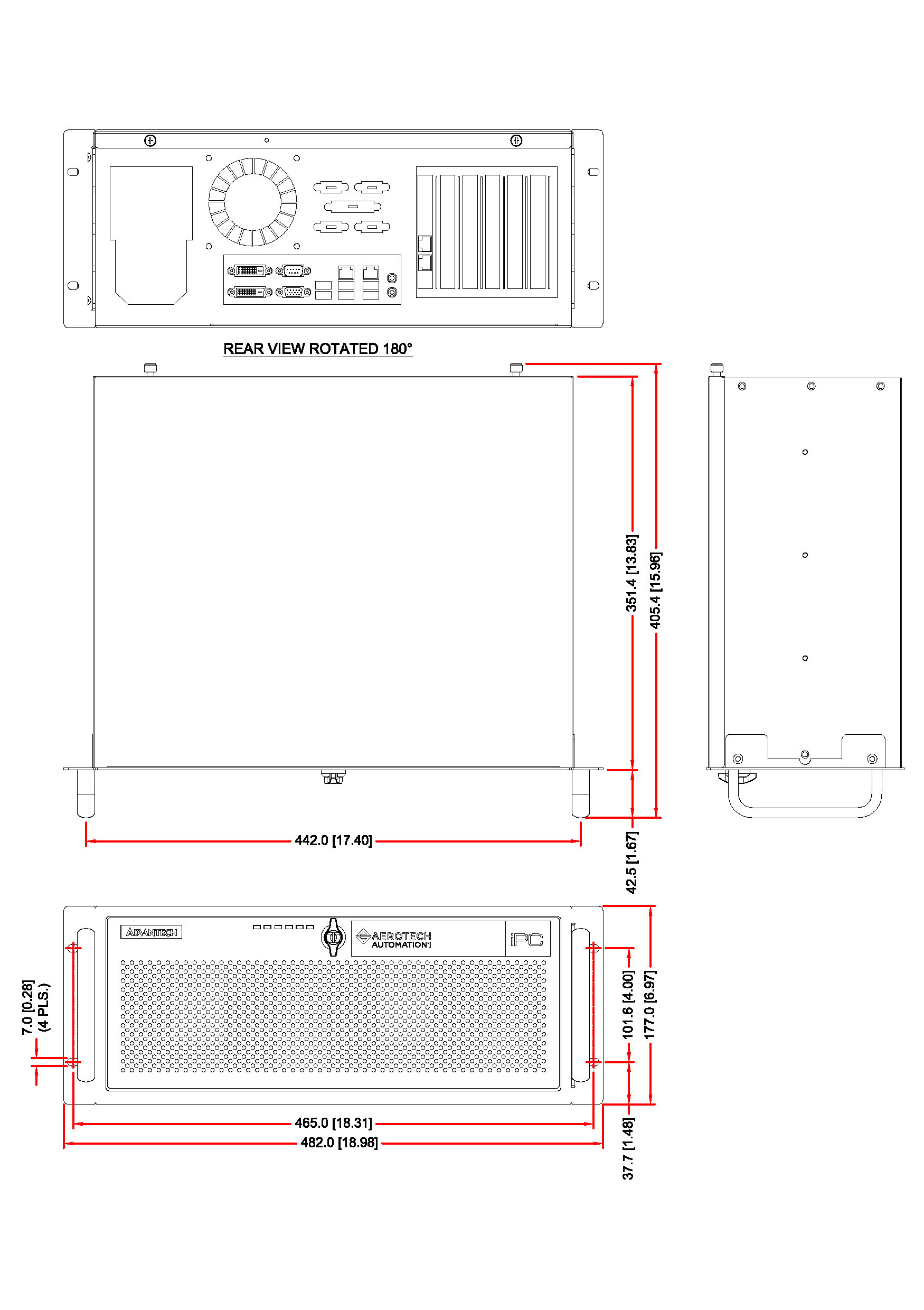
Standalone motion controllers are self-contained units that connect to drives over a real-time bus or analog command lines. They offer a clean separation of duties: the controller handles trajectory and coordination, the drives handle torque. Aerotech, Bosch Rexroth, and Omron Delta Tau all ship standalone families, and they suit machines where motion is the primary function and the engineer wants a dedicated, deterministic platform rather than a shared PLC scan.
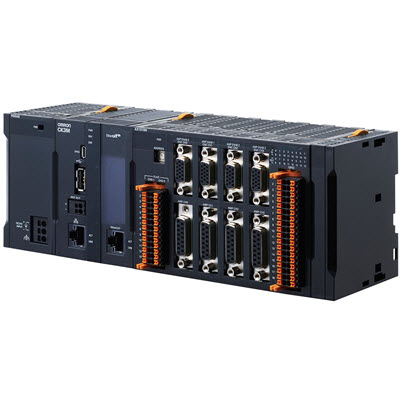
Motion control cards plug into an industrial PC over PCI, PCIe, or, increasingly, an Ethernet port, and turn the PC into the supervisor while the card runs the hard-real-time loop. The Omron Delta Tau PMAC line, descended from the original Programmable Multi-Axis Controller, is the archetype; the CK3 family carries that capability forward. Cards excel in test rigs, semiconductor tools, and OEM equipment that already centers on a PC for vision or data.
PC-based soft-motion controllers push the motion kernel into software running in a real-time slice of an industrial PC. Beckhoff TwinCAT is the reference example: it turns a compatible PC into a real-time controller with PLC, NC point-to-point, NC interpolation, CNC, and robotics runtimes, and acts as the de-facto reference EtherCAT master. The RSI RMP EtherCAT master is a comparable open-API soft controller. Soft motion wins where engineers need open programming interfaces, tight vision integration, and the freedom to scale axis count with CPU performance.
The second classification dimension is where the loops close. In a centralized architecture the controller closes every position, velocity, and current loop and streams torque commands to relatively simple amplifiers, giving the tightest synchronization and a single tuning point. In a distributed architecture each drive closes its own current and velocity loops while the controller sends cyclic position setpoints, for example using the CiA 402 Cyclic Synchronous Position mode. With a fast bus such as EtherCAT, the network is quick enough to support either approach, leaving it to the designer; distributed control scales to more axes and tolerates longer cabling, but coordination then depends on distributed-clock synchronization across the network.
The third dimension is the motion function set. Basic controllers offer jogging and point-to-point positioning. Motion-centric controllers add advanced trajectory planning and interpolation, calculating intermediate positions and velocities between target points to create smooth coordinated motion, plus electronic gearing, camming (ECAM), position-velocity-time (PVT) streaming, and contouring. CNC-class controllers extend this to coordinated 3-axis to 16-axis interpolation for complex machining paths.
Chapter 3 / 06
Control-Loop and Fieldbus Technology
The heart of any motion controller is its control loop and the real-time network that carries commands to the drives. Two engineering questions dominate: how the cascaded loops compute the command, and which fieldbus delivers it with low enough cycle time and jitter. This chapter addresses both. The first is the loop structure; the second is the bus comparison summarized in the table that follows.
The standard structure is a cascaded loop: an outer position loop, an inner velocity loop, and an innermost current (torque) loop. Each loop typically uses proportional-integral (PI) or proportional-integral-derivative (PID) regulation. Feedback alone, however, is reactive: it only acts after error appears. To anticipate the demand, motion controllers add feedforward terms. Velocity feedforward injects the commanded velocity so the position loop does not have to lag behind; acceleration feedforward compensates for the inertia term so the loop does not fall behind during ramps; some controllers add friction and gravity compensation. Properly tuned feedforward dramatically reduces following error during a move while leaving the feedback loop free to reject disturbances.
The servo update rate sets the achievable bandwidth. A faster loop permits a higher position-loop bandwidth and more aggressive feedforward, which sharpens settling and tracking. Precision platforms run very fast loops: the Aerotech A3200 provides a 20 kHz servo update rate for 1 to 32 coordinated axes, and the Omron CK3M reaches a fastest servo cycle of 25 microseconds for five axes, equivalent to a 40 kHz update rate, with an ultra-high-speed mode at 50 microseconds for five axes (20 kHz). A faster loop only helps if the drive, the encoder data rate, and the mechanical resonance can keep pace, so loop rate must be matched to the whole signal chain.
The fieldbus carries the cyclic setpoints. Real-time industrial Ethernet protocols, including POWERLINK, Sercos III, EtherNet/IP, PROFINET, EtherCAT, and Mechatrolink, differ by an order of magnitude in determinism. They split into two tiers: the hard-real-time motion buses, EtherCAT, Sercos III, PROFINET IRT, and POWERLINK, reach cycle times from roughly 31 to 200 microseconds with sub-microsecond jitter, while the lower-real-time buses, standard PROFINET RT and EtherNet/IP, sit around 1 millisecond, roughly an order of magnitude slower. EtherCAT, Sercos III, and PROFINET IRT push determinism into the physical layer, so PROFINET IRT requires special IRT-capable hardware to reach cycle times below 250 microseconds. EtherCAT has been adopted by far more servo-drive and I/O suppliers than any other motion bus, which is a decisive practical advantage when sourcing drives. The table below compares the mainstream motion buses.
Two more points matter for the buyer. First, distributed-clock jitter, not just nominal cycle time, governs how tightly axes stay synchronized; EtherCAT distributed clocks hold sub-microsecond alignment across a network. Second, a synchronized machine should not mix motion buses: putting some axes on EtherCAT and others on PROFINET IRT forces gateway translation that destroys the determinism the buses were chosen for. Standardize one motion bus per coordinated machine.
Chapter 4 / 06
Feedback, Profiles, and Motion Standards
A motion controller is only as accurate as the feedback it reads and only as portable as the standards it follows. This chapter covers the feedback interfaces that report axis position, the trajectory profiles that shape every move, and the standards that govern how the controller talks to drives and how the application is programmed.
Feedback interfaces. Legacy axes used incremental A/B/Z quadrature lines and analog sin/cos, but modern servo systems use digital absolute interfaces that report position over a few wires with built-in error checking. The dominant interfaces are EnDat, BiSS-C, and Hiperface DSL. The table below summarizes their key engineering differences.
Interface
Type
Clock / Data Rate
Key Traits
EnDat 2.2
Bidirectional serial
up to 16 MHz
Heidenhain, rich diagnostics, 4-wire
BiSS-C
Open serial
up to ~10 MHz
License-free, CRC error check, multi-source
Hiperface DSL
2-wire digital
9.6 Mbit/s class
SICK, runs on motor cable, SIL3 safe motion
SSI
Unidirectional serial
~ 1 to 2 MHz
Simple, 13 to 32-bit, no diagnostics
Resolver
Analog ratiometric
n/a
Rugged, low resolution, needs RDC
EnDat 2.2 is a synchronous bidirectional standard from Heidenhain that uses four wires and supports clock frequencies up to 16 MHz with extensive diagnostic data. BiSS-C is an open, license-free protocol that implements CRC for data integrity and supports cyclic real-time exchange, which makes it easy to multi-source. Hiperface DSL is a SICK two-wire interface that carries feedback, motor-parameter, and condition-monitoring data plus integrated safe motion over a digital pair, and it is compliant with SIL3 functional safety. The capabilities of BiSS-C, EnDat 3, and Hiperface DSL have converged, so the practical choice is dictated by which protocol the drive and the encoder both natively support.
Trajectory profiles. Every move is shaped by a velocity profile. A trapezoidal profile uses constant acceleration, a constant cruise velocity, and constant deceleration; it is time-optimal for a given acceleration limit but produces a step change in acceleration at every corner, which means infinite jerk and the vibration, settling oscillation, and mechanical stress that come with it. An S-curve profile limits jerk by smoothing the acceleration transitions, rounding the corners of the velocity curve. This reduces oscillation, lowers audible noise, extends mechanical life, and shortens settling time, in exchange for a marginally longer move. Most controllers expose jerk as a tunable parameter so the engineer can trade cycle time against smoothness, and CNC-class systems support PVT and spline streaming for fully arbitrary paths.
Programming and drive standards. Three standards frame interoperability. IEC 61131-3 defines the PLC programming languages (Ladder, Structured Text, Function Block Diagram, and others). PLCopen, an independent organization, published Function Blocks for Motion Control as version 1.0 in November 2001, layered on IEC 61131-3; it standardizes blocks such as MC_MoveAbsolute, MC_MoveVelocity, MC_GearIn, and MC_CamIn together with a common axis state machine, covering single-axis and coordinated multi-axis motion. On the drive side, IEC 61800-7 defines the generic drive interface and harmonizes the major profiles, while the CiA 402 drive profile defines the operating modes, including Cyclic Synchronous Position, Velocity, and Torque, that controllers use over EtherCAT (CoE) and other buses. Together these standards reduce vendor lock-in and let application code port across compliant platforms with far less rework.
Chapter 5 / 06
Key Specification Parameters
Reading a motion controller datasheet is a core procurement skill. Different vendors list dozens of parameters, but only a handful truly drive the selection. The table below collects the key specifications and their typical industrial ranges; the parameters are decoded in the paragraphs that follow.
Parameter
Typical Range
Why It Matters
Coordinated axes
1 to 64 (256+ soft)
Sets machine scope and synchronization scope
Servo update rate
1 to 20 kHz
Caps position-loop bandwidth
Bus cycle time
62.5 us to 4 ms
Caps command and feedback throughput
Interpolation
Linear / circular / spline
Determines achievable path geometry
Feedback interface
EnDat / BiSS / DSL / SSI
Sets resolution and diagnostics
Encoder resolution
17 to 26 bit absolute
Sets positioning granularity
Functional safety
SIL2 / SIL3
Required for STO and safe motion
Coordinated axis count is the first parameter, but the word coordinated is critical: a controller may address many axes while only synchronizing a subset on one interpolation group. Aerotech coordinates up to 32 axes from one A3200 controller; soft-motion platforms scale further with CPU power. Count the axes that must interpolate together, then add 20 to 30 percent headroom for future stations. Synchronized axes must share one controller and one bus segment.
Servo update rate is how often the controller recomputes the position and velocity loop, typically 1 to 20 kHz. It caps the achievable closed-loop bandwidth: a 20 kHz loop can support a far higher position-loop crossover frequency than a 1 kHz loop and tolerates more aggressive feedforward. Bus cycle time is the related network parameter, the interval at which cyclic setpoints and feedback cross the fieldbus; EtherCAT supports cycle times below 100 microseconds. Both must be considered together, because the slower of the two governs real-world dynamics.
Interpolation and motion functions determine which geometries the controller can produce. Look for linear and circular interpolation as a baseline; spline and PVT for arbitrary paths; electronic gearing and camming for synchronization to a master; and registration or print-mark capture for high-speed product tracking. The richer the function set, the less custom logic the application engineer must write.
Feedback interface and resolution set how finely the controller can see and command position. A 20-bit single-turn absolute encoder resolves a revolution into roughly one million counts, a 23-bit into about eight million; multi-turn encoders add revolution counting so the machine knows its absolute position at power-up without homing. The interface (EnDat, BiSS-C, Hiperface DSL, SSI, or resolver) also dictates whether diagnostics and safe-position data are available.
Functional safety is increasingly mandatory. Look for support of Safe Torque Off (STO) and, for advanced machines, Safe Stop, Safely Limited Speed, and Safe Direction, rated to SIL2 or SIL3 under IEC 61800-5-2 and IEC 61508. Hiperface DSL and the newer safe encoder protocols carry safe position over the feedback channel, which lets the controller implement safe motion without separate sensors.
Two further parameters round out the sheet. Latency and jitter of the command path govern how tightly axes track each other; distributed-clock synchronization holding sub-microsecond alignment is the benchmark. I/O and registration inputs with hardware position capture, often resolving to the encoder count at microsecond latency, are essential for flying-shear, labeling, and vision-triggered applications where the moment of capture must align exactly with axis position.
Chapter 6 / 06
Selection Decision Factors
To turn the preceding chapters into a specific model, follow the decision sequence below. Most selection mistakes come not from one wrong number but from deciding the controller before the machine architecture is fixed. These eight steps work well as a fixed RFQ template.
Axis count and synchronization groups: List every axis, then mark which axes must interpolate or gear together. Synchronized axes must live on one controller and one bus segment. Add 20 to 30 percent spare axis capacity for future stations.
Motion functions required: Decide whether you need only point-to-point and jogging, or also linear and circular interpolation, electronic gearing, camming, PVT, contouring, or full CNC. Buy the function set you need, because retrofitting interpolation later often means a new controller.
Servo rate and dynamics: Map the required settling time and following error to a servo update rate. General handling runs at 1 to 4 kHz; high-dynamic indexing and laser work want 8 to 20 kHz. Confirm the drive and encoder data rate can sustain the chosen loop rate.
Fieldbus and drive ecosystem: Choose one motion bus for the whole synchronized machine. EtherCAT has the largest drive vendor pool and sub-100-microsecond cycles; Sercos III and PROFINET IRT are alternatives. Match the controller bus master to the drives you intend to buy.
Feedback and resolution: Select the encoder interface (EnDat, BiSS-C, Hiperface DSL, SSI, or resolver) and resolution that meet your positioning granularity, then verify both the drive and controller support that interface natively.
Functional safety: Determine the required safety integrity level and functions: STO at minimum, plus Safe Stop, Safely Limited Speed, or Safe Direction to SIL2 or SIL3 under IEC 61800-5-2 where the risk assessment demands it.
Programming model and standards: Prefer PLCopen-compliant function blocks over IEC 61131-3, and confirm CiA 402 / IEC 61800-7 drive-profile support, so application code is portable and engineers can reuse training across machines.
Total cost of ownership: Sum the controller, drives, engineering software licenses, training, and a decade of spare-parts and support availability. The toolchain and firmware ecosystem, not the controller hardware price, usually dominate the ten-year cost.
One last commonly overlooked dimension is vendor serviceability and ecosystem: in-region engineering support, firmware update policy, library and add-on availability, and the depth of the local drive and spare-parts supply. Established platforms include Aerotech Automation1 and A3200, Beckhoff TwinCAT 3 with NC PTP, NC I, and CNC on EtherCAT, Omron Delta Tau PMAC and the CK3M, plus Bosch Rexroth, B&R, Mitsubishi, Yaskawa, and Delta. These seem secondary at purchase time but determine repair response and upgrade paths over the 10-to-15-year life of a production machine, so weight them alongside the raw specifications.
FAQ
What is the difference between a motion controller and a PLC?
A PLC scans logic and process I/O, typically on a 1 to 10 ms cycle, and is excellent at sequencing, interlocks, and discrete machine logic. A motion controller is a specialist that runs a dedicated servo loop at 1 to 20 kHz, generates coordinated trajectories, and performs interpolation, electronic gearing, and camming with microsecond determinism. Many modern platforms merge the two: a single IPC or CPU runs IEC 61131-3 logic alongside a PLCopen motion kernel. The rule of thumb is to use a PLC for process and discrete machine automation, and a motion controller when you need synchronized multi-axis paths, contouring, or sub-micron positioning.
What does centralized versus distributed motion control mean?
In centralized control the motion controller closes every position, velocity, and current loop and streams torque or velocity commands to dumb amplifiers over a real-time bus. This gives the tightest axis-to-axis synchronization and a single point of tuning, but bus bandwidth and controller CPU set the axis ceiling. In distributed control each servo drive closes its own current and velocity loops locally while the controller sends cyclic position setpoints, for example using the CiA 402 Cyclic Synchronous Position mode. Distributed control scales to more axes and tolerates longer cables, but axis coordination depends entirely on distributed-clock time synchronization across the network.
What servo update rate does a motion controller actually need?
The servo update rate is how often the controller recomputes the position and velocity loop. General industrial handling and packaging run comfortably at 1 to 4 kHz. High-dynamic indexing, electronic cam, and laser processing benefit from 8 to 20 kHz. Precision platforms such as the Aerotech A3200 run a 20 kHz servo loop on every axis, and the Omron CK3M reaches a 25 microsecond servo cycle for five axes, equivalent to 40 kHz. A higher loop rate raises the achievable position-loop bandwidth and lets you use more aggressive feedforward, but it only helps if the drive, encoder data rate, and mechanical resonance can keep up.
What is the difference between trapezoidal and S-curve motion profiles?
A trapezoidal profile ramps velocity linearly: constant acceleration, constant cruise, constant deceleration. It is the fastest profile for a given acceleration limit, but the instantaneous jump in acceleration at each corner produces infinite jerk, which excites mechanical resonance, snaps belts, and leaves settling oscillation. An S-curve profile limits jerk by smoothing the acceleration transitions, so the velocity curve gains rounded corners. The result is lower vibration, less audible noise, longer mechanical life, and shorter settling time, at the cost of a slightly longer move. Most controllers expose jerk as a tunable parameter so you can trade cycle time against smoothness.
Which encoder feedback interface should I choose: EnDat, BiSS-C, or Hiperface DSL?
All three are digital absolute interfaces that replace legacy incremental A/B/Z lines. EnDat 2.2 is a Heidenhain standard, bidirectional, with clock rates up to 16 MHz and rich diagnostics; it is common on linear and rotary encoders. BiSS-C is an open, license-free protocol with CRC error checking, widely supported and easy to multi-source. Hiperface DSL is a SICK two-wire digital interface that runs feedback and safety data over the motor cable shield pair and supports SIL3 safe motion. EnDat 3, BiSS-C, and Hiperface DSL now offer comparable resolution and functional safety, so the practical decision is which protocol your chosen drive and encoder both natively support.
How do I size the number of axes and pick a fieldbus?
Count real coordinated axes first, then add spare capacity of 20 to 30 percent for future stations. Synchronized axes that must interpolate together must share one controller and one bus segment. For the network, EtherCAT is the most widely adopted motion bus, supports sub-100 microsecond cycle times with distributed-clock jitter under 1 microsecond, and is supported by the largest pool of drive and I/O vendors. Sercos III and PROFINET IRT deliver similar hard-real-time performance, while standard PROFINET or EtherNet/IP suit lower-dynamic motion. Match the controller bus master to the drives you intend to buy, because mixing motion buses across one synchronized machine is rarely worth the integration cost.
What is PLCopen and why does it matter for motion control?
PLCopen is an independent organization that published Function Blocks for Motion Control, first released as version 1.0 in November 2001, layered on top of the IEC 61131-3 PLC programming standard. It standardizes function blocks such as MC_MoveAbsolute, MC_MoveVelocity, MC_GearIn, and MC_CamIn, plus a common axis state machine, so application code written for one compliant platform ports far more easily to another. For a buyer this reduces vendor lock-in, shortens engineer training, and makes coordinated and single-axis motion behave predictably across Beckhoff, B&R, Omron, and other compliant controllers.
Motion Controller Manufacturers
Source-backed product routes. Open a company dossier for procurement scope and cited evidence.