Crucible furnaces recovered more metal than rotary furnaces in an aluminum refining study, but their lower melting capacity prevented an industrial-scale substitution [S1].
Rotary furnaces process mixed and contaminated scrap through a rotating cylindrical vessel, while crucible furnaces separate metal batches in refractory or metal containers for aluminum, copper, brass, bronze, and zinc [S2][S5][S6].
Decision criteria for scrap melting equipment
Select a crucible furnace when feedstock is reasonably segregated, alloy changes are frequent, and controlled ladle pouring is required. Choose a rotary furnace when incoming scrap is mixed, contaminated, or variable enough to justify continuous tumbling and in-furnace separation [S2][S6].
The comparison turns on four criteria: scrap tolerance, batch flexibility, melting capacity, and control complexity. Crucible furnaces offer three practical configurations: round, square, and tilting designs, with gas and electric heating available [S2]. Rotary furnaces use a cylindrical furnace that rotates during processing, increasing exposure of the charge to the heat and allowing fluxing and refining operations within the rotating vessel [S6].
Neither option is the universal choice. A crucible furnace provides direct containment and practical alloy separation, but the removable vessel imposes a lower melting-capacity limit [S1][S2]. A rotary furnace accepts heterogeneous scrap, but the rotating process adds mechanical, thermal, and metallurgical control requirements that must be designed into the operating cycle [S6].
Throughput and feed flexibility
Aluminum refining research found crucible melting more efficient than rotary melting in metal recovery, while identifying lower crucible melting capacity as the reason it could not replace rotary equipment on an industrial scale [S1].
Crucible capacity should be based on usable metal volume rather than nominal vessel size. Allowances must cover working volume, melt loss, heel practice, recharge time, temperature recovery, batch weight, melts per shift, and the downstream pouring schedule [S2]. A furnace with adequate nominal capacity can still be undersized for the required cycle.
Rotary equipment is the stronger candidate for a scrap stream containing mixed grades, coatings, or contaminants. Its rotating cylinder is specifically associated with processing mixed or contaminated scrap, while a crucible is better matched to controlled batches that can be identified and handled separately [S2][S6]. The distinction affects charge preparation, sampling, alloy correction, and slag management.
Operating control and production flexibility
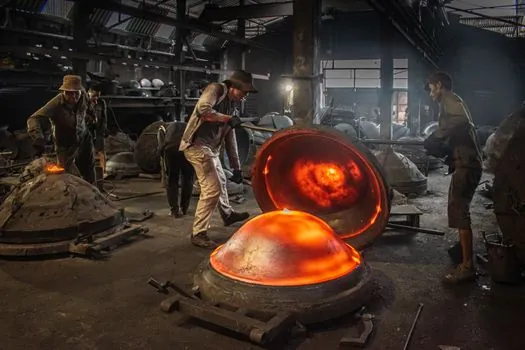
Crucible furnaces contain the molten bath in a refractory or metal crucible, making alloy changes, batch scheduling, and metal separation straightforward operating functions [S2]. Round geometry follows common cylindrical crucibles and supports even heating around the vessel, while square arrangements can suit particular vessel formats, access requirements, or floor layouts [S2].
Tilting crucibles pour directly into a ladle, mold, or transfer point without removing the vessel. Their specification depends on pour height, spout position, receiving equipment, hydraulic arrangement, operator visibility, and the tilt path, not furnace capacity alone [S2]. Stationary designs remain appropriate where manual removal, smaller batches, or existing handling equipment dictate the workflow.
Rotary furnaces perform more work inside the furnace shell because rotation combines the charge, flux, and heat while the scrap is being converted into usable metal [S6]. That makes them operationally different from a flame-heated crucible whose exterior contacts the vessel and whose contents remain physically separated from the furnace shell [S7].
Heat source and utility requirements
Crucible furnaces can use gas or electric heating, allowing selection around melt rate, utility cost, maintenance strategy, ventilation, and plant standards [S2]. Gas-fired systems suit installations with suitable fuel infrastructure, while electric systems favor clean operation and controlled heat input where electricity is practical [S2][S3].
Rotary furnaces use rotation as part of the melting process, so the thermal strategy must be matched to the rotating vessel and its scrap charge. The relevant engineering review includes fuel or electricity availability, operating duration, and the need for continuous handling of heterogeneous material rather than comparing purchase price alone [S2][S6].
For clean batch melting, compare the complete heat-delivery path. A gas crucible applies flame heat to the crucible exterior, and an induction arrangement can heat a graphite crucible through electromagnetic coupling without a direct flame [S4][S7]. The choice changes ventilation, electrical demand, refractory exposure, and maintenance duties, so it cannot be reduced to fuel price alone.
Metallurgical control and failure modes

Crucible operations face direct failure risks from damaged or deteriorated crucibles, unsafe vessel handling, loss of containment, and insufficient working capacity. The crucible condition and handling method are central to safe operation, making inspection, lifting access, charging method, and refractory maintenance part of the purchase specification [S2].
Rotary operations face a different risk set: variable scrap behavior, poor heat transfer, excess wear, uncontrolled slag formation, and chemistry shifts between charges. The rotary furnace is suited to feeds that can overwhelm or disrupt a clean batch process, but that same feed variability makes sampling, flux dosing, melt-rate control, and metal-recovery verification more demanding [S1][S6].
For both furnace types, contaminant control must be designed before the equipment is ordered. A crucible is most defensible when incoming material can be segregated; a rotary furnace earns its place when the value of processing contaminated scrap outweighs the added process complexity [S1][S2][S6].
Use-case recommendations and specification checklist
Choose a crucible furnace for foundries melting segregated aluminum, brass, bronze, copper, or zinc in defined batches, particularly where alloy changes and controlled pouring are frequent. Use a tilting model when direct pouring and reduced vessel handling justify the hydraulic and layout requirements; use gas or electric heating according to utility availability and operating priorities [S2][S3][S5].
Choose a rotary furnace for continuous reclamation of mixed or contaminated nonferrous scrap, where rotation, flux interaction, and in-vessel separation justify a larger centralized process. This selection is especially credible when the material cannot be economically segregated into crucible batches, while the plant can support the greater control burden [S6].
Issue the request for quotation with at least six operating inputs: average batch weight, melts per shift, maximum charge, scrap contamination range, alloy-change frequency, and required melt temperature. Add usable capacity, charging method, pouring method, utility prices, ventilation arrangement, and maintenance access [S2]. The crucible furnace capacity sizing guide is useful for translating batch demand into working capacity, while a rotary furnace enquiry should state the expected feed variability and slag-control requirements.
The next procurement checkpoint is a measured trial or historical mass-balance comparison covering usable melt per hour, recovered metal per tonne, energy per tonne, slag volume, crucible or lining consumption, and labor per melt cycle. If clean-batch alloy flexibility dominates, specify a crucible; if feed contamination and sorting cost dominate, specify a rotary furnace [S1][S2][S6].