For a small foundry pour schedule, the first sizing number is the usable molten metal delivered per pour, not the nominal crucible nameplate, because heel, dross, working volume, and recharge soak all erode what actually reaches the mold [S1].
On non-ferrous work, fixed crucible furnaces are practical up to about 1,000 kg aluminum and tilting designs up to roughly 1,500 kg aluminum, with electric heating delivering around 250 kg Al/h and gas- or oil-fired units up to about 400 kg Al/h [S2]. Below that band, a crucible furnace is usually the cheapest flexible-melt tool a small shop can install, and the wrong call shows up first as temperature drift between pours, not as a nameplate miss.
Start with the pour schedule, not the catalog
Build the sizing sheet from the pour schedule: per-pour weight, number of pours per shift, alloy changeovers, target pouring temperature, and the gap between the last pour of one batch and the first pour of the next [S1]. A shop that runs 80 kg aluminum pours every 25 minutes has very different requirements than one running 400 kg pours twice a shift, even though both might describe themselves as a "small foundry."
On a gas or electric crucible furnace, a 100 kg aluminum pour typically needs 20–30 minutes of hot-furnace cycle time including charge, melt, superheat, and skim, so a one-shift schedule of twelve 100 kg pours lines up with a roughly 300 kg working-capacity furnace rather than a 100 kg unit [S3]. Small hydraulic tilting induction units, in the 100–350 kg range, are specifically engineered for this kind of repeated batch work, with 6 standard configurations covering 30–300 kg per melt [S3].
Choose geometry and tilt action from workflow, not habit
Round furnaces dominate because cylindrical crucibles heat evenly around the bath, and the small-shop sweet spot is a round shell with a removable crucible for alloy change or a hydraulic tilt for repeated pours of the same alloy [S1]. Tilting reduces manual lifting and improves pour-angle control, but it adds a hydraulic station, a spout alignment problem, and a clear floor footprint for the tilt arc [S1].
For a fixed non-tiltable unit used as a bale-out holding furnace, the holding furnace logic applies: charge with pre-melted metal, hold a tight temperature band, and avoid dropping cold ingot into a ready-to-cast bath, which guarantees a temperature dip and often a casting defect [S2]. For pre-melting duty, a separate tilting unit with a recuperative burner is the better fit, and recuperative combustion-air pre-heat can save 25–38% of fuel versus a cold-air burner on the same furnace [S2].
Gas, electric, or induction: decide on melt rate, not sticker price
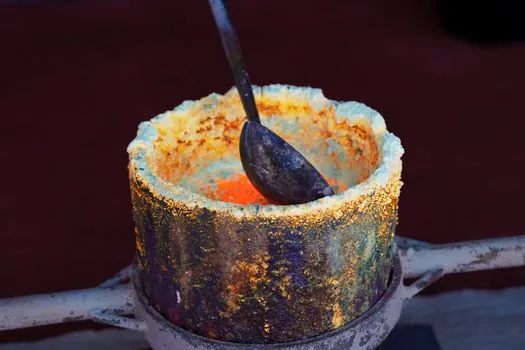
Gas and oil-fired crucible furnaces give higher melt rate per kilowatt of input, with the 400 kg Al/h figure for fuel heating versus 250 kg Al/h for electric heating, so on shift-limited schedules the fuel-fired unit often wins even after the gas bill [S2]. Electric resistance and induction units win on clean operation, tight temperature control, and lower ventilation load, which matters more in shops with limited hood capacity or strict workplace-air targets [S1].
For mixed-metal or precious-metal shops below about 300 kg, a small induction furnace in the 30–300 kg range with medium-frequency 1–20 kHz power and 45–160 kW input is the typical pick, because electromagnetic stirring evens out alloy and temperature distribution without external paddles [S3]. Choose the input power by the actual metal: aluminum, copper, gold, and steel have very different specific heats and densities, so a single kilowatt-per-kilogram rule does not transfer cleanly across alloys [S3].
Footprint, clearance, and the gap you forget
Around the crucible, leave a controlled annular gap for flue-gas circulation on fuel-fired units: a working figure from small furnace builds is roughly 1 inch (about 25 mm) of clearance per side between a 5–6 inch steel crucible and the refractory wall, which lets the hot gases sweep the crucible evenly without starving the burner [S4]. A loose, oversized shell wastes fuel; a tight, undersized shell overheats the refractory and shortens lining life [S4].
On tilting units, the gap also has to clear the pour arc, the ladle or mold station, and any dust extraction hood; the pour height and spout position need to match the receiving ladle, not the floor, or the operator ends up shimming the ladle stand [S1]. A standard 30 kg hydraulic tilting induction configuration, for example, is sized for laboratory and small-batch work, so the surrounding space has to be planned for the 100 kg, 150 kg, or 200 kg layouts if the pour schedule is going to grow [S3].
Heel practice and the real usable capacity
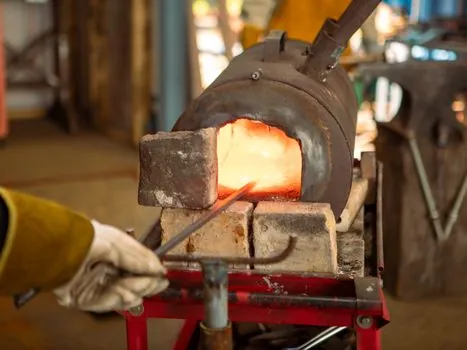
Heel practice is where most small-foundry capacity miscalculations start.
Crucible material choice also feeds back into usable capacity: graphite and silicon carbide crucibles carry the highest temperature ratings, cast iron and special cast iron are used for specific alloy families, and cast steel or sheet steel appears mainly on magnesium and zinc work, so the alloy mix determines which crucible you can run at full nominal capacity [S2]. For mixed-alloy shops, the cross-contamination risk on a single crucible often forces a second small furnace rather than one big one, which is a sizing decision that lives in the alloy log, not the catalog sheet [S5].
Comparison: fixed bale-out vs tilting pre-melt vs small induction
Across the three common small-foundry options, the trade is between flexibility, melt rate, and pouring ergonomics. A fixed bale-out unit up to about 1,000 kg Al is cheapest and best as a holding furnace on pre-melted metal, with very tight temperature control and zero tilt hardware; the cost is manual ladling per pour [S2]. A separate tilting pre-melt unit up to about 1,500 kg Al, ideally with a recuperative burner, gives the highest melt rate at up to 400 kg Al/h fuel-fired and 25–38% fuel savings versus cold-air burners, at the price of more floor space and a hydraulic system [S2]. A small hydraulic tilting induction unit, 30–300 kg standard or 500–1000 kg custom, 1–20 kHz medium frequency, 45–160 kW input, 20–30 minute hot cycle, is the cleanest fit for a small job shop running precious metals, copper alloys, or short aluminum runs, with the lowest ventilation load and the most repeatable pour angle [S3].
On selection criteria of cost per kg melted, melt rate, and pouring control, the ranking shifts with shop size: below 100 kg per pour the small induction unit wins on control, between 100–400 kg the tilting fuel-fired pre-melter wins on throughput, and above 400 kg the fixed bale-out holding furnace plus separate melting unit becomes the more robust pattern because holding and melting are decoupled and each furnace runs at its best duty point [S1][S2].
What to verify before signing the order
Before committing on capacity, the buyer should confirm the rated melt rate at the actual alloy, the heel volume the supplier assumes in their sizing math, the working volume above the heel, and the time to recharge and recover pouring temperature [S1]. The same checks apply to the crucible itself: alloy compatibility, flux and degassing practice, charging method, dross removal, and emptying method all feed back into the size decision [S5].
For a related look at how a small induction unit is matched to a small job-shop pour schedule, the earlier walkthrough on sizing an induction furnace for a small job shop foundry covers the electrical and refractory side of the same problem. For a small non-induction alternative in the same capacity band, the small cupola furnace capacity sizing breakdown is the comparable reference on the iron side.