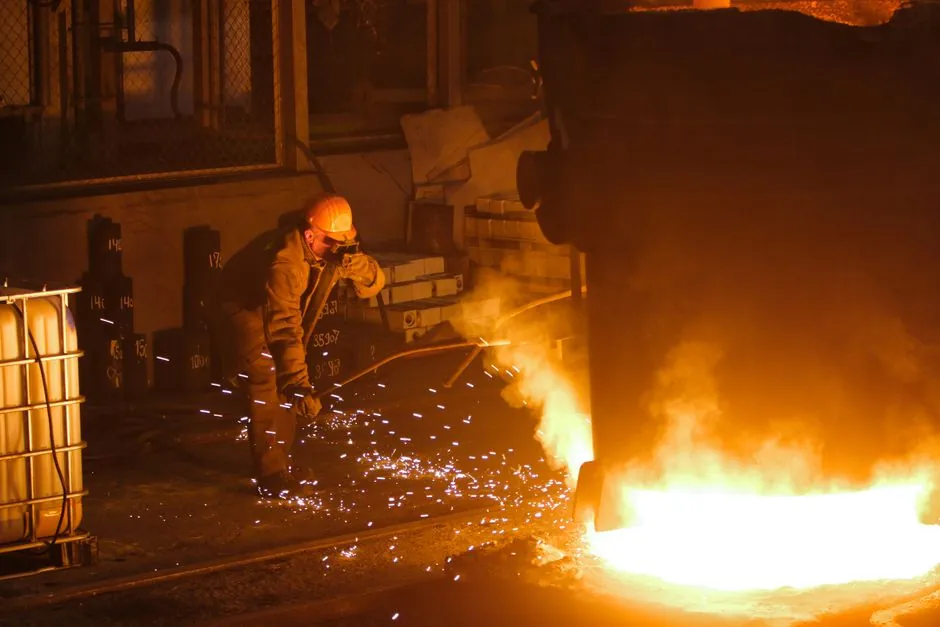
A cupola's coke bed height is measured from the tuyere plane to the top of the coke column, and Bureau of Mines trials put the working value at 30 in (≈760 mm) above the tuyeres for acceptable furnace performance [S1].
Inside the cupola furnace shaft, that fixed-volume coke mass fixes where the oxidation zone ends, where the reduction zone starts, and how much preheat the descending charge actually receives, three things that decide melt rate, spout temperature, and stack emissions at the same time.
Where the 30 in / ≈760 mm number comes from
Spironello's 1984 Bureau of Mines evaluation of a gas-assisted cupola explicitly identifies the 30 in bed height as a level previously determined to be critical for acceptable performance of the unit [S1]. The same trials linked that bed volume to two operational outputs: the energy input per pound of iron melted, and the iron's silicon loss (oxidation) across the coke bed [S1].
A more recent design study on a 0.5 t/h foundry cupola describes the active high-temperature zone as starting at the top of the coke bed and extending roughly 900 mm upward, with temperatures around 1600°C, which places the bed-to-stack transition in the same order of magnitude as the older 30 in working point [S2]. For context on overall stack layout, the cupola furnace reference entry breaks the shaft into tuyere, combustion, reduction, and preheat zones, with the coke bed sitting between the first two.
What happens when the bed is too low or too high
Particulate loading on the top gas rises as the coke bed height deteriorates, so a low bed is a visible-emissions problem before it is a melt-rate problem [S3]. Griffiths' 1992 measurements on coke-fired cupolas also show that falling CO in the top gas is an early indicator that the iron temperature is about to drop and that foaming slag is developing, both downstream symptoms of a bed that has thinned or slumped [S3].
On the other side, Modern Casting's operator-facing guidance is blunt: if the spout temperature climbs while everything else is unchanged, the coke bed is too high for the current blast volume, and the cure is to bring blast up to match, not to leave the bed tall [S4]. A bed that is too thick also shifts the oxidation zone upward, lengthens the path combustion gases must travel, and pushes more CO into the off-gas, which is exactly why cold-blast cupolas already run 8–18% specific coke consumption and need CO recovery to stay viable [S5].
Bed height vs. the rest of the charge ratio
Bed height is one number in a stack of three that move together: coke charge per batch, blast volume (ft³/min or Nm³/h), and blast temperature (cold-blast ≈ ambient vs. hot-blast 400–600°C) [S4][S5]. Holding bed height constant while pushing more blast through the same tuyere area will simply erode the bed; holding blast constant while adding more coke will lift the bed and starve the melt zone of air [S4].
The whole ratio question, including the iron-to-coke and limestone-to-coke percentages that sit on top of the bed-height set point, is treated in detail in the related cupola charge calculation breakdown, and a sensor-side discussion of how operators actually watch the spout and backpressure in real time is in the balancing your cupola operations article referenced alongside this spec.
Diagnostic signals when the bed drifts off-spec
Five measurable signals are used in practice to detect a coke bed that is no longer at its set height: spout iron temperature, stack-gas CO percentage, backpressure on the blast line, water temperature out of the tuyeres / cooling cylinders, and the top-gas particulate loading [S3][S4]. The Modern Casting decision rule is that rising spout temperature with constant blast means the bed is too high; rising spout temperature followed by a fall, or a fall on its own, means the bed has thinned and the oxidation zone is collapsing toward the tuyeres [S4].
Griffiths adds that CO trending down in the top gas is the earliest of those five indicators, and it shows up before spout temperature or backpressure move, which is why continuous stack-gas analysis, not just periodic iron sampling, is the control loop that actually protects bed height [S3].
Engineering limits of the 30 in rule
The 30 in / ≈760 mm figure is a cold-blast, natural-draft working point, not a universal constant. Hot-blast cupolas run blast at 400–600°C, recover CO in a recuperator, and the melting zone sits noticeably closer to the tuyere plane than in a cold-blast unit [S5]. Cold-blast units in the 2–10 t/h class with above-throat gas take-off tolerate a wider range of charge materials but pay for it in specific coke rate, around 8–18% of metal weight depending on configuration [S5].
Scaling the rule up or down is also non-linear: doubling a 0.5 t/h unit's diameter does not halve the bed height, because tuyere area scales with the square of diameter while bed mass scales with diameter squared times bed height, so the same bed height in millimetres drives a much larger absolute coke inventory at industrial tonnage [S2][S5]. Stack-zone heights in the published reference cupola layouts are commonly quoted in 15 cm increments, which is the same order of magnitude as the 30 in / ≈760 mm bed number and is useful as a sanity check when scaling drawings between 0.5 t/h and 10 t/h class units [S6].
What to track on the next operating shift
Two signals are worth pinning to a control board: (1) the CO:CO₂ ratio in the top gas, logged at least every 15 minutes against the bed set point, because falling CO at constant blast is the earliest indicator that the bed has thinned [S3]; and (2) the spout temperature trend over a 30 to 60 minute window, the same window the charge takes to travel from the feed door to the spout, with a rising trend flagged as bed-too-high-for-blast and a falling trend flagged as bed-collapse risk [S4]. Both are usable on existing cold-blast and hot-blast cupolas without new instrumentation.
For component-level specifications, see height gauge, and crucible furnace.