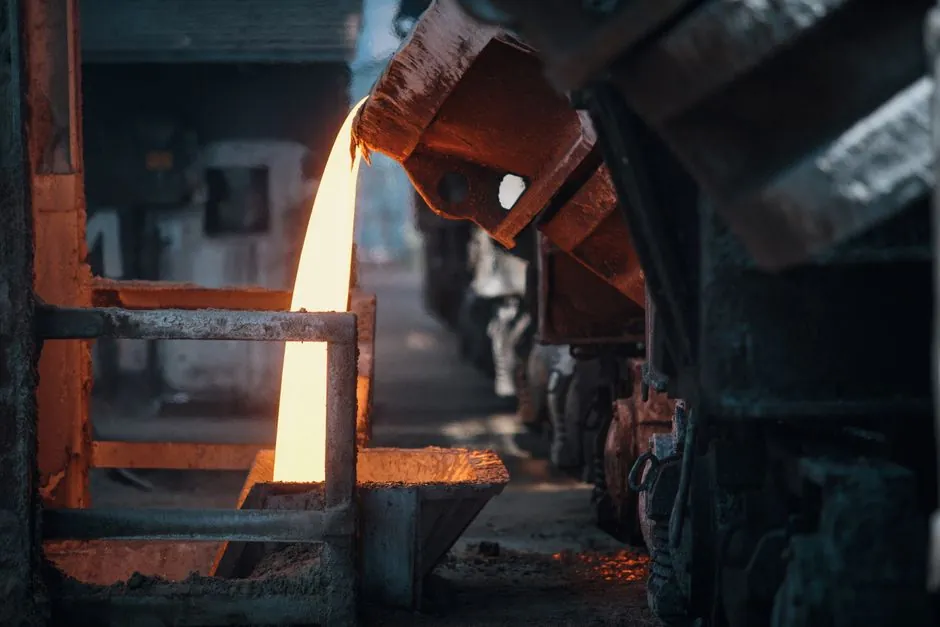
EPA economic impact analysis pegs cupola capital at about $225 per annual short ton of installed iron-melting capacity across units rated 10-140 tons per hour (tph) [S1].
That figure sets the reference line; below it the article breaks the components, the cupola-vs-induction capital gap, the labor and energy deltas, and where the 2026 cupola furnace economics still hold versus where they break.
Reference capital figure and what is inside the $225/short-ton number
The $225/annual short ton figure bundles the furnace shell, charging system, hot blast train, dust collection, basic instrumentation and auxiliary handling; it is a project-level rate, not the bare furnace price [S1]. Applied to a 20 tph cupola running on a typical U.S. 5,000-6,000 hour melt year, it resolves to a low double-digit million-dollar install, with sizing and emissions equipment the two biggest swing variables.
For a 15 tph mid-sized foundry, a 2025 supplier-published comparison reports $2.1M of equipment capital as one line item, with energy and fuel spending over the project life at $4.3M and maintenance at $1.2M, totaling $7.6M against $4.5M for an energy-saving electric unit, a 41% premium for staying on the conventional fuel-fired path [S7]. The capital-only line is in the same order as the EPA per-ton rate when converted to annual capacity.
Cupola vs induction capital gap and where it inverts
A 2018 IEEE/IJSRST cost study comparing cupola against a medium-frequency induction melting furnace line found capital investment roughly 25% lower for the cupola, with a total melted-iron cost advantage of $25.02 per ton for the cupola path on the Indian SME input set used [S5]. The same paper notes the gap is volume-sensitive: the labor productivity of a cupola improves sharply above 20-25 tph, where continuous melt and steady-state coke combustion dominate [S4].
ASM's Iron and Steel Melting Furnaces chapter states the same directional finding qualitatively: capital investment is higher for an induction furnace than for a cupola at comparable throughput, with operating cost, melt quality and scrap flexibility the differentiators rather than footprint [S3]. EPRI's CMP Report 89-4 provides the workbook model behind those numbers, splitting cost into energy, materials, maintenance, labor, environmental and equipment, with electrical energy vs coke as the primary axis [S2].
Cost drivers that swing the per-ton-hour price
Four drivers do most of the work. (1) Emissions package: baghouse or wet scrubber, plus ducting and ID fan sizing, can add 15-30% to a turnkey cupola budget in regions enforcing tight particulate limits. (2) Hot blast rating: preheated air up to about 1,150°F lowers coke rate per ton and is now standard on surviving U.S. cupolas, but adds recuperator cost [S4]. (3) Charge handling and continuous feeding, because labor cost per ton drops markedly above 20-25 tph, a single shift savings often justifies the automated charge equipment [S4]. (4) Auxiliary iron handling, including holding furnace and pouring ladles, which is where most of the post-furnace capex hides in a greenfield.
On the operating side, a modern cupola's labor cost per unit of iron drops versus induction at high throughput, even though the headcount for coke handling, slag disposal and emissions compliance remains non-trivial [S4]. Total cost of ownership therefore depends on the tonnage and the labor market, not just the equipment invoice.
Cupola capacity class and the $225/ton envelope
EPA's 10-140 tph envelope covers essentially every operating cupola in service today, with 2018 industry data showing 42 U.S. cupola foundries producing roughly 6.07 million tons/year of iron, about 53% of all U.S. cast iron, and 62% of U.S. gray iron at 3.75 million tons/year [S4]. That installed base is the empirical sample the $225/ton figure is anchored to; small Indian SME cupolas below 5 tph fall below the EPA envelope and are cheaper in absolute terms but more expensive per ton of capacity, a typical capex-U-curve pattern.
The market context: the broader melting furnaces market was valued at $9.8B in 2025 with a 5.9% CAGR projection to $16.4B by 2034 [S6], so capacity additions, not retirements, are still net positive globally.
When the cupola is the wrong choice
Below 10-15 tph, the labor and emissions fixed cost per ton erodes the cupola's economics and a coreless or channel induction furnace usually wins on total cost of ownership, even with a higher capital line. Foundries needing seven or more daily alloy transitions still get a serviceable answer from a modern cupola with in-spout alloy additions [S4], but a flexible coreless induction setup wins on transition speed. For ductile iron at high purity or for low-volume specialty alloys, an electric melt path is typically specified instead.
The 2018 industry survey also flags that the surviving U.S. cupola fleet has concentrated in ductile iron pipe and high-production automotive/industrial/municipal work, while sectors demanding wide metallurgical variety have moved to electric melting [S4]. That segmentation is the real boundary of the 2026 cupola-vs-induction decision, and the coreless vs channel induction furnace trade-off matters more in those displaced sectors than inside the surviving cupola niches. Where the choice is between two electric paths rather than fuel vs electric, the coreless induction furnace economics for aluminium scrap remelt breakdown is the parallel reference.
Sourcing, standards and verification
For 2026 capex work, anchor the budget on the EPA $225/annual short ton rate as the U.S. reference, layer the supplier-published $2.1M equipment line for a 15 tph mid-sized build as a sanity check, and use the 25% capital delta and $25.02/ton operating delta from the 2018 IJSRST cupola-vs-induction study to position the alternative case [S1][S5][S7]. Cross-check with EPRI's CMP workbook for site-specific energy, labor and coke-cost inputs [S2].
Trackable signals to watch: any 2026 update to AFS Metalcasting Forecast & Trends tonnage figures, since the 6.07 million tons/year U.S. cupola-melted number is 2018-vintage [S4]; and any published revision to the EPA Economic Impact Analysis capital rate, since that is the most-quoted per-ton benchmark in the industry [S1].