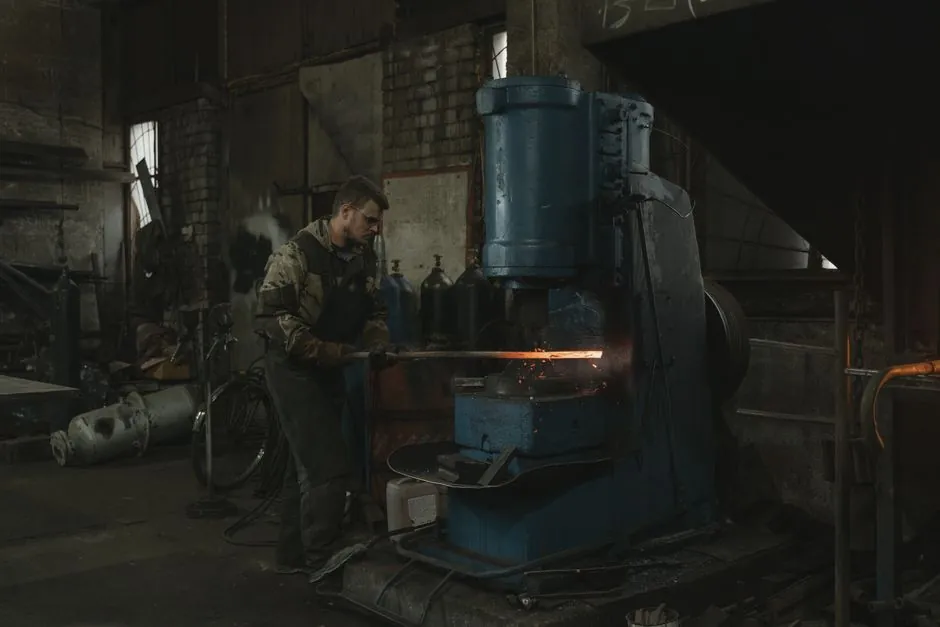
The cupola furnace is generally the better economic choice for uniform gray iron castings produced continuously above 40 metric tons per hour, whereas a rotary furnace is the more flexible option for variable charges, smaller campaigns and controlled oxidation [S3][S5].
The comparison is principally about production rate, scrap tolerance, chemistry control, superheating capability and operating complexity. A cupola retains its advantage for high-volume, repetitive iron melting, but it does not adapt easily to changing demand and is inefficient for superheating iron [S4].
Production Rate and Operating Pattern
For a high-tonnage foundry running the same gray iron grade through repeated pours, the cupola is the stronger selection because ASM identifies it as the better economic solution for uniform castings at rates exceeding 40 t/h [S3]. Its cylindrical steel shell, refractory lining and bottom tuyeres support a continuous stream of iron, while coke provides the heat and limestone assists slag formation [S5].
Rotary furnaces have the opposite operating advantage. Their batch format permits the charge to be changed between heats, so a foundry can run different scrap mixes, alloy additions and production targets without redesigning the entire campaign. That flexibility is valuable below the high-volume regime, for short production runs and for foundries serving many casting sizes. It also avoids committing a large continuous iron system to a product mix that may change.
U.S. cupola operations still represent a substantial industrial base: cupolas account for about 32% of foundry iron production, or roughly 4.7 million tons per year, while the 10 largest cupola producers melt about 3 million tons annually [S2]. The top 10 producers therefore operate at an average scale of about 300,000 tons per year, demonstrating the production concentration behind the cupola’s high-rate economics.
Gray Iron Chemistry and Charge Tolerance
Gray cast iron normally contains 2.0–4.0% carbon and 1.0–3.0% silicon, with manganese at 0.40–1.0%, sulfur at 0.05–0.25% and phosphorus at 0.05–1.0% [S1]. A furnace that can accept variable scrap and still reproduce these limits provides a major practical advantage for high-volume gray iron operations.
Cupolas can process contaminated, dirty, oily, painted, mixed and zinc-coated scrap efficiently, and they do not require every incoming fragment to be clean, dense and homogeneous [S2]. That charge tolerance supports the economic case for large gray iron operations, where the cost and availability of scrap can outweigh the environmental and control advantages of an electric furnace.
Rotary melting can also process foundry scrap and return charges, but it remains more dependent on batch preparation and chemistry management. The distinction is not that either furnace can ignore sulfur, phosphorus, zinc or coating contamination. It is that the cupola has a documented operating advantage with the mixed charge streams common in gray iron foundries, while a rotary furnace is more attractive when each campaign can be sorted, weighed and adjusted as a discrete batch.
Cost, Flexibility and Energy Comparison
On capital and operating strategy, cupola versus rotary furnace selection depends on the production target. The cupola wins on continuous output above 40 t/h and where dirty scrap is a dependable feed [S3]. The rotary furnace wins where product mix changes frequently, campaign sizes are smaller, or the foundry values independent control over each heat.
Gray iron production in the cited U.S. comparison is approximately 2.4 million tons per year, compared with 2.1 million tons per year for ductile iron [S2]. A foundry with 1,000 t/h of gray iron demand can justify a large cupola installation. A shop producing 5 t/h in alternating grades cannot apply that same economic logic. Even at 20 t/h, a plant may gain from continuous cupola operation, but the 40 t/h figure provides a useful published breakpoint for uniform castings, not a universal minimum for every configuration [S3].
Rotary furnaces also avoid the operational constraints of holding a large coke-fired system at a steady state, while cupolas avoid the furnace-change and batch-cycling losses associated with rotary processing. The proper comparison is therefore per saleable casting, including metal yield, coke and electricity use, refractory wear, labor, charge preparation and lost production during a campaign change. A quoted purchase price alone does not establish the lower total cost.
Superheating, Oxidation and Product Quality
Gray iron melt quality depends on temperature stability and chemistry control, not simply on whether the furnace reaches a nominal melting temperature. The published technical limitation is explicit: a cupola “does not adapt easily to varying demands, nor is it an efficient furnace for superheating iron” [S4].
That limitation makes the cupola less attractive when the casting plan requires a large superheat margin, precise pouring temperature or frequent transition between iron grades. A rotary furnace provides greater batch-level control and can be stopped without maintaining a continuously burning coke burden. That operating flexibility is the stronger argument for rotary melting, not an automatic claim of superior casting quality.
The rotary furnace is more readily associated with nonferrous melting than with large gray iron campaigns, so its evaluation should include the ability to handle the specific iron charge, required lining, slag practice and temperature profile. Related process selection for crucible versus rotary melting of nonferrous scrap illustrates why furnace geometry, charge behavior and batch discipline must be matched to the metal rather than selected from a general furnace ranking.
Environmental and Control Tradeoffs
Coke combustion creates a larger process-emission burden at the cupola than an electric melting route, because carbon is burned in the furnace to generate heat. Modern cupola systems can still improve fuel performance, and optimized cupola melting is presented as economically competitive with induction melting, but the comparison depends on regional electricity generation and local operating conditions [S2].
The environmental decision cannot be reduced to “coke versus electricity.” A low-carbon electric grid changes the emissions balance substantially, while a grid with carbon-intensive generation weakens that advantage. Cupola performance must also be assessed through hot-metal output, air and oxygen delivery, sensible heat loss, Boudouard reactions and slag generation [S2].
Rotary furnaces generally have less inherent carbon-combustion equipment, but their total environmental case still depends on electricity consumption, charge yield, refractory service and batch rejection. Neither option automatically satisfies an emissions target. The controlling data are annual coke or electricity consumption, scrap utilization, recovered output, slag mass and measured CO2 per tonne of saleable casting.
Decision Rules by Foundry Profile
Choose a cupola when gray iron demand is stable, output is continuous, the casting mix repeats, and the charge includes substantial dirty or mixed foundry scrap. The selection is strongest for uniform castings above 40 t/h, where coke-fueled continuous operation and high scrap tolerance create the clearest economic case [S2][S3].
Choose a rotary furnace when production is intermittent, campaign sizes are modest, grades or charge recipes change frequently, or each heat requires independent temperature and chemistry control. The case weakens when the foundry cannot justify dedicated rotary equipment, the iron volume is too small, or continuous output is needed to amortize the system.
Do not choose a rotary furnace solely because it offers cleaner combustion, and do not choose a cupola solely because it has lower scrap cost. The documented cupola advantages are continuous high-rate operation, mixed-scrap tolerance and economic production of uniform castings above 40 t/h [S2][S3]. The documented rotary advantages are batch flexibility and easier adaptation to variable production [S4]. For a plant with 2,400 t/h of repetitive gray iron demand, the cupola normally wins on scale. For a 5 t/h shop changing heats every few days, the rotary furnace may be the more rational choice.
Before procurement, capture the foundry’s average and peak melt rate, annual gray iron tonnage, number of grades, scrap contamination rate and required superheat margin. Then compare each proposal using saleable tonnes per hour, coke or electricity per tonne, yield, campaign change time, refractory life and measured CO2 per tonne, with the selected furnace sized around those verified operating figures.