On the Made-in-China B2B index, listed CT unit prices span roughly US$0.27 to US$235 per piece in 2026, with the spread almost entirely explained by primary current, accuracy class, and core type rather than by brand alone [S1].
More than 2,000 manufacturers and 6,000+ CT products are indexed on the platform, and the same source shows MOQ tiers starting at 1 piece for listings from Demule and Denggao [S1].
What a current transformer actually is and why price varies
A current transformer is an instrument transformer that steps down a high primary alternating current to a standardised secondary current (typically 1 A or 5 A) for metering and protection, and its core material — silicon steel, Fe-based amorphous (1K101), or Fe-based nanocrystalline (1K107) ribbon — is the single largest material cost driver [S2][S3].
Manufacturers split the CT catalog into four mechanical families: PCB-mounted, bushing-type, casing-type, and split-core, plus dedicated three-phase and Hall-effect current sensors, and each family targets a different busbar or PCB footprint with its own tooling cost [S3]. Because a precision current transformer is selected around burden VA and accuracy class (e.g. 0.2S, 0.5, 5P10), the magnetising current loss and core cross-section scale with the meter's burden, which is why a 0.2S revenue-metering CT costs several times a 5P10 protection-only unit at the same primary current [S2].
2026 price tiers observed in the China B2B market
Five live CT listings on Made-in-China, all dated within the rolling 6-month window used for this guide, set the realistic price bands engineers should anchor to [S1]:
PCB-mount and relay-class CTs from Jiangxi Weiqi Electric sit at US$0.27/piece at 100-piece MOQ and US$0.29/piece at 1,000-piece MOQ, a textbook example of how volume tier moves price (here by roughly -7% at 10× volume) [S1]. AL Transfo Technology lists split-core and toroidal CTs at US$0.84-0.86/piece at 200-300 piece MOQ from Hefei, Anhui [S1]. Demule Transformer (Zhejiang) prices general-purpose CTs at US$42, US$156, and US$235 per piece at 1-piece MOQ, with the spread tracking primary current and insulation class [S1]. Beijing GFUVE Electronics lists metering and test-grade CTs at US$30, US$180, and negotiable tiers, with energy-meter calibration and power-quality analyser SKUs concentrated in the US$180 band [S1]. Denggao Electric (2000+ m² plant, 427 employees) anchors its drop-out fuse cutout, lightning arrester, and switchgear-aligned CT line at US$100/piece at 1-piece MOQ [S1].
Nanjing Qineng Electronic Technology lists split-core CTs and Hall-effect current/voltage sensors at US$1.00, US$2.10, and US$3.00 per piece at 1-3 piece MOQ, the typical Hall-sensor band where the transducer cost dominates over the magnetic core [S1].
Cost drivers, ranked
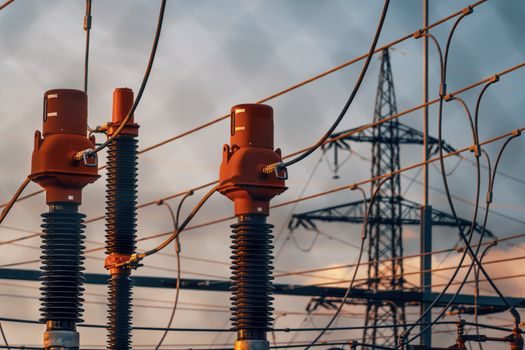
Core material is the dominant material cost in a current transformer, and the upgrade from grain-oriented silicon steel to Fe-based amorphous 1K101 ribbon or nanocrystalline 1K107 ribbon roughly doubles the magnetic material cost but cuts no-load loss and magnetising current, which is why precision metering CTs and high-frequency switching CTs consistently use amorphous or nanocrystalline cores [S3].
Primary current rating and short-time thermal current (Ith) drive the conductor cross-section and the number of primary turns; a 600 A/5 A CT uses a much smaller core window than a 4000 A/5 A busbar CT, and the latter's cost is typically 3-5× higher at the same accuracy class because of the larger core and heavier insulation. Accuracy class compounds that: 0.2S revenue-metering CTs require more turns, tighter burden matching, and phase-error calibration, and they list 2-4× above 1.0-class or 5P10 protection CTs of the same ratio [S2].
Certification (ISO 9001:2015 mgmt. cert, IEC 61869 family compliance for instrument transformers) and test reports (CT PT analyser, energy-meter calibration) are bundled into the higher-tier Beijing GFUVE and Qinhuangdao Dechang Electric SKUs, adding roughly 10-20% to the unit price but removing the buyer's incoming-test burden [S1].
Comparison: low-end PCB CT vs precision metering CT vs medium-voltage power CT
On the four decision criteria that move price the most, the three common CT classes line up as follows, anchored to the 2026 listings [S1]:
PCB-mount relay CT (Jiangxi Weiqi class): primary current typically 5-100 A, accuracy 1.0-3.0, core is silicon-steel toroid, US$0.27-0.29/piece at 100-1,000 piece MOQ, MOQ-driven pricing [S1]. Split-core / Hall-effect CT (AL Transfo, Nanjing Qineng class): primary current 100-2000 A, accuracy 1.0-3.0 with Hall output, core is silicon-steel split core or Hall IC, US$0.84-3.00/piece at 1-300 piece MOQ, sensor-IC cost dominates [S1]. Medium-voltage metering and power CT (Demule, Denggao, GFUVE class): primary current 600-4000 A, accuracy 0.2S-0.5 with burden 5-30 VA, core is silicon-steel or amorphous/nanocrystalline (1K101/1K107) with cast-resin or oil-paper insulation, US$100-235/piece at 1-piece MOQ, configuration-driven pricing [S1][S3].
Total cost of ownership, not just unit price

For panel builders and switchgear OEMs, the all-in cost is rarely the CT unit price alone; burden VA, wiring, and the upstream meter or relay drive the spec, and an undersized CT forces a more expensive meter downstream [S2].
Installation cost is dominated by the busbar or cable preparation: split-core CTs clamp over an existing conductor in minutes, while a bar-primary CT requires the busbar to be broken and re-terminated with proper torque, often adding 1-2 labour-hours per phase on a 4000 A switchboard. Calibration and test cost shows up on the metering side: a 0.2S revenue CT must be accompanied by a CT PT analyser trace, and Beijing GFUVE bundles this into its US$180 tier, which is why the higher unit price often beats a cheap CT plus a separate on-site calibration visit [S1].
For a related upstream transformer cost reference, the Oil-Immersed Transformer Price Guide 2026: kVA, Core, and Cost Drivers walks through the same kVA-and-core trade-off at the distribution-transformer level, and a precision CT sits logically in the metering cubicle downstream of that transformer. Energy and loss cost over the asset life is small for CTs (typically 1-5 W no-load loss) compared with the upstream power transformer, so it is rarely the deciding factor unless the CT is on a continuously energised summation bus with thousands of units.
Who current transformers are for, and who should skip them
CTs are the right instrument transformer for any AC metering or protection scheme above about 5 A primary, including revenue billing, power-quality analysers, and overcurrent / differential protection, and they are mandatory where direct shunt insertion is impractical or unsafe [S2].
They are NOT for DC measurement (use a Hall-effect current sensor or a manganin shunt instead — Malio lists PCB-mounted EBW shunts and EBW shunts with brass terminals in the same product family) [S3]. They are also not a substitute for a power transformer on the energy side, and a dry-type transformer for distribution should be specced separately from the CT that meters it. Engineers specifying protection CTs should remember that a CT saturates above its accuracy-limit primary current, and once saturated, the secondary no longer represents the primary — this is the single most common field failure mode in differential protection schemes and is why 5P10 or 10P10 class is non-negotiable for busbar differential.
Sourcing, standards, and trackable signals
Instrument transformer performance is governed by the IEC 61869 family, with accuracy classes 0.1-0.2S-0.2-0.5-0.5S-1.0-3.0 for metering and 5P-10P for protection; the 0.2S and 0.5S classes are the revenue-metering tiers where phase error at low primary current (1% of rated) is tightly bounded [S2].
For sourcing, the 2,000+ manufacturer base on Made-in-China gives wide price dispersion, and the practical filter is supplier capability: ISO 9001:2015 mgmt. cert, in-house CT PT analyser test benches, and willingness to share type-test reports at the offered accuracy class [S1]. For amorphous and nanocrystalline core supply — the upgrade path for precision CTs — Malio (Shanghai) lists Fe-Based 1K101 amorphous ribbon, 1K107 nanocrystalline ribbon, and finished amorphous E-cores, C-cores, and bar-block cores alongside its CT line, which is the typical one-stop BOM in this segment [S3]. Coilcraft's free-sample same-day shipping program is the comparable North-American fast-turn signal for low-current PCB CTs and is worth a check when prototyping [S4].
Trackable signals for the next 3-6 months: amorphous and nanocrystalline ribbon price moves (driven by Fe-Si-B feedstock), any IEC 61869 revision activity affecting 0.2S phase-error limits, and MOQ-tier compression as more Chinese CT exporters compete on the same Made-in-China storefronts — each of these will move the per-unit numbers in the table above by single-digit percent without changing the four-tier structure.
Component reference pages worth checking: eddy current tester.