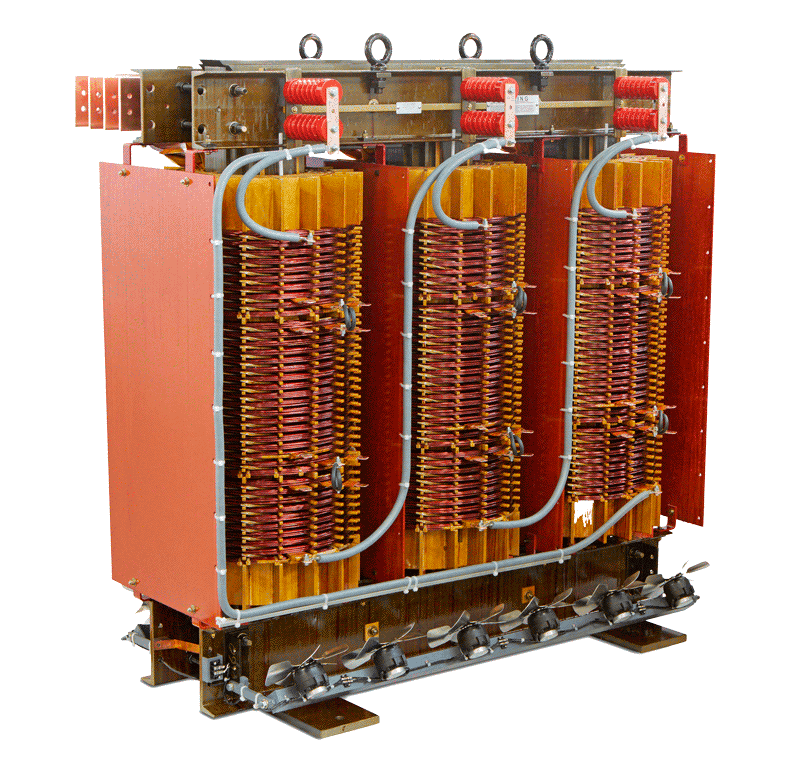
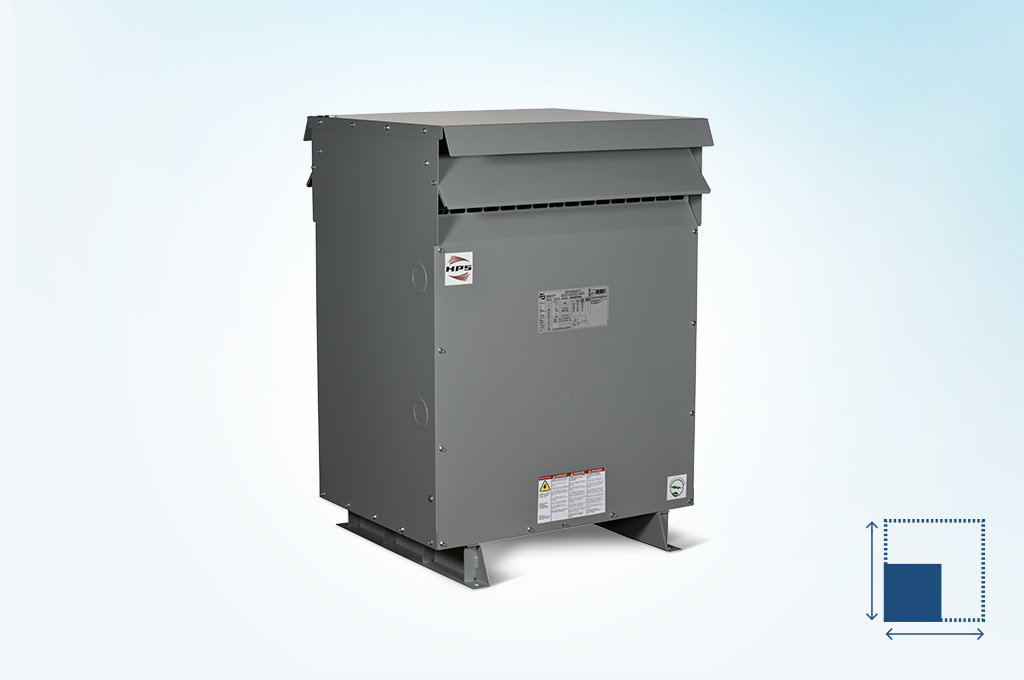
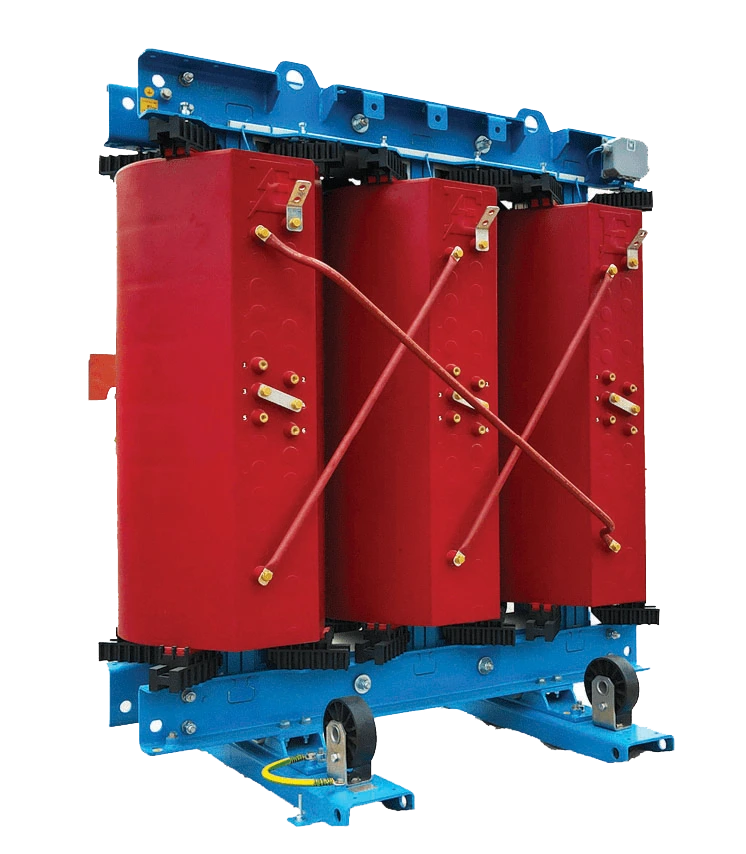
A dry-type transformer is a static electromagnetic device that steps voltage up or down using windings cooled and insulated by air and solid materials, not by mineral or ester oil. Because it carries no flammable liquid, it can be installed indoors, next to the load it serves, without a fire vault or an oil-containment bund. The two dominant constructions are cast resin, where the medium-voltage coil is encapsulated in vacuum-cast epoxy, and vacuum pressure impregnated (VPI), where an open winding is impregnated with varnish.
This category sits under Electrical & Automation, in power distribution equipment. The reference standard is IEC 60076-11 internationally and ANSI/IEEE C57.12.01 in North America. Both define the climatic, environmental, fire, thermal, and loss requirements that separate a building-grade unit from a utility-grade one.
This guide is written for procurement engineers and design engineers comparing dry-type transformers before a six- or seven-figure purchase. It covers six chapters, from what the device is and how it differs from oil units, through cast resin and VPI construction, the IEC 60076-11 class system, key nameplate parameters, and the selection decision sequence, plus seven selection FAQs and verified manufacturer references. All parameters reference the public standards IEC 60076-11, ANSI/IEEE C57.12.01, IEEE C57.110, UL 1561, and EU Ecodesign Regulation 548/2014.
Chapter 1 / 06
What is a Dry-Type Transformer
A dry-type transformer performs the same job as any transformer: it transfers electrical energy between two or more windings through a shared magnetic core, built from stacked silicon steel laminations, changing voltage and current in inverse proportion while keeping power, minus losses, constant. What defines the dry-type family is the insulation and cooling medium. Instead of immersing the active part in mineral oil or synthetic ester, a dry type relies on air for cooling and on solid insulation, either cast epoxy resin or impregnating varnish, for dielectric strength. There is no liquid to leak, sample, filter, or catch fire.
That single design choice drives almost every practical advantage and limitation. Because the cooling medium is air rather than oil, a dry type runs hotter at the same loading and at the same physical size, so it carries a lower power density and tends to be larger and heavier per kVA in the medium-voltage range. In exchange, it earns fire class F1 under IEC 60076-11, meaning it can be placed inside an occupied building, a basement substation, a ship, a wind turbine nacelle, a tunnel, or a data hall, in each case close to the load, without the fire-separation vault, oil bund, and deluge system that an oil-filled unit of the same rating would require.
The industrial history of the dry type tracks the history of high-temperature solid insulation. Early dry transformers used class A cellulose and varnish systems limited to roughly 105 degrees C and were confined to small, low-voltage ratings. The decisive step came in the 1960s, when manufacturers learned to cast medium-voltage windings inside epoxy resin under vacuum, eliminating internal voids and the partial discharge they cause. Siemens introduced its GEAFOL cast resin line in 1965; the technology made distribution-class dry transformers practical at thousands of kVA and tens of kilovolts. Vacuum pressure impregnation matured in parallel as a lower-cost open-winding alternative.
In terms of scale, dry types now span from a 1 kVA control transformer up to medium-power units above 40 MVA. Siemens states its GEAFOL cast resin range covers roughly 50 kVA to over 40,000 kVA at voltages up to 52 kV, and the family is partial-discharge-free up to twice rated voltage. Above roughly 10 MVA, and at transmission voltages of 72.5 kV and higher, the oil-immersed power transformer reasserts its cost and thermal advantage, so the dry type is principally a distribution and intake-substation device rather than a grid transmission device.
Four engineering attributes determine dry-type quality and total cost of ownership: the insulation thermal class and temperature rise it actually runs at, the IEC 60076-11 climatic, environmental, and fire class certified by independent test, the no-load and load losses against the prevailing efficiency regulation, and the partial discharge level measured at the factory. A unit that is cheap on the purchase order but runs hot, loses efficiency, or discharges internally will age its own insulation and impose decades of higher energy cost on the building that houses it.
Chapter 2 / 06
Construction Types and Classification
Dry-type transformers divide into three construction families by how the winding is insulated and exposed: open-wound (also called open ventilated or dip-and-bake), vacuum pressure impregnated (VPI), and cast resin (also called cast coil or encapsulated). The three form a ladder of rising moisture resistance, fire performance, and cost. Choosing the wrong rung is the most common and most expensive selection error, because the cost of an unplanned outage in a hospital or data center dwarfs the price difference between a VPI and a cast resin unit. The table below sets out the core distinctions.
Construction
Winding Insulation
Typical Voltage
Moisture / Pollution Resistance
Typical Use
Open-wound (ventilated)
Dip-and-bake varnish, open coil
Up to 1.1 kV mostly
Low
Clean indoor LV distribution
VPI
Vacuum-impregnated polyester / epoxy varnish
Up to 36 kV
Moderate
Controlled indoor commercial / industrial
Cast resin
Vacuum-cast epoxy with quartz filler
Up to 52 kV
High (C2 E2)
Data centers, hospitals, marine, humid sites
Open-wound ventilated transformers leave the conductors exposed between turns, coated only with dipped and baked varnish, and rely on free air circulation through the coil for cooling. They are the simplest and least expensive dry type, used mainly for low-voltage distribution in clean, dry, climate-controlled indoor spaces. Their open structure offers little defence against humidity, dust, or corrosive atmospheres, and an extended de-energization in a damp room can lower insulation resistance enough to require drying before re-energization.
VPI transformers take an open winding, place it in a vacuum chamber to draw out air and moisture, then impregnate it under pressure with polyester or epoxy varnish that penetrates the insulation layers and the gaps between turns. The result keeps ventilation channels open, so a VPI unit cools efficiently and costs less than cast resin, while gaining better moisture resistance than a bare open-wound coil. VPI suits standard indoor commercial and industrial duty where the environment is controlled and the highest moisture immunity is not required. VPI windings commonly use class F, class H, or class 220 insulation systems.
Cast resin transformers fully encapsulate the medium-voltage winding in epoxy resin mixed with quartz powder, cast under vacuum so no internal voids remain. The sealed coil is immune to humidity and pollution, mechanically robust against short-circuit forces, and self-extinguishing, which is why cast resin readily meets the severe C2 climatic and E2 environmental classes and the F1 fire class of IEC 60076-11 without auxiliary dehumidification. Cast resin is the choice where an outage is unacceptable: data centers, hospitals, airports, marine and offshore platforms, and humid or contaminated industrial sites.
Beyond construction, dry types are also classified by cooling method using the IEC two-letter code. AN (air natural) relies on convection alone and is the baseline rating. AF (air forced) adds fans; cross-flow fans typically lift the continuous rating by 40 to 50 percent above the AN figure, giving an inexpensive overload reserve. Larger units may use AFWF with a forced-water heat exchanger. Each transformer is rated for one or more of these stages, for example a natural-convection AN rating paired with a higher AF rating that the fans engage on demand.
Chapter 3 / 06
Cast Resin and VPI Technologies
Cast resin and VPI are the two technologies that matter at medium voltage, and the trade-off between them recurs in almost every project specification. They are not simply better and worse; each wins on different axes. Cast resin wins on moisture immunity, fire performance, mechanical robustness, and maintenance-free operation. VPI wins on cooling efficiency, first cost, and weight. The table below compares the engineering metrics that drive the decision.
Metric
Cast Resin
VPI
MV winding insulation
Vacuum-cast epoxy + quartz, sealed
Impregnated open varnish, ventilated
IEC 60076-11 class
Up to C2 E2 F1
Typically C1/C2 E1 F1
Partial discharge
PD-free to 2x rated voltage
Higher, void-dependent
Relative first cost
Higher
Lower
Cooling / thermal margin
Good, sealed coil
Better airflow, lower rise
Moisture / pollution
Immune, no drying needed
Limited, may need drying
Cast resin construction begins by winding the medium-voltage coil, then placing it in a mold and casting epoxy resin filled with quartz powder around it under vacuum. The vacuum step is critical: it removes air before the resin sets, so the cured coil contains no voids. Voids are where partial discharge starts, and partial discharge slowly erodes solid insulation from within until it fails. A void-free cast coil can therefore be certified partial-discharge-free up to twice rated voltage, as Siemens states for GEAFOL. The cured epoxy and quartz body is also flame-retardant and self-extinguishing, with low smoke and toxic-gas emission, which is what earns the F1 fire class.
The same encapsulation makes the coil hermetic to its environment. Humidity, salt fog, conductive dust, and corrosive vapor cannot reach the conductor, so a cast resin unit holds its insulation resistance through long shutdowns and can be re-energized without drying. This is the property that lets cast resin satisfy the C2 climatic class, verified by a cold test, and the E2 environmental class, which assumes frequent condensation and heavy pollution. The cost is that epoxy encapsulation uses more material and a more demanding process, raising both the purchase price and the weight relative to VPI.
VPI construction keeps the winding open and impregnates it rather than encapsulating it. The assembled coil is evacuated to pull moisture and air out of the insulation, then flooded with low-viscosity polyester or epoxy varnish under pressure so the varnish wicks into every layer and turn-to-turn gap. The coil is then drained and cured. Because the surface stays open, air flows freely through the winding, giving lower thermal resistance and a lower temperature rise than an encapsulated coil of the same rating, which translates into better cooling efficiency and lower cost.
The limitation is exposure. A VPI coil resists moisture far better than a bare open-wound coil, but it is not sealed, so in a humid, condensing, or polluted environment its insulation resistance can fall and it may need periodic drying before re-energization. For this reason VPI is specified for clean, dry, controlled indoor environments, while cast resin is specified where continuity of supply is critical or the environment is harsh. A practical rule used by many specifiers: if an unplanned outage is merely inconvenient, choose VPI; if an unplanned outage is unacceptable or the room is humid, choose cast resin.
Chapter 4 / 06
Standards and Class System
A dry-type transformer specification is governed by a small set of standards that define its environmental ruggedness, its thermal limits, its efficiency, and its harmonic capability. The internationally dominant standard is IEC 60076-11, currently edition 2.0 of 2018, harmonized as EN 60076-11. North America uses ANSI/IEEE C57.12.01 for general requirements with C57.12.91 for the test code, and UL 1561 for listing. Understanding the class letters and the thresholds behind them is what lets a buyer compare two nameplates on equal terms.
IEC 60076-11 climatic, environmental, and fire classes are the heart of the dry-type specification, and they are independent of one another. The climatic class describes how cold the transformer can go: C1 means it operates down to -5 degrees C and may be stored or transported to -25 degrees C, while C2 confirms operation, storage, and transport down to -25 degrees C, verified by a dedicated cold test. The environmental class describes humidity and pollution: E0 means no condensation or pollution, E1 allows occasional condensation and restricted pollution, and E2 allows frequent condensation and heavy pollution. The fire class describes flammability: F0 imposes no special fire restriction, while F1 requires restricted flammability with limited heat release and minimized smoke and toxic emission. A premium cast resin unit is certified C2 E2 F1.
Class
Designation
Meaning
Climatic
C1
Operates to -5 degrees C; transport and storage to -25 degrees C
Climatic
C2
Operation, storage, transport to -25 degrees C, cold test verified
Environmental
E0
No condensation, no pollution (clean, dry room)
Environmental
E1
Occasional condensation, restricted pollution
Environmental
E2
Frequent condensation, heavy pollution
Fire
F0
No special fire-restricting requirement
Fire
F1
Restricted flammability, limited heat, low smoke and toxicity
Thermal class and temperature rise form a second axis. The insulation system carries a thermal class set by the materials, commonly class F (155 degrees C), class H (180 degrees C), or class 220 (formerly designated R) for high-temperature VPI. Within a thermal class, the standard caps the average winding temperature rise above ambient. Under IEC, a class F winding is limited to a 100 K rise above a maximum 40 degrees C ambient. Under ANSI/IEEE C57.12.01, dry types are commonly specified at an 80, 115, or 150 K rise above a 40 degrees C ambient on a 220 degrees C insulation system. A lower rise on the same system leaves more margin to the thermal limit, which lengthens life and allows overload.
Efficiency regulation is the third axis and is now mandatory in major markets. In the European Union, Ecodesign Regulation 548/2014 sets minimum efficiency for transformers rated 1 kVA and above on 50 Hz networks, with Tier 1 effective 1 July 2015 and the tighter Tier 2 effective 1 July 2021. Tier 2 caps no-load and load losses in watts for medium-power dry types and, above 3,150 kVA, sets a minimum Peak Efficiency Index (PEI). The United States enforces the DOE 2016 efficiency standard, derived from NEMA TP-1, instead. Meeting either standard requires more core and conductor material, so it affects both first cost and physical footprint.
Harmonic capability is the fourth standards axis for modern electronic loads. UL 1561 recognizes K-factor ratings K-1, K-4, K-9, K-13, K-20, K-30, K-40, and K-50, calculated using the method of IEEE C57.110. The K-number expresses how many times the rated 60 Hz winding eddy-current loss the design can dissipate without exceeding its thermal limit when supplying harmonic-rich current, such as that drawn by a variable frequency drive feeding a motor. A K-rated transformer also requires a neutral bus rated for at least 200 percent of full-load current to carry triplen harmonic currents that add in the neutral, and severe harmonic distortion may additionally warrant a separate harmonic filter on the network.
Chapter 5 / 06
Key Specification Parameters
Reading a dry-type transformer nameplate is a core procurement skill. A datasheet may list two or three dozen entries, but a manageable set of parameters drives the selection and the price: rated power, voltage ratios and tap range, vector group, impedance, no-load and load losses, temperature rise and thermal class, BIL, partial discharge, sound level, ingress protection, and K-factor. Each is explained below, with the standard kVA ladder shown for reference.
Rated power (kVA / MVA) is apparent power, not real power, because the transformer must carry the full current regardless of the load power factor. Distribution dry types follow a preferred IEC R10 ladder, with each step roughly 25 percent above the previous: 100, 160, 200, 250, 315, 400, 500, 630, 800, 1,000, 1,250, 1,600, 2,000, and 2,500 kVA, continuing upward to medium-power units above 40 MVA. Size to the maximum demand plus a margin, not to the connected load, and remember that an AF cooling stage can add 40 to 50 percent on top of the AN rating for intermittent peaks.
Parameter
Typical Range / Value
Governing Standard
Rated power
100 to 2,500 kVA (to over 40 MVA)
IEC 60076-1
Highest voltage Um
Up to 52 kV
IEC 60076-11
Vector group
Dyn11 (typical LV distribution)
IEC 60076-1
Impedance Uk
4 to 10 % (commonly 6 %)
IEC 60076-1
Temperature rise (class F)
100 K (IEC); 80, 115, 150 K (IEEE)
IEC 60076-11 / C57.12.01
Off-load tap range
Typically +/- 2 x 2.5 %
IEC 60076-1
Ingress protection
IP00 / IP21 / IP23 / IP54
IEC 60529
Voltage ratio, tap range, and vector group define how the unit fits the network. A typical building distribution transformer steps a medium-voltage primary, for example 11 kV or 20 kV, down to a 400 V or 415 V three-phase secondary. Off-load taps, usually plus or minus two steps of 2.5 percent, let an installer trim the ratio to the actual incoming voltage during commissioning, when the transformer is de-energized. The vector group, most often Dyn11 for distribution, means a delta primary and a star (wye) secondary with an earthed neutral and a 30-degree phase shift; the wye neutral provides the building earth reference and helps with unbalanced and harmonic loads.
Impedance (Uk) is the percentage of rated primary voltage needed to drive rated current through a short-circuited secondary, and it sets the short-circuit current the downstream circuit breaker in the distribution board must interrupt. Distribution dry types commonly run 4 to 10 percent, with 6 percent typical. Lower impedance gives better voltage regulation but higher fault current; higher impedance limits fault current but worsens regulation and voltage dips on motor starting. Impedance must be coordinated with the protective device ratings and, in parallel operation, matched between transformers.
Losses are split into no-load loss, which is the core (iron) loss present whenever the unit is energized, and load loss, the copper and stray loss that rises with the square of the load current. No-load loss runs 24 hours a day for the transformer's life, so it dominates the energy cost of a lightly loaded unit, which is exactly why the Ecodesign and DOE regulations cap it. BIL (basic lightning impulse level) is the crest withstand for a standard 1.2/50 microsecond surge and scales with the voltage class. Partial discharge, measured in picocoulombs, indicates internal void activity; a quality cast resin coil is partial-discharge-free up to twice rated voltage. Sound level, in dB, and ingress protection, from IP00 to IP54, round out the environmental specification.
Chapter 6 / 06
Selection Decision Factors
To turn the preceding five chapters into a specific model, follow the decision sequence below. Most selection mistakes are not a single wrong number but a decision taken at the wrong level, for example fixing the kVA before understanding the load harmonic content, or fixing the construction before knowing the room humidity. The eight steps below double as a fixed RFQ template.
Power rating and cooling stages: Size the AN rating to maximum demand plus margin from the IEC R10 ladder, then decide whether an AF stage is needed for peak or contingency loading, recalling that fans add roughly 40 to 50 percent over the AN figure.
Voltage, tap range, and vector group: Fix the primary and secondary voltages, the highest voltage for equipment (Um up to 52 kV), the off-load tap range (commonly plus or minus 2 by 2.5 percent), and the vector group (Dyn11 for most LV distribution).
Construction type: Choose open-wound, VPI, or cast resin from the room environment and continuity requirement: cast resin for humid, polluted, or outage-critical sites; VPI for clean, controlled indoor duty; open-wound only for benign low-voltage cases.
IEC 60076-11 class certificate: Require the verified climatic, environmental, and fire class, typically C2 E2 F1 for severe duty, and confirm it is supported by an independent test report, not merely claimed.
Thermal class and temperature rise: Specify the insulation system (class F, H, or 220) and the temperature rise (100 K under IEC, or 80, 115, 150 K under IEEE) to set the thermal margin and the overload capability you actually get.
Losses and efficiency tier: State the applicable regulation (Ecodesign Tier 2 in the EU, DOE 2016 in the US) and the maximum no-load and load losses, because no-load loss runs continuously and drives lifetime energy cost.
Harmonics and K-factor: Estimate the non-linear load share. For drives, UPS, LED, and IT loads, specify a K-factor (K-4, K-13, or K-20 per UL 1561 and IEEE C57.110) and a neutral bus rated for at least 200 percent of full-load current.
Enclosure, ingress, and accessories: Fix the IP grade (IP21 indoor, IP23 weather-angled, IP54 dust and splash), enclosure derating, sound limit, temperature monitoring (PT100temperature sensors and a controller), and short-circuit withstand to the project fault level.
One last dimension is often overlooked: manufacturer serviceability. Local spare-part inventory, field temperature-controller and fan support, factory test reports traceable to the nameplate, and the maker's ability to retest after a fault all determine repair response time over a 20- to 30-year service life. Established medium-voltage dry-type series with broad service coverage include Siemens GEAFOL, ABB RESIBLOC, Schneider Electric Trihal, Eaton, and Hitachi Energy, alongside Hammond Power Solutions, TMC, and Olsun in North America. Confirm the C2 E2 F1 certificate, the thermal class, the loss tier, and the service footprint before committing to a series.
FAQ
What is the difference between a dry-type and an oil-immersed transformer?
A dry-type transformer cools and insulates its windings with air and solid insulation (epoxy resin or impregnating varnish) rather than mineral or ester oil. Because there is no flammable liquid, dry types carry fire class F1 under IEC 60076-11 and are installed indoors and close to the load without a fire vault or oil-containment bund. Oil-immersed units run cooler at the same loading, achieve higher efficiency and voltage classes (up to hundreds of kV), and cost less per kVA above roughly 10 MVA, but they require oil testing, leak management, and fire separation. Dry types dominate buildings, data centers, ships, and tunnels; oil types dominate utility substations and large industrial intakes.
What is the difference between cast resin and VPI dry-type transformers?
In a cast resin transformer the medium-voltage winding is fully encapsulated in vacuum-cast epoxy and quartz filler, giving a sealed, moisture-immune, partial-discharge-free coil that meets the severe C2 climatic and E2 environmental classes of IEC 60076-11. In a VPI (vacuum pressure impregnated) transformer the open winding is dipped and impregnated with polyester or epoxy varnish, leaving ventilation channels between turns. VPI runs cooler for a given rating and costs less, but its open structure has lower moisture and contamination resistance, so it suits clean, dry indoor environments. Cast resin is preferred for data centers, hospitals, and humid or polluted sites where continuity matters.
What do the IEC 60076-11 classes C2, E2, and F1 mean?
IEC 60076-11 assigns three independent class letters. The climatic class describes minimum temperature: C1 allows operation down to -5 degrees C (storage and transport to -25 degrees C), while C2 confirms operation, storage, and transport down to -25 degrees C with a verified cold test. The environmental class describes humidity and pollution: E0 means no condensation or pollution, E1 allows occasional condensation and restricted pollution, and E2 allows frequent condensation and heavy pollution. The fire class describes flammability: F0 means no special fire-restricting requirement, while F1 means restricted flammability with limited heat release and minimized smoke and toxic emission. A premium cast resin unit is typically certified C2 E2 F1.
How do I select the temperature rise class and insulation system?
Cast resin and VPI dry types use high-temperature solid insulation systems, most commonly thermal class F (155 degrees C) and class H (180 degrees C); class 220 (formerly R) is used in some VPI designs. Under IEC the class F winding temperature rise limit is 100 K above a 40 degrees C maximum ambient. Under ANSI/IEEE C57.12.01 the common rises are 80, 115, and 150 K above a 40 degrees C ambient on a 220 degrees C system. Lower rise for the same insulation class buys thermal margin: an 80 K rise design loaded to nameplate runs far below its insulation limit, extending life and allowing overload. Specifying a lower rise costs more copper but lowers losses and lengthens service life.
Do I need a K-factor transformer for non-linear loads?
Yes, when a significant share of the load is electronic: variable frequency drives, UPS rectifiers, LED lighting, and IT power supplies inject harmonic currents that multiply winding eddy losses and create localized hot spots in a standard transformer. UL 1561 recognizes K-ratings K-1, K-4, K-9, K-13, K-20, K-30, K-40, and K-50, calculated per IEEE C57.110; the number is roughly how many times the rated eddy losses the design can dissipate. K-4 suits moderate drive loads, K-13 suits offices, schools, and hospitals dominated by non-linear loads, and K-20 suits data centers and mission-critical UPS rooms. A K-rated unit also needs a neutral bus rated for at least 200 percent of full-load current to carry triplen harmonics.
What efficiency rules apply to dry-type transformers in Europe?
EU Ecodesign Regulation 548/2014 sets minimum efficiency for transformers from 1 kVA upward on 50 Hz networks. Tier 1 applied from 1 July 2015 and the stricter Tier 2 from 1 July 2021. Tier 2 caps no-load and load losses for medium-power dry types and, for units above 3,150 kVA, sets a minimum Peak Efficiency Index where PEI = 1 minus 2 times the sum of no-load loss and cooling no-load power, divided by rated power times that same sum plus the load loss corrected to reference temperature. Compliance usually requires more core and conductor material, so it changes both first cost and footprint. The United States uses the DOE 2016 standard derived from NEMA TP-1 instead.
What ingress protection and cooling options should I specify?
An unenclosed cast resin or VPI core-and-coil is bare to the room, so it is mounted inside an electrical room or fitted with a sheet-steel enclosure rated IP00, IP21, IP23, or up to IP54 with forced ventilation. IP21 stops fingers and dripping water for indoor switchrooms; IP23 adds rain protection at an angle; IP54 is dust-protected and splash-proof for harsher industrial bays. Standard cooling is AN (air natural). Adding cross-flow fans gives AF (air forced) and typically lifts continuous rating by 40 to 50 percent above the AN rating, a low-cost way to buy overload headroom without a larger core. Higher IP grades trap heat, so an enclosure usually derates the AN kVA and may require AF to recover it.
Dry-Type Transformer Manufacturers
Source-backed product routes. Open a company dossier for procurement scope and cited evidence.