
A cut-off machine is any tool or stationary unit whose function is to section a workpiece to length with a straight, usually perpendicular cut, and the cutting action is the differentiator, not the brand on the label [S4].
The two governing physical modes are shearing (a toothed blade scoops discrete chips) and high-speed grinding (an abrasive or diamond-bonded wheel wears material away at the contact line); rotary tube cutters and metallographic abrasive cutters are specialised variants built on the same two principles [S2][S4][S5].
Shearing action: cold-saw cut-off machines
Cold saws use a circular blade with machined teeth that engage the workpiece at relatively low blade surface speed; each tooth removes a small, discrete chip while significant downward force is applied, producing a clean, burr-minimised cut with a smooth surface that often needs no secondary finishing [S4].
The shearing process is quieter, transfers less heat into the workpiece than abrasive cutting, and ejects coiled chips rather than a spark shower, which is why cold saws dominate finished-part cut-off in machine shops and structural-steel fabrication [S4]. Trade-offs are higher capital cost, lower cutting speed per pass, and the need for the right tooth geometry and pitch for the material being cut; a cold saw intended for mild steel is not a drop-in replacement for a stainless cut-off line.
Grinding action: abrasive cut-off machines and chop saws
An abrasive cut-off saw uses a thin, fibre- or resin-reinforced disc impregnated with abrasive grains, most commonly aluminum oxide or silicon carbide, that severs material through friction and mechanical particle removal rather than slicing; the disc is rigid and rotates at high surface speed, and stationary units are what metalworkers call a chop saw [S4].
Handheld and stationary abrasive saws cut stone, masonry, and metal with the same mechanism, with cut-off wheels running roughly 8,000 to 12,000 RPM on typical 12 to 16 inch portable machines, so the cutting line is actually a narrow grinding zone [S3]. The trade-off is heat, sparks, and a wider kerf relative to a cold saw; the win is blade cost, cut speed on hard stock, and the ability to section material a toothed blade would chip or shatter. For metallographic lab work, the same abrasive principle is applied at much lower feed and force, where selecting the right feed speed, approach angle, and cutting mode is what minimises sample deformation and burn [S2].
Hard-material cut-off: diamond and carbide wheels on portable saws
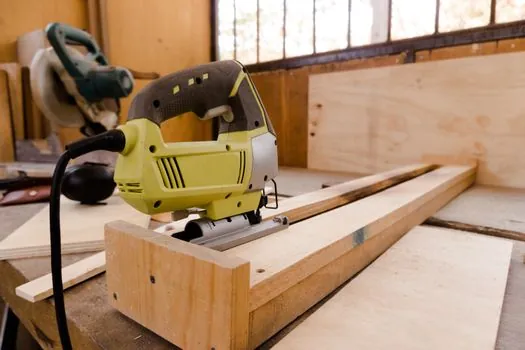
For concrete, asphalt, stone, and refractory work, the cut-off machine keeps the high-speed grinding principle but swaps the abrasive grain for industrial diamond crystals bonded into a segmented or continuous rim; the diamond crystals do the actual scratching and the bond is sacrificial, wearing to expose fresh grit [S3].
Carbide-tipped blades cover the middle ground of steel, aluminium, pipe, and conduit cutting on portable saws, where a toothed geometry is wanted but the wear resistance of brazed carbide is needed to survive the cut-off duty cycle [S3]. Wheel speed, bond hardness, and segment design are the three spec levers a buyer should match to the aggregate or metal being cut; a diamond blade spec'd for cured concrete will glaze and burn out if pushed into green concrete or asphalt.
Rotary tube and pipe cut-off: blades on rolls
Rotary tube and pipe cut-off machines operate like a powered version of a hand tube cutter: a circular blade is drawn into a rotating workpiece, the workpiece is supported on a set of rolls, and the blade is fed in incrementally until the wall is fully severed [S5].
Because the part rotates and the blade is fixed, the cut is concentric, the kerf is narrow, and the cut-off length is repeatable to a tolerance set by the blade-feed position and the part-stop locator; this is the standard set-up for high-volume tubing cut-off in furniture, automotive, and HVAC fabrication [S5]. The principle scales: small shops run a single-blade rotary on bench rolls, while production lines run multi-blade rotary turrets that cut several lengths per index.
Decision criteria: matching the cut-off principle to the job
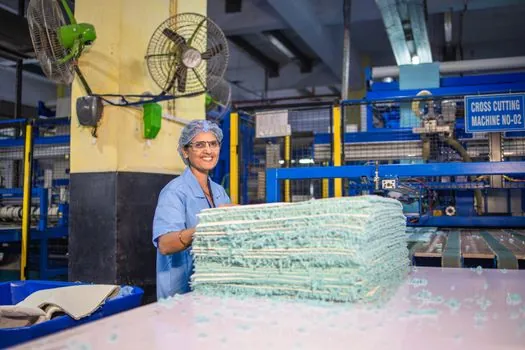
For procurement, the right cut-off machine is the one whose removal mechanism matches your tolerance, heat, spark, and throughput constraints, and the comparison below is the cleanest way to shortlist. [S4]
Cold-saw cut-off machines win on cut quality, burr control, and heat, but lose on capital cost and cut speed, and they are the right answer for finished steel, aluminium, and stainless parts where downstream machining is minimal [S4]. Abrasive chop saws and portable abrasive saws win on blade cost and the ability to cut very hard or hardened stock, and lose on heat input, kerf, sparks, and consumable dust, so they dominate fab-shop cut-off and on-site metal demo [S3][S4]. Diamond-wheel cut-off saws are the only practical choice for cured concrete, reinforced concrete, stone, and asphalt, while carbide-tipped portable cut-off saws cover the steel, aluminium, pipe, and conduit niche where a toothed cut is wanted at high RPM [S3]. Rotary tube cut-off is purpose-built for round hollow stock where concentricity and length repeatability matter more than cut surface finish [S5].
Safety and guarding baseline for any cut-off machine
Cut-off wheels spinning at 8,000 to 12,000 RPM store significant kinetic energy, which is why pre-use checks, blade inspection for cracks or warping, guard verification, and throttle and stop-switch testing are non-negotiable before every shift [S3][S6].
Guarding must cover as much of the wheel as the cut allows, the workpiece must be clamped or supported so it cannot kick or pinch the wheel, and the operator must keep hands and fuel lines clear of the cut line; abrasive and diamond wheels can shatter, and a clamped cut is the difference between a clean section and a wheel burst [S3][S6]. The same cut-off principle that drives a stationary chop saw is what cuts in a guarded metallographic abrasive cutter, where feed, approach angle, and cutting mode are the variables that protect the sample instead of the operator [S2].
Constraints and failure modes specific to cut-off work

Three failure modes dominate cut-off work regardless of machine class: wheel or blade shatter from a pinched, warped, or wrong-spec wheel, workpiece kick from inadequate clamping, and thermal damage to the cut face from too aggressive a feed on an abrasive or diamond wheel [S2][S6].
On abrasive and diamond cut-off, excessive feed generates frictional heat that burns the cut face, glazes a diamond rim, or loads an abrasive wheel with swarf, all of which shorten wheel life and degrade cut quality; the mitigation is to let the wheel cut at its own rate, which is why metallographic cut-off procedures specify feed, approach angle, and cutting mode as a set rather than as independent knobs [S2]. On cold saws and carbide-toothed portable saws, the failure mode is chipped or stripped teeth from a feed that exceeds the chip load, or from a blade geometry that does not match the material; on rotary tube cut-off, the failure mode is a burr or worm on the cut end from a dull blade or a feed that is too slow relative to the part rotation [S4][S5].
Where the term overlaps with broader cutting equipment
In packaging and sheet conversion, the term cutting machine covers guillotine and score-cutting lines that section flat stock with edge-to-edge cuts parallel to the bin edges, frequently constrained to alternating horizontal and vertical cuts with a hard limit of two or three cuts per bin, which is the same planning logic that a cut-off machine applies in one dimension to a bar or tube [S1].
The shared engineering content is the cut-pattern constraint, the kerf, and the cut sequence; the difference is geometry, with packaging cutters solving a 2D bin-packing problem and cut-off machines solving a 1D length-set problem on a continuous or discrete stock [S1]. For a buyer mapping adjacent equipment, a cutting machine selection spec map sets the same part-fit, kerf, and tolerance vocabulary used in cut-off procurement, and the broader machine safety baseline defines the guarding and lockout rules that any rotating-wheel cut-off line has to meet. Trackable signals for the next planning cycle: shifts in abrasive-bond formulations for metallographic wheels that promise lower deformation at higher feed, and any move to carbide or cermet tooth geometry on portable cut-off saws aimed at structural-steel and stainless stock.
Component reference pages worth checking: coding machine.
Background reading: Contour measuring machine suppliers 2026: spec-driven buyer map.