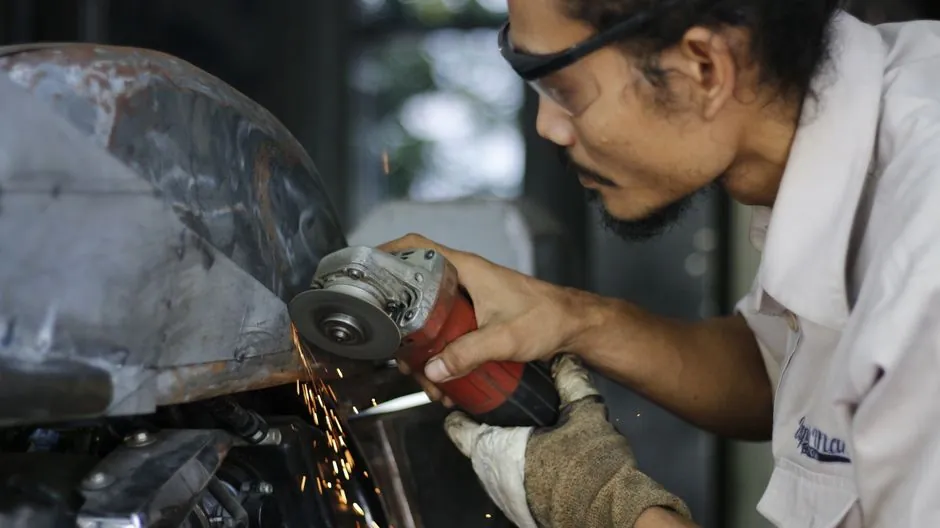
Angle grinder uptime depends almost entirely on three wear categories: carbon brushes, abrasive discs, and spindle fasteners, which together account for the majority of parts replaced on 4-1/2 in. and 5 in. corded and cordless tools [S1][S2][S5].
Carbon brushes are the highest-frequency wear item on brushed angle grinders, sold as matched sets with wire leads and brush springs; examples include Makita CB303 and CB340, DeWALT NA121629, and Milwaukee 22-18-2240, all listed as genuine OEM replacements at specialist parts distributors [S2][S5]. Cut-off wheels, depressed-center grinding wheels (T27), and flap discs are the main abrasive consumables, while the spindle stack (inner flange, clamp washer, flange nut) handles wheel retention [S1][S2][S5].
Wear Items: Brushes, Brush Holders, and Armatures
Carbon brushes are square or rectangular graphite blocks with a lead wire and spring, sized to the specific brush holder; they conduct current to the rotating commutator and wear down through friction, which is why they are described as one of the most commonly replaced power tool parts across Milwaukee, Makita, and DeWALT service notes [S2][S4][S5]. A worn brush is identifiable by a lead wire exposed near the brush face, cracking, pitting, or burn marks, and the failure mode it produces is consistent: intermittent motor function, reduced electric braking, and reduced motor power [S2][S5].
The OEM service guidance is to replace brushes as a matched set even if only one is visibly worn, because uneven spring tension and resistance accelerate commutator damage on the surviving brush [S5]. Brush assemblies are typically priced between $10 and $15 per set for major-brand replacements; for example, the Milwaukee 22-18-2240 set retails at $12.72 and the 22-18-2250 set at $12.10 [S2]. During every brush replacement, the armature should be inspected for burns, cracks, or rounding of the commutator, which signals that the motor itself is at end of service life rather than a candidate for further brush swaps [S2]. On brushless angle grinders, the brush wear path disappears, but the electronic control board and trigger switch become the analogous service items, and the overall parts catalog for a cordless angle grinder is structured around the same functional blocks.
Spindle Fasteners: Inner Flange, Clamp Washer, and Flange Nut
Wheel retention is a three-part stack on most small angle grinders: the inner disc flange seats against the gearbox shoulder, the abrasive disc or wheel sits on it, and the flange nut threads onto the spindle to clamp the wheel, typically tightened with a spanner wrench engaged in the two holes on the nut face [S2]. The Milwaukee 43-34-0935 inner disc flange ($8.22) and the matching 44-40-0035 flange nut ($6.68) are a representative OEM pair, and the supplier instructions are explicit: place the inner flange on the spindle first, fit the wheel, then thread the nut on with a spanner, never by hand force against a running tool [S2].
DeWALT's equivalent clamp washer N115381 is a metal support washer that locates the grinding wheel to the spindle shaft and is replaced with a hex wrench, illustrating that the same functional part is called a "clamp washer" on one brand and an "inner flange" on another, a naming inconsistency buyers should normalize against the tool's parts diagram rather than the marketing label [S5]. The fastener stack must always be re-used with the original lock geometry; mixing an inner flange across brands at the same nominal spindle thread (commonly M10 or 5/8 in.-11 for North American 4-1/2 in. and 5 in. models) can produce a wheel-seat mismatch that loads the disc asymmetrically. Cord protectors and cordset assemblies such as the DeWALT N353819 handle the same role on the electrical side, preventing strain relief failure at the cord entry which is a documented cause of intermittent power [S4][S5].
Abrasive Consumables: Cut-Off, Grinding, and Flap Discs
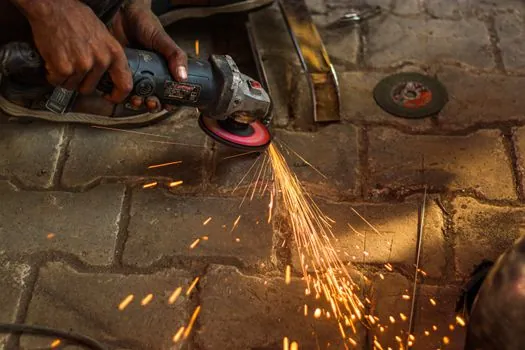
Abrasive consumables are the highest-volume replacement category by piece count, and the working-end vocabulary is specific: Type 1 cut-off wheels are flat for peripheral cutting, Type 27 (depressed center) wheels grind at 15 to 30 degree angles, and Type 29 convex flap discs handle stock removal plus finishing in a single pass [S1]. Abrasive grain choice maps to workpiece: aluminum oxide for mild steel and general-purpose grinding, zirconia alumina for higher stock-removal rates on stainless and carbon steel, and ceramic alumina for hardened alloys and heat-sensitive work, with flap discs typically specified by diameter (4-1/2 in., 5 in., 7 in.) matched to the tool's guard and rated maximum RPM [S1].
The rated maximum RPM printed on every bonded abrasive must equal or exceed the tool's no-load speed, which is typically 11,000 RPM for a 4-1/2 in. corded grinder and 8,500 to 10,000 RPM for an 18 V cordless model; mismatched ratings are the most common abrasive failure path. Bonded abrasive shelf life is also controlled by humidity and by the resin bond's cure state, so warehouses that rotate stock by manufacture date rather than receipt date reduce field chipping. Operators transitioning from a standard angle grinder to surface-conditioning work typically add flap discs and non-woven quick-change discs, both of which are stocked alongside cut-off wheels in the same vendor catalog [S1][S3].
Control and Safety Parts: Guards, Triggers, and Switches
The blade guard (also called a wheel guard) is a half-circle steel or cast shroud mounted to the gearbox face, oriented between the wheel and the operator to deflect sparks and wheel fragments; it is a consumable in the sense that it must be reconfigured or replaced when the tool is re-tasked from cutting to grinding, because the guard opening direction changes between Type 1 and Type 27 work [S4]. The paddle trigger assembly combines the on/off switch, lock-off button, and in some models the speed control dial; on the Milwaukee 31-92-0210 paddle trigger, the paddle is 5 in. long by 1.25 in. wide and the assembly includes the safety lock to prevent accidental starting, with replacement triggered by a tool that does not start, stops unexpectedly, has inconsistent speeds, or makes unusual switch noise [S2].
Switches and triggers fail from dust ingestion and from impact damage when the tool is dropped, and the OEM service procedure is to switch the tool off, remove the housing fasteners, and detach the assembly before fitting a new unit and re-securing it with the original fasteners [S2]. Side handles, the main power handle shell, and cord protectors round out the safety and ergonomics parts list, and they are stocked alongside the drive train so a single repair work order can resolve handle, switch, and cord faults without ordering from multiple vendors [S4]. Specifying the correct guard part number requires the tool model and the wheel type, because the same gearbox housing accepts different guard geometries for cutting versus grinding, and a grinding guard retrofitted for cutting work exposes the operator to the wheel's full periphery [S1][S4].
Selection Criteria by User Profile
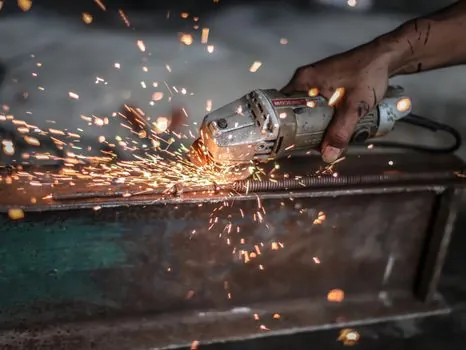
The parts catalog branches sharply by user profile, and the right part set for a fab-shop welder is not the right part set for a maintenance mechanic or a concrete finisher [S1][S3][S4]. Comparing three common operator profiles on the criteria that actually drive stocking decisions makes the trade-off visible.
Profile 1, fab-shop metalworker: priorities are cut-off wheels (Type 1, 4-1/2 in.), grinding wheels (Type 27, 4-1/2 in.), carbon brush sets, flange nut, and inner flange; the failure mode is brush and abrasive wear at high cycle counts, so the stocking strategy is OEM-matched brushes and OEM spindle fasteners plus a multi-pack of bonded abrasives [S1][S2][S5]. Profile 2, construction trades (masonry, tile, rebar): priorities are diamond blades, dust shrouds, and guard assemblies; abrasive geometry dominates the spend, and brush service is secondary because many site tools are now brushless [S1][S4]. Profile 3, automotive and finishing work: priorities are flap discs, quick-change surface-conditioning discs, and polishing pads; the failure mode is consumable exhaustion rather than mechanical wear, so stocking skews to abrasive grits (40, 60, 80, 120) rather than spare motors or armatures [S1][S3]. Buyers in the second and third profile will often choose a brand-diversified abrasive stock and a single OEM for the tool body, which is the inverse of the fab-shop pattern [S1][S3].
Standards, Sourcing, and Failure-Mode Discipline
Spare parts specification is governed less by a single document and more by the interaction of three layers: the tool's rated no-load speed and wheel diameter, the abrasive's printed maximum RPM and bond specification, and the operator's documented training and PPE. Abrasive wheels are required by general industry practice to be marked with maximum operating speed, bond type, expiry or manufacture date where applicable, and the appropriate application code, and the guard and flange stack must be re-assembled to the torque and spanner procedure described in the tool's service sheet [S1][S2][S5].
Sourcing channels split into three tiers: OEM parts distributors (eReplacementParts, Home Depot Appliance Repair) stock genuine carbon brushes, switches, flanges, and cordsets with model-level diagrams and 365-day returns [S2][S5]; abrasive specialists (Benchmark Abrasives) stock cut-off wheels, grinding wheels, flap discs, and quick-change discs in abrasive-specific grain and bond grades [S1]; and OEM accessory catalogs (Festool) bundle abrasives, dust shrouds, and guide rails as system-level accessory sets for higher-end grinders [S3]. Buyers should always cross-check the parts list against the tool's exploded diagram rather than the marketing part name, because the same function (wheel support) is sold under "inner flange," "clamp washer," and "backing flange" depending on the brand [S2][S5]. The two trackable signals for the next quarter are OEM brush-set lead times for the most common cordless platforms, and the abrasive manufacturers' published moves to ceramic-alumina grain bonds for 4-1/2 in. flap discs, both of which will reset stocking math for the angle grinder parts bench in 2026.
For operators building a parts bench from zero, a commissioning checklist defines the pre-use inspection values, and a service-life decision map sets the scrap threshold once brushes, armatures, and gears are all approaching wear limits.
Spec-level background on the components involved: linear guide, and crossed roller guide.