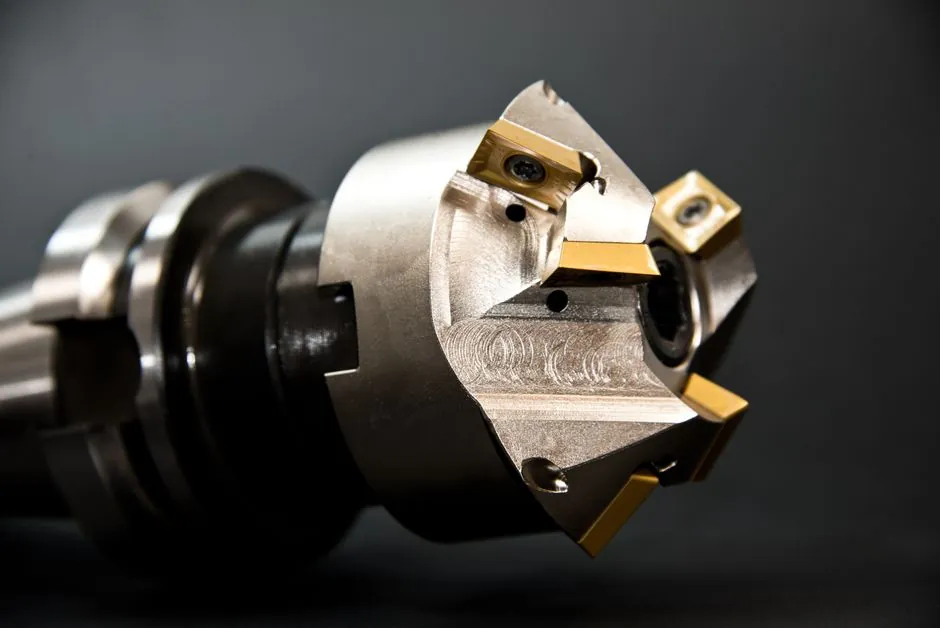
Cutting tool buyers in 2026 are running on roughly 4–12 months of inventory cover, dual-region qualification for cemented carbide and HSS, and post-tariff frontloading cycles that the top supply-chain outlets have been tracking all year [S1].
Indexable inserts, coated end mills, and PCD/CBN tooling sit on the tightest lead-times, while supply chain software for planning and risk work now appears as a default line item in mid-sized machine shops [S1][S4]. The shift is technical, not narrative: it is about which SKU gets dual-sourced first and which tariff line gets challenged in the sourcing ledger.
How Cutting Tool Supply Chains Are Structured in 2026
Cutting tool supply chains in 2026 are typically modelled through the SCOR framework (Plan, Source, Make, Deliver, Return, Enable), with the Source and Make nodes dominating capex and lead-time risk [S3]. The Source node covers tungsten, cobalt, tantalum, niobium, and CVD coating precursors, and the Make node covers blank pressing, sintering, grinding, coating, and edge prep; each step has its own bottleneck profile.
For indexable inserts, the practical bottleneck is still cemented carbide blank pressing and HIP sintering in China, Japan, Korea, and the EU, with lead-times commonly reported in the 8–14 week range for non-stock geometries [S1]. PCD and CBN blanks concentrate in a smaller vendor set, so buyers usually carry 6–12 months of safety stock on those SKUs, and they treat the supply chain as a cutting machine line item, meaning grade, geometry, and tolerance are specified, not negotiated at PO. Standard reference points like ISO 513 (cutting tool material classification) and ISO 3685 (turning tool life testing) define the test conditions, while the actual carbide chemistry and coating stack sit on the OEM data sheet.
Lead-Time, Tariff, and Frontloading Signals to Watch
Cutting tool lead-times in 2026 are best read in two buckets: commodity HSS twist drills and taps, and engineered inserts. The HSS bucket tracks global HRC and bar stock and is normally a 4–8 week lead-time on stocked SKUs and 12–20 weeks on special diameters or coatings; the engineered insert bucket runs 8–14 weeks on catalogue geometries and 16–26 weeks on custom chipbreakers or non-standard radii [S1]. The split matters because buyers often blend the two on the same BOM without realising that tariff exposure and grade availability move on different clocks.
Tariff exposure through 2026 sits on the carbide substrate side, where China-origin tungsten and cobalt powder carry the highest Section 301 / EU CBAM-style surcharges, and on coated tools where CVD coating service returns to a small number of regional hubs [S1]. The frontloading signal is in the data: SCOR-based sourcing teams are pulling POs forward by 30–60 days on Q4 2026 deliveries and pre-booking sinter capacity for Q1 2027, especially on inserts used in construction tools and infrastructure work, where the consumption curve is tied to project award dates, not steady retail demand.
Selection Criteria: Inserts vs End Mills vs Taps vs PCD

The main cutting tool families behave differently under supply stress, and the practical comparison is on four axes: lead-time, tariff exposure, grade flexibility, and minimum order quantity. A reasonable engineering cut-off for 2026 is to dual-source anything that scores high on three of those four. [S4]
They are the workhorse for turning, milling, and parting, and they are usually the first family a buyer dual-sources because the geometry is standardised under ISO 1832 (insert thickness, corner radius, hole type) and the grade can be substituted without re-touching the CNC program. Solid end mills (HSS, carbide, variable helix) sit in the short-to-medium lead-time, medium tariff exposure, low grade flexibility, and low MOQ band, so a 4-flute carbide end mill in a common diameter usually has two or three regional alternates. Taps (HSS, HSS-E, carbide, forming taps) sit in the short lead-time, low tariff exposure, low grade flexibility, and very low MOQ band, which is why they are often left single-sourced. PCD and CBN tools are the long lead-time, medium tariff exposure, low grade flexibility, and high MOQ band, which is why they are usually pre-qualified, not spot-ordered.
Selection also depends on the workpiece. The right tool family in 2026 is rarely the cheapest catalogue SKU, it is the one whose grade stack and geometry are documented to ISO 513 and 3685 and whose welding and cutting tool consumables (rods, fluxes, gouging carbides) are also spec-tracked, because consumable drift is a common hidden failure mode on multi-vendor cells.
Who Dual-Sourcing Is For, and Who Should Skip It
Dual-sourcing is for buyers running high-mix, low-volume job shops, tier-1 automotive and aerospace lines, and any plant with a 2026 production plan that cannot absorb a 12-week insert slip. It is also for buyers who consume enough coated carbide to make a second PO economically viable, which in practice is a run rate of roughly a few thousand inserts per year per grade family [S1][S4].
Dual-sourcing is not for very small job shops buying 50 inserts a month, not for taps and small-diameter drills where a single qualified source is usually enough, and not for proprietary geometries where the OEM holds the IP on the chipbreaker and the grade stack. For those SKUs, the engineering answer is inventory and consignment, not second sourcing.
Internal Linkage: Where Cutting Tools Sit in the Wider Sourcing Map

Cutting tool supply chains do not move in isolation. They share tungsten, cobalt, and rare-earth inputs with abrasives, so the same tariff and frontloading signals that hit bonded and coated abrasive suppliers in 2026 also hit PCD tools and CVD-coated inserts, as tracked in the related Abrasives Supply Chain Analysis 2026 piece. They share linear motion rails, spindles, and bearing supply with steel mills, so linear bearing lead-times and cutting tool lead-times are tracked on the same PO calendar, which is covered in Steel Mill Linear Bearing Spec Gates 2026. And they share the supplier directory with the rest of the metalworking ecosystem, which is mapped in the Global Abrasives Supplier Directory Landscape, August 2026 review. Treating cutting tools as a standalone category is the most common sourcing mistake in mid-sized plants. [S1]
Failure Modes and Constraints Buyers Hit in 2026
The most common failure mode on a 2026 cutting tool PO is grade drift, where the second source ships the same ISO designation insert in a different substrate and coating, and tool life drops 20-40% on the first batch. The fix is to lock the grade by OEM data sheet, not by ISO 513 classification alone, and to qualify the second source on a 50-piece trial before any production release. The second most common is geometry drift, where a slight difference in chipbreaker land or nose radius drives chatter, BUE on stainless, and chip evacuation problems on deep cavities; the fix is to qualify on the same workpiece, same holder, same run, not on a catalogue comparison. [S4]
Hard constraints in 2026 are: carbide substrate tariff exposure, PCD blank capacity, CVD coating line capacity, and minimum order quantity on special geometries [S1]. Buyers who accept those as fixed and plan around them, rather than push them back into the vendor's hand, are the ones who hold tool life within ±5% across the year. The temptation to swap to a cheaper uncoated insert in a tariff window is a classic 2026 failure: the tool life loss on stainless or high-temp alloy is usually bigger than the tariff saving, and the rework cost is rarely recovered.
Standards, Metrics, and Sourcing Discipline

Cutting tool sourcing in 2026 is governed by a small set of standards: ISO 513 (classification and application of hard cutting materials), ISO 3685 (tool-life testing with single-point turning tools), ISO 1832 (insert dimensional coding), and ASME B94.55M (taps). For coated tools, the relevant coating families are TiN, TiCN, TiAlN, AlCrN, Al2O3, and DLC, and the relevant metric is thickness (typically 2–8 μm for PVD, 5–25 μm for CVD) and process temperature, which dictates the substrate compatibility. [S4]
The SCOR model (Plan, Source, Make, Deliver, Return) is the default reference for cutting tool supply chain analysis, and the four-Cs framework (chain structure, competition, capacity, coordination) is the planning lens, both cited in mainstream 2026 supply chain management guides [S3][S5]. Software-side, the power supply and controller side of a CNC cell is also now part of the spec gate, because lead-time on a 480V three-phase CNC bus can match or exceed insert lead-time on a 2026 build. Disciplined buyers lock the SCOR map first, then the grade stack, then the geometry, and only then the PO terms.
Cutting tool supply chains in 2026 will continue to be a function of three trackable signals: tungsten and cobalt tariff notices, PCD and CVD coating line capacity at the major Chinese, Japanese, and EU hubs, and SCOR-based inventory cover that most plants now hold at 4–12 months [S1][S4]. The next practical node for a buyer is a quarterly dual-source qualification pass on the top ten insert SKUs, with the second source locked to an OEM data sheet rather than a catalogue line, and a PCD grade review each time the insulated tools and riser cutting machine BOMs are revised for the new quarter.