Engineers comparing a cyclone separator to a basket strainer are usually solving one question: which device removes the right particle size at the right pressure drop, and which one they can live with on a Friday night when it clogs. The two devices solve overlapping but fundamentally different problems — one uses centrifugal acceleration on a continuous flow, the other captures particles on a defined mesh or perforated surface until a pressure-differential signal forces shutdown.
The published 2026-07-20 DirectIndustry basket-filter index lists 308 basket-style products across 120 manufacturers, with operating pressures specified by vendors in pascal, psi and bar units and filtration methods distributed across pressure (144 products), vacuum (14), centrifugal (14), coalescing (12) and magnetic (11) [S4]. Cyclone offerings on the same index cluster around particle and gas duty, with D95 separation sizes spanning 74 µm to 250 µm (0.149 to 0.060 mm) on ceramic-lined hydrocyclone geometries [S1][S2].
Operating Principle: Centrifugal Force vs Surface Capture
A cyclone separator relies on tangential inlet flow that creates a rotating, sinking stream in a conical chamber; centrifugal force drives larger particles outward against the casing, while fine particles remain entrained and exit with the clean gas through the central vortex finder [S2]. No consumable media is consumed — the body, optional ceramic lining and the geometry do all the work, which is why cyclones are dominant in dust-collection and pre-separation service ahead of bag filters or electrostatic precipitators [S2].
A basket strainer traps contaminants inside a removable basket — perforated plate, woven wire mesh, or sintered multi-layer — as the entire flow is forced through the element. DirectIndustry's 2026-07-20 basket-filter catalog shows 308 basket products using basket (308), microfiber (5) and sintered mesh (3) element constructions, with the basket as a near-universal option [S4]. Differential pressure climbs with solids loading; once ΔP reaches the switch setpoint (commonly 0.5-1.0 bar depending on housing rating), the basket must be cleaned or replaced.
Particle Size and Removal Efficiency
Industrial hydrocyclones from KREBS ENGINEERS are specified at D95 = 100 to 250 mesh, i.e. 0.149 to 0.060 mm separation, in 10/15/20-inch (254/381/508 mm) diameters with high-purity alumina ceramic lower cones and carbide ceramic upper sections for abrasion resistance [S1]. The Scheuch gas-industry cyclone operates on the same centrifugal principle but is positioned as a pre-separator ahead of filters and electrostatic precipitators on combustion exhaust streams, where it handles the coarse fraction that would otherwise blind downstream fabric filters [S2].
Basket strainers go finer. Standard perforated baskets start at roughly 500 µm (35 mesh) and run to 6 000 µm, while woven-wire and sintered-mesh baskets cover 1 µm up to 500 µm [S4]. Fine baskets (≤25 µm) deliver near-absolute retention suitable for protecting flow meters, pressure transmitters and seal faces on centrifugal pumps from particle damage. The trade-off is differential pressure: a 10-inch basket with a 25 µm sintered element at 100 m³/h can show 0.3-0.8 bar clean ΔP, and that number roughly doubles as the basket loads to its switch setting.
Duty Coverage: Where Each Device Belongs

Cyclones are the right pick for high-solids gas streams, dry bulk classification, and as a first-cut liquid/sludge desander. The Montalbano ZIG ZAG cable separator illustrates the dry pre-separation use case — heavy copper and metalloid pieces are lifted out of an airflow before a turbine pulverizer, reducing blade wear and mechanical stress in recycling lines [S3]. At process scale, hydrocyclones are widely used in closed-circuit grinding, classification, thickening, desliming, dewatering and tailings backfill in mining [S7]. In gas service the cyclone's role is to drop the coarse dust load ahead of a bag filter or ESP, where it functions as a 10-100 µm pre-cutter [S2].
Basket strainers belong on the liquid side — protecting steam separators, nozzles, control valves, and instrument lines from weld slag, scale, and pipe-debris events. They are the standard device for pump suction protection (typically a 60-100 mesh perforated basket) and for clean-service polishing on chemicals, water, and hydrocarbons. For steam service, baskets with condensates and vacuum receivers handle 5-bar to 40-bar duties with stainless or carbon-steel housings. Vacuum receivers and clean-service polishing at 5-150 µm is the basket's home turf — the cyclone would not survive the differential pressure or the liquid carry-over.
Decision Matrix: Cyclone vs Basket Strainer
Four criteria frame the choice: separation target, operating pressure, solids loading, and maintenance model. The matrix below is a planning reference, not a vendor quote — exact values come from each OEM's data sheet. [S1]
1. Separation target: Cyclones are sized on D95 in the 60-250 µm band; baskets are absolute-rating and cover 1-500 µm with finer retention [S1][S2][S4]. If the spec reads "≥99% at 10 µm absolute," the basket is the only answer; if the spec reads "drop 80% of dust above 75 µm ahead of the baghouse," a cyclone is cheaper and runs unattended.
2. Operating pressure: Cyclones in dust service run near atmospheric; hydrocyclone feed pressures are typically 0.5-6 bar with overflow/underflow controlled by apex and vortex geometry [S1][S7]. Basket strainers are routinely specified in ANSI 150# to 600# classes — i.e. up to about 100 bar at 38 °C — and dominate any line above 10 bar on the liquid side [S4].
3. Solids loading: Cyclones tolerate high continuous solids loads because there is no element to load; baskets are sized for low-to-moderate loading and require cleaning cycles. A cyclone bank followed by a polishing basket is a common two-stage train on abrasive slurries.
4. Maintenance model: Cyclones are near-zero-maintenance except for liner wear (urethane or alumina ceramic in KREBS-style units), with liner replacement driven by measured wall thickness rather than schedule [S1]. Baskets are the opposite — periodic ΔP-driven cleaning, gasket replacement, and a basket inventory.
Failure Modes and Operating Limits
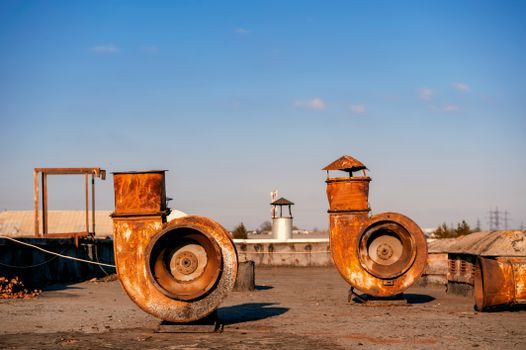
Cyclones fail by roping, where the underflow discharges a coarse slurry in surges rather than a controlled density; this happens when the apex is too open or the feed pressure drops below design. Cyclone cut-point drift is sensitive to feed density and viscosity — a hydrocyclone rated at 100 µm on water can shift to 150 µm on a dense slurry, which a process engineer should verify on the OEM's correction curve [S1][S7]. On dry dust service, the failure mode is erosion: the lower cone takes the brunt, which is why KREBS specifies high-purity alumina ceramic in the lower cone and carbide ceramic in the upper sections, with optional molded urethane liners as a lower-cost entry [S1].
Basket strainers fail by blinding (ΔP climbs to trip), basket collapse from ΔP shock, or gasket blow-by on dirty-side seating. The microfiber and sintered-mesh sub-classes [S4] are the most sensitive to differential-pressure shock — a cold start against a dead-headed pump can rupture a 25 µm element. The fix is a slow-fill bypass or a startup basket in the 250-500 µm range swapped to the fine basket once flow stabilises. Forged stainless or carbon-steel housings in 150# to 600# ratings are the typical envelope; operators should size the basket area so clean ΔP sits below 0.2 bar at design flow.
Standards, Sourcing and Cost Signals
There is no single harmonised design standard that covers both devices across all duties; selection is usually pinned to ASME B16.34 (valve and housing pressure-temperature ratings), ASME B31.3 (process piping) and ASME B73.1 for chemical pumps, with filtration elements per ISO 16889 (multi-pass calibration) for hydraulic duty and ASTM E11 for woven-wire sieve ratings. ATEX 2014/34/EU certification is a separate procurement line when the device is in a classified zone; the equipment selection itself does not change the ATEX category. The 2026-07-20 DirectIndustry basket-filter index still records 308 active products across 120 manufacturers, of which the largest pressure-rated sub-segment is 144 products rated for pressure service, confirming how dominant the basket is in liquid-line protection duty [S4]. The cyclone side, by contrast, is dominated by mining and dust-collection specialists: KREBS, Scheuch, Montalbano and Chinese hydrocyclone OEM clusters exporting to the USA, Brazil, Indonesia and Russia [S1][S2][S3][S7].
Indicative capital cost is one or two orders of magnitude apart: a 10-inch ceramic-lined cyclone from KREBS-class OEM is a 5-figure USD line item with multi-month lead time on the ceramic cones, while a 10-inch ANSI 150# basket strainer in carbon steel with a 100 µm SS basket is closer to mid-4-figure USD and typically ships in 2-6 weeks from a fluid-system distributor. Consumables skew the lifecycle math the other way: the basket costs the same to keep clean, while the cyclone costs nothing consumable but pays out in liner-replacement labour every 3-10 years depending on the slurry.
Selection Rules of Thumb
Pick a cyclone separator when the duty is gas/dust or high-solids liquid pre-separation, the cut-point is in the 60-250 µm D95 band, the operator will not babysit the device, and the line pressure is below the hydrocyclone's 0.5-6 bar feed envelope. Pick a basket strainer when the duty is liquid polishing, the spec is absolute micron retention, the line runs at any pressure up to ~100 bar, and the plant can tolerate scheduled ΔP-driven cleaning. A Y-strainer is the third option worth naming for low-solids, low-cleaning-interval service below 600# — it is the inline cousin of the basket, but with a smaller capture area and no quick-open cover. [S1]
For a full upstream protection train on abrasive slurry, the working pattern is hydrocyclone (bulk cut) → basket strainer (polish to instrument grade) → flow meter; the basket and meter are paired because the basket is what makes the meter's published accuracy reproducible in field service. For a gas train ahead of a bag filter or ESP, the working pattern is cyclone (pre-cut) → bag filter (final) → ID fan; the cyclone is what makes the bag change interval viable.
Trackable signals: DirectIndustry's basket-filter index still grows with new ANSI 600# and quick-clean variants as of 2026-07-08 [S4]; ceramic-lined cyclone capacity is being expanded by Chinese hydrocyclone OEM clusters exporting to the USA, Brazil, Indonesia and Russia [S7]; and CFD-based cyclone geometry work, while already cited in cyclone-separator dictionaries [S8], is becoming a procurement specification line on new dust-handling projects. The centrifugal pump cost guide sits in the same duty band and is the natural next read for any spec covering pump-suction strainers.