
Data center manufacturing equipment covers the full lifecycle stack — from front-end fab tools (lithography, deposition, etch) feeding advanced-node logic and HBM memory, to white-space power and cooling hardware (UPS, PDU, diesel generators, CRAH units, raised access flooring), through MES/OT analytics that ingest sensor streams, and finally EPA-certified decommissioning crews that strip and liquidate the same assets at end of life [S1][S3].
The top-of-stack market signal: MarketsandMarkets values the semiconductor manufacturing equipment (SME) segment at USD 166.35 B in 2025, projected to USD 344.36 B by 2032 at an 11.0% CAGR, with Asia Pacific holding the largest regional share and Applied Materials, ASML, Tokyo Electron, Lam Research, and KLA as the leading OEMs [S3]. That is the upstream half of the data center manufacturing equipment story — the wafer-side capital that makes the silicon running in the racks.
Upstream Fab Equipment: Lithography, Deposition, Metrology
Front-end equipment dominates the SME spend mix and is segmented by MarketsandMarkets into lithography, deposition, wafer surface conditioning, wafer cleaning, metrology, and "other front-end" categories — the unit operations that pattern, build, and inspect wafers at the nanometer scale [S3]. Back-end segments (assembly & packaging, dicing, bonding, wafer/IC testing) handle the singulated die, and the advanced-packaging ramp is directly tied to HBM and chiplet integration for AI accelerators in hyperscale data centers [S3].
End-user split on the same MarketsandMarkets study is foundries, IDMs, OSAT companies, and other end users — foundries typically taking the largest share for leading-edge nodes, with OSAT capacity expansion tied to advanced-packaging demand from AI-server GPUs [S3]. For a process engineer sourcing a fab, the practical comparison gates are node capability (nm-class resolution), throughput (wph), footprint, and facility-side utilities (power, ultrapure water, cleanroom class) — the latter two are often the binding constraint when siting a new fab inside an existing data-center manufacturing equipment cluster.
White-Space Power and Cooling Hardware
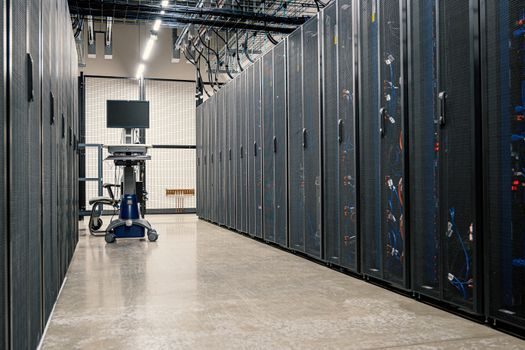
Once silicon ships, the receiving data center manufacturing equipment list is dominated by rotating and static power assets plus precision cooling. ATEK's national removal practice enumerates the standard set: air-handling equipment, uninterruptible power supplies (UPS), power distribution units (PDU), standby diesel generators, and raised access flooring — the same categories that need to be redeployed, resold, or recycled at end of life [S1].
The specification gates on this side are runtime autonomy (minutes of battery at full load for the UPS), generator fuel strategy and EPA Tier rating, PDU metered-vs-switched (with branch-circuit monitoring on kWh/bay), and raised-floor static load rating in PSF for heavy transformer or battery cabinet placement. For hyperscale builds, additive manufacturing material grades are increasingly specified for custom busbar shims and PDU brackets, but the hardware itself remains dominated by copper busbar, lithium-ion UPS battery cabinets, and N+1 generator configurations.
OT/IT Data Ingestion: The AI Layer on the Equipment

The 2026-vintage data layer on top of data center manufacturing equipment is best modelled by Oracle's Adaptive Intelligent Apps for Manufacturing (AIAMFG), which collects, stores, prepares, and analyzes OT data from equipment, machines, sensors, and test stations, then contextualizes it with IT data from SCM, ERP, HCM, and CRM [S2]. The four analytical modules — Insights, Predictions, Genealogy and Trace, and Factory Command Center — give plant engineers the same kind of predictive yield/scrap analytics that data center operators are starting to demand for fleet-level UPS, PDU, and CRAH reliability [S2].
Ingestion is CSV-template-based, with out-of-the-box integrations using Oracle Data Pump and Oracle GoldenGate for E-Business Suite (EBS) customers, so a brownfield site running non-Oracle ERP can still feed AIAMFG [S2]. The complementary Oracle Manufacturing Operations Center exposes an Equipment and Work Order management menu (Setup → Contextualization → Equipment, plus Reason Code, Event, and Run Requests) for tagging machines, defining meters, and driving event-driven alerts on the same equipment fleet [S5]. For a hyperscale DC, the same pattern — contextualize meter data from PDU/CTs, fire events on threshold breach, and route to a command-center dashboard — is what operationalizes the data logger estate behind battery health and cooling set-point monitoring.
Selection Criteria: Who This Guide Is For
This guide is for process engineers, plant managers, and procurement leads sizing either a new fab, a greenfield data center, or a brownfield retrofit where the same hardware taxonomy — UPS, PDU, generator, raised floor, plus upstream fab tools — must be specified, sourced, and integrated [S1][S3]. It is also for IT/OT teams standing up a Factory Command Center or equivalent to consume the sensor streams those assets produce [S2][S5].
It is NOT for hyperscale cloud operators whose procurement is locked under master service agreements with the fab OEMs and the big three switchgear vendors — those buyers need contract-level SLA negotiation, not spec guidance. It is also not a substitute for a site-specific electrical coordination study or a seismic-rated equipment schedule; both are mandated at the project level and outside the scope of a general manufacturing equipment guide.
Use Cases and Real Deployments
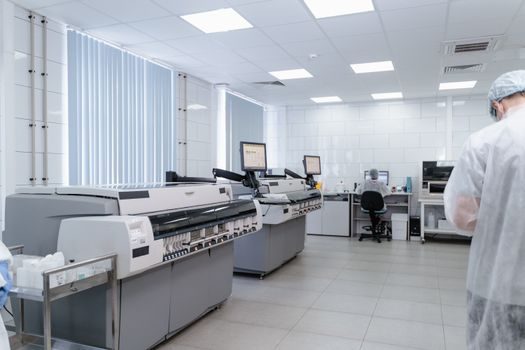
ATEK's reference deployments cover end-of-life work for IBM, HP, and Microsoft data centers, with project management, complete site demolition, removal of old cabling, A/C, UPS, raised floors, overhead racks, and diesel generators handled under EPA-certified hazardous-waste disposal [S1]. The same crew re-deploys the assets in white-glove fashion for customers executing data center relocations, with pre-bid site visits, scope-of-work definition, and asset-purchase agreement paperwork preceding any truck movement [S1].
On the upstream side, the MarketsandMarkets growth driver list is direct: AI/HPC expansion, smartphone and consumer-electronics volume, EV/ADAS semiconductor content, and government semiconductor-localization programs (US CHIPS Act, EU Chips Act, Japan/Japan-Korea subsidies) are all pulling new fab capacity online, with data center expansion cited as a top-two demand driver for advanced-node logic and memory [S3]. For a procurement team, that translates into 12–18 month lead times on lithography and HBM test tools, and 26–40 week lead times on large UPS modules and medium-voltage switchgear as of 2025–2026 ordering windows.
Limitations, Failure Modes, and Standards Anchors
Failure modes diverge by equipment class. UPS modules fail most often at the electrolytic-capacitor and lithium-ion battery interfaces after 7–10 years; PDU failures cluster at the branch-monitoring current transformers and the controller board; standby diesel generators fail at the fuel system, block heater, and starting battery after extended low-load operation. Fab-side, EUV pellicle and photomask logistics are the recurring yield-killers per the SME growth-driver literature [S3].
On standards, the practical anchors a data center manufacturing equipment buyer should pin: EPA-certified hazardous-waste disposal for end-of-life UPS batteries and diesel fuel residue per federal and state rules (ATEK explicitly cites EPA-certified methods and State/Federal compliance) [S1]; IEEE 141 (Red Book) for industrial power distribution inside the data hall; NFPA 75 for IT equipment fire protection; NFPA 76 for telecom facilities; and UL 9540 / UL 9540A for energy storage system safety testing. For EU sites, ATEX 2014/34/EU applies to any equipment intended for use in potentially explosive atmospheres, including standby generator rooms if classified. Hyperscale operators should also map to ANSI/TIA-942-B for site/cabling topology tiers I–IV.
Sourcing Reality and the Next 12 Months
Two signals are worth tracking. First, the SME forecast trajectory (USD 166.35 B → USD 344.36 B at 11.0% CAGR through 2032) implies continued tightness on lithography, advanced deposition, and HBM test capacity through 2027, with backlog visibility driving price escalation rather than softening [S3]. Second, the AIAMFG/Operations Center documentation refreshes published on 2026-06-30 (Process Manufacturing Quality Management and Manufacturing Operations Center Implementation guides) confirm Oracle is actively shipping 2026-vintage feature parity for contextualization, equipment tagging, and meter management — the building blocks plant IT teams will use to instrument new data center manufacturing equipment as it lands on site [S4][S5].
Related reading for specifiers covering adjacent equipment classes: Additive Manufacturing Material Types: Metal Powder Spec Map and Process Fit for fab-side and on-site AM tooling, and Load Cell Module Buying Guide 2026: Spec Gates, Sensor Patterns, and Sourcing Reality for the structural-load instrumentation that pairs with raised-floor static-load ratings and battery-cabinet weighing.
Component reference pages worth checking: anti static equipment.