Wind turbine Industry 4.0 adoption is converging on two concrete technical pillars: the IEC 61400-25 data and communication standard for wind power plants, and the Reference Architecture Model Industry 4.0 (RAMI 4.0) Asset Administration Shell (AAS) used to build interoperable digital twins of nacelle, tower, and balance-of-plant assets [S5][S7][S9].
Offshore wind farms are the proving ground because each 8-15 MW unit streams thousands of tags through SCADA, and the operating envelope (Class IA / IB turbines designed to a 50-year extreme mean recurrence interval wind speed per the IEC 61400-1 design load cases framework) makes real-time digital twin feedback a hard economic necessity, not a marketing layer [S1][S6].
IEC 61400-25: the data spine that Industry 4.0 stacks on top of
IEC 61400-25 is the wind-specific extension that defines a uniform information model and communication profile for condition monitoring, power curve reporting, and operational control of wind power plants; the IEA Wind Topical Expert Meeting #92 (TEM92, 2022) lists adoption of IEC 61400-25 — with mandatory free-of-charge access to the data model — as a top-priority standardization action for digitalization [S9].
In practical terms, IEC 61400-25 lets a vendor's condition monitoring system hand structured data to a third-party pressure transmitter gateway, a plant-level PLC historian, or a cloud analytics stack without bespoke tag mapping on every project [S5][S9]. For engineering teams, the immediate consequence is that any new SCADA retrofit should be specified against IEC 61400-25 conformance, not against a proprietary XML or OPC-UA dialect — see the broader flow meter data-handling approach for comparison on how standardized process data cuts integration cost [S5].
RAMI 4.0 Asset Administration Shell: the digital-twin envelope for wind
The Asset Administration Shell is the standardized digital representation of a physical asset defined inside the RAMI 4.0 reference architecture; for offshore wind it is the wrapper that holds nameplate data, live operational KPIs, maintenance history, and documentation for every turbine, tower section, and substation component in a single addressable object [S5][S7].
WES (Wind Energy Science) preprint research on offshore wind digital twins concludes that implementing the AAS is the practical route to achieving Industry 4.0 interoperability, because the AAS carries both static type information and dynamic submodels that can be discovered and consumed by external services without custom integration code [S5]. On a 2.3 MW class turbine (Pattern Energy South Kent specification: 690 V asynchronous generator, 80 m hub height, 3–4 m/s cut-in, SCADA via WebWPS), the AAS holds roughly the same nameplate data the operator already publishes in a spec sheet, but adds the live interface the digital twin needs to run predictive models against the actual gearbox, generator, and industrial valve health streams [S5][S8].
Onshore vs offshore vs distributed wind: who adopts what, and who does not
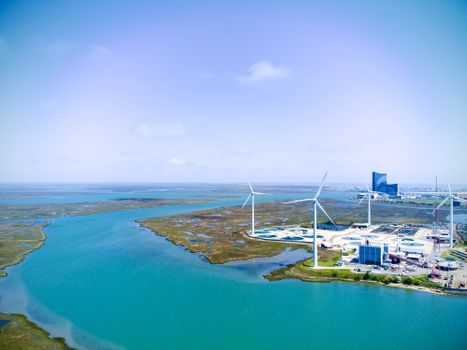
Offshore wind leads the digital twin and AAS deployments because the cost of an unscheduled vessel jack-up visit dwarfs any reasonable IIoT retrofit spend, so remote monitoring plus condition-based maintenance is a hard economic requirement rather than a nice-to-have [S5][S7].
Onshore utility-scale wind has broader IEC 61400-25 adoption through OEM SCADA platforms and fleet-level analytics, but the AAS-based digital twin coverage is patchier and tends to live in vendor cloud stacks rather than open interoperable shells [S5][S9]. Distributed wind turbines (residential, agricultural, remote community) are the laggard segment: the DOE-funded Distributed Wind Certification Best Practices Guideline (OSTI 2583523) still focuses on adoption of the IEC 61400 series for product safety and performance certification in the US, with digital-twin functionality a secondary concern driven by installer economics, not OEM push [S2]. For procurement teams building a fleet in 2026, the practical split is: offshore and onshore utility-scale — specify IEC 61400-25 plus an AAS strategy; distributed wind — specify IEC 61400 conformance for safety and grid, and treat digital-twin features as future option value [S2][S5].
Real-time monitoring, predictive maintenance, and the data loop
Real-time monitoring on a modern wind turbine is a layered stack: nacelle vibration and temperature sensors, main-shaft torque, pitch and yaw feedback, gearbox oil condition, generator winding RTDs, and meteorological inputs (anemometer, wind vane, temperature, sometimes LiDAR) feed the turbine controller; the controller then publishes a structured tag set up to the plant SCADA, where IEC 61400-25 exposes it to operations, asset management, and external analytics [S1][S8][S9].
Predictive maintenance is where the AAS pays back: by binding the static nameplate, the dynamic condition-monitoring stream, and the maintenance work-order history inside one shell, an analytics service can run anomaly detection, remaining-useful-life models, and root-cause traces against a single canonical asset, instead of stitching them from three different databases [S5][S7]. The industrial controls link is direct — the same pressure sensor that feeds a hydraulic pitch system also feeds the digital twin through the AAS submodel interface, which is what enables closed-loop model updates rather than dashboard-only visualization [S5][S9].
Standards, certification, and the procurement spec gates

For 2026 procurement, the binding standards are IEC 61400-1 (design requirements including the 50-year MRI extreme wind model load cases used for structural sizing), IEC 61400-25 (wind plant communication and information model), and the broader IEC 61400 series for product safety; the US Distributed Wind Certification Guideline documents the adoption of these IEC 61400 standards through accredited certification bodies as the path to grid interconnection and insurance approval [S2][S6].
Fire-protection data sheets for wind turbine risk assessment (FM DS 13-10, 2022-07) modify specific IEC 61400 design load cases to set recommended loss-prevention performance, which means the structural envelope the digital twin models is the same envelope the insurer certifies against — a useful cross-check when validating turbine-class spec data in a datasheet [S6]. For turbine flowmeter cooling circuits, hydraulic pitch units, and gearbox lubrication skids, the same rule applies: cite the IEC 61400-25 data-model conformance in the I/O list, then the AAS submodel binding, and only then accept the vendor's proprietary tag dictionary as a fallback [S1][S2][S5][S6][S9].
Workforce and organizational consequences (what actually changes in the plant)
Springer research on three Italian manufacturing organizations (Margherita and Braccini, 2021) finds that Industry 4.0 adoption shifts the production workforce from manual execution toward data-driven decision support, with positive productivity effects but negative social effects on task identity that management has to actively address through training and role redesign [S3].
Translating to a wind operations context: the same dynamic is visible in the move from scheduled route-based maintenance crews to centralized condition-monitoring analysts who watch fleet-wide AAS dashboards and dispatch only the work that the model flags — workforce composition shifts, but on-site mechanical, electrical, and rope-access skills do not disappear, they get re-priced and re-scheduled around the model's output [S3][S5].
Limitations, failure modes, and what the standards do not cover

IEC 61400-25 standardizes the information model and the communication profile but does not by itself guarantee semantic interoperability across OEMs — submodel selection, unit conventions, and condition-monitoring thresholds still vary, which is exactly the gap the AAS submodel registry is meant to close [S5][S9].
A second constraint is the data-architecture gap: AAS implementation in offshore wind is described in the literature as a development path "to further improve" interoperability, not a finished plug-and-play stack, so any 2026 spec should be written to require an AAS submodel listing and conformance evidence rather than a vendor-declared "AAS-ready" marketing line [S5]. Third, the IEA Wind TEM92 proceedings flag that standards are moving targets — power-curve modelling and operational performance assessment protocols are listed as still under development, so a pressure transmitter or flow meter selected today against current IEC 61400-25 may need a firmware or gateway update when revised power-curve protocols land [S9]. For related manufacturing-equipment context, see the Wind Turbine Manufacturing Equipment Guide: Vendor Spec Map 2026 and the Wind Turbine Manufacturing Quality Standards: 2026 Spec and Sourcing Map for the factory-floor side of the same digitalization trend [S1][S9].