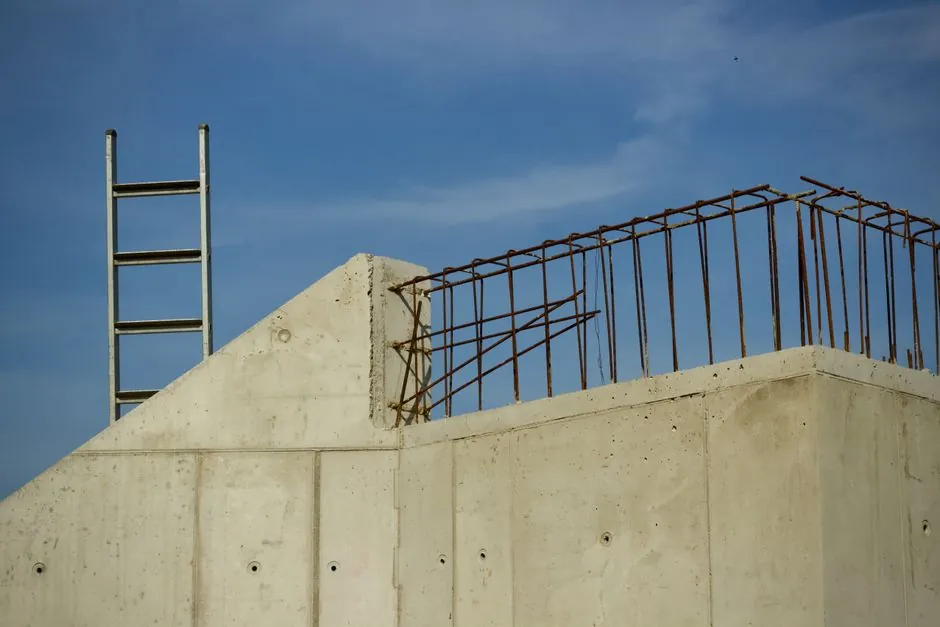
A deformed bar anchor (DBA) is a drawn-arc weld stud with ribbed surface deformations, not a length of reinforcing bar welded to a plate. DBAs are cold-worked from low-carbon ASTM A1064-18 wire (formerly A496) with a minimum 80,000 psi tensile and 70,000 psi yield, and are produced with an aluminum flux ball for arc stud welding [S2][S5].
Typical reinforcing bar (ASTM A615 Grades 60, 75, 100) is higher-carbon, non-weldable in the standard condition, and yields 60-78 ksi at Grade 60 versus 80-98 ksi at Grade 80 [S3]. The two products solve different problems; substituting one for the other in a welded embedment is the most common specification error on tilt-up and precast submittals.
DBA vs HCA: Two Weld Studs, Two Load Paths
A DBA transfers tension and shear through mechanical interlock between its ribs and the surrounding concrete matrix along the full embedded length, with no head at the tip [S1]. A headed concrete anchor (HCA) instead concentrates load transfer on a forged head plate, the standard solution for composite beam shear connectors.
Use a DBA when the design calls for distributed bond in a precast panel, tilt-up embed plate, or infrastructure bearing plate; use an HCA when the head-bearing mechanism is required by the structural engineer [S1]. Mixing the two on a submittal is a common mistake, because both parts look like weld studs on the drawing.
Why Common Rebar Should Not Be Stud-Welded
Standard ASTM A615 Grade 60 rebar carries 80 ksi minimum tensile and 60-78 ksi yield; Grade 80 reaches 100 ksi tensile and 80-98 ksi yield, both with carbon levels that produce brittle, crack-sensitive arc welds [S3]. Welding this rebar without a qualified WPS typically produces HAZ cracking, and the affected stud loses the ductility the precast detail relies on.
DBA sidesteps that problem by being manufactured from A1064-18 low-carbon wire specifically for stud welding, so the weld zone is fusion-bonded to a ductile base material and the joint is stronger than the stud [S2]. The path of last resort, where rebar must be welded, is to switch to ASTM A706 rebar embossed with a "W", which is formulated for arc welding and is sold in straight, threaded, or fabricated configurations [S3].
Sizing, Length After Weld, and Common Diameters
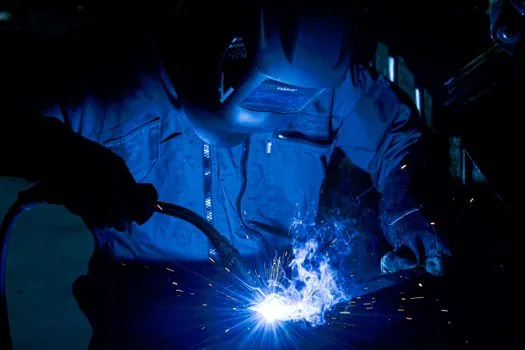
Structural engineers set DBA diameter and length, not general rules; in practice, stock sizes run 1/2" through 7/8" diameter and 3" through 8" length, with deep embedment anchors like 1/2" x 12-1/8" and 3/4" x 36-1/8" stocked by manufacturers [S1][S5]. Cox Industries publishes a full length table from 3/8" x 6-1/8" (180 lbs/M) up to 3/4" x 36-1/8" (4400 lbs/M) [S5].
Manufacturer-rated post-weld shortening is 1/8" for studs 1/2" and below, and 3/16" for 5/8" and 3/4" diameter, so the as-welded embedment depth is shorter than the as-received length [S2][S5]. Specifiers should dimension to the post-weld length, not the catalog length, when calling out embedment depth on the drawing.
Welding Process and Quality Control Risks
Arc stud welding uses a ceramic ferrule to contain the molten pool and an aluminum flux ball to initiate the arc; with the correct lift, plunge, current, and time, the resulting fusion weld is stronger than the DBA itself [S2]. The ferrule is part of the consumable system, and Cox ships the matching ferrule (e.g., 38FER, 12FER, 58FER, 34FER) for each stud diameter [S5].
Quality control matters because welds fail before studs: a 2000 PCI Journal study of 69 production 3/8" DBA studs from four US manufacturers found 19% fractured at the weld, with nearly all failures traced to a specific stud-gun setting procedure rather than stud material [S4]. The recommendation is documented WPS/PQR per project, plus verification of the gun's time-and-current settings before production runs [S2][S4].
Codes, Standards, and Approvals That Govern the Callout
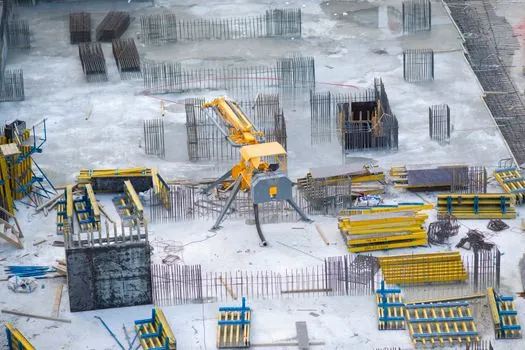
Welded DBAs are qualified under AWS D1.1 Type C, manufactured to ASTM A1064-18, and accepted under ICC-ES evaluation reports (e.g., ESR-2823) and International Building Code Section 19, so they can be specified without project-specific qualification [S2]. Cox's product line also meets CSA W59 for Canadian work and offers 300-series stainless steel for corrosive service [S5].
For a quick cross-reference on the fastener family and how it sits alongside headed studs, see the encyclopedia entry on stud welder and the rebar base reference; for bearing-plate and embedment detailing, the chemical anchor and rebar coupler pages cover adjacent but distinct attachment methods. For a relevant concrete-side supply example, the curing compound vs wet curing cost map gives a 2026 per-liter cost sense for the wet-cure side of the same embedment pours.
Decision Matrix: Pick DBA, Switch to A706 Rebar, or Go Non-Welded
Use DBA (ASTM A1064-18) when the design calls for distributed bond along the embedment, a headless tip, and a code-listed welded stud in precast, tilt-up, or bearing-plate work [S1][S2]. Switch to A706 rebar (embossed "W") only when the structural detail specifically requires a reinforcing bar geometry, threaded bar, or coupler engagement, and a WPS is written for it [S3].
Avoid welding ASTM A615 Grade 60/75/100 rebar without a qualified WPS, and avoid substituting A706 for DBA where the engineer specified a Type C stud under AWS D1.1 [S2][S3]. When arc stud welding is impractical on site, fall back to mechanical rebar anchors (screw-lock or threaded couplers such as the D260) instead of forcing a weld [S3].
For procurement, lead-time signals to track are: (1) ESR-2823 / ESR-2907 ICC-ES listing on the supplier's data sheet, (2) 300-series stainless availability for corrosive environments, and (3) documented WPS/PQR support offered by the stud vendor for the project-specific diameter and base-metal combination [S2][S5].