
DC fast charger architectures in 2026 split into two production-grade tracks: modular multi-vehicle stacks scaling 20-180 kW, and integrated all-in-one autonomous units in the 50-200 kW band. ABB's Terra family covers 20 kW (Terra 24) through 180 kW (Terra 184), with the Terra 54 cited as the most deployed model in the line [S1].
KEBA's KeContact DCA10 sits on the all-in-one side, packaged with internal cooling, display, and payment terminal for sites that need a single-cabinet footprint [S2]. The two architectures target different duty cycles, and procurement teams are increasingly specifying by use case rather than chasing peak kilowatts alone.
Modular DC Stacks: 20-180 kW, Up to Three Vehicles Simultaneously
ABB's Terra modular platform scales charging power incrementally up to 180 kW and serves up to three electric vehicles concurrently, including high-voltage battery packs [S1]. The Terra family spans Terra 24 to Terra 184 across 20-180 kW, with the Terra 54 described as the most deployed 50 kW SKU in the product line [S1]. Modularity matters in fleet depots because operators can start at 50 kW and add 30 kW power modules as depot throughput grows, instead of replacing the entire dispenser.
Modular chassis also allow mixed connector outputs (CCS, CHAdeMO, GB/T) on the same cabinet, which is why the same family spec sheet references "multi-standard" hardware [S1]. For spec-first buyers, the engineering differentiator is shared DC bus architecture plus parallel power-module output, not raw peak kW.
All-in-One Autonomous Units: DCA10 and the Single-Cabinet Play
KEBA's KeContact DCA10 is positioned as an all-in-one DC charging station, integrating the power conversion, controller, HMI, and backend connectivity in a single enclosure [S2]. This contrasts with modular stacks that pair a power cabinet with separate dispensers. All-in-one designs reduce cabling, footprint, and commissioning time, which matters at sites with limited grid headroom or where civils cost dominates.
The DCA10 architecture is engineered for autonomous operation, which implies integrated payment, OCPP backend, and authentication without a separate dispenser head [S2]. Procurement teams that previously had to coordinate power-cabinet, dispenser, and payment vendors are consolidating on this single SKU pattern. Related engineering decisions on grid-tie converters and isolation are documented in the DC power supply reference, since the AC-DC stage inside any DC fast charger shares topology with industrial DC-DC converter building blocks used in substation auxiliaries.
2026 Selection Criteria: Power Band, Connector Mix, Footprint

Three decision criteria now separate modular from all-in-one bids: required peak power, vehicle concurrency, and site footprint. Below 100 kW with single-vehicle duty, all-in-one units win on installed cost. Above 100 kW or where three vehicles must charge at once, modular cabinets with parallel dispenser heads (like the Terra 184's three-vehicle mode [S1]) pull ahead.
A second criterion is connector policy. Multi-standard modular chassis support CCS1, CCS2, CHAdeMO, and GB/T outputs in the same physical frame [S1], whereas all-in-one autonomous units typically ship with one or two connector standards per SKU. Sites on European corridors commonly specify CCS2 only; mixed-fleet Asian deployments need at least CCS2 plus GB/T. A third criterion is grid-side interface: modular cabinets often accept 400 V AC three-phase input, while higher-power stacks in the 180 kW class increasingly require 800 V DC-link compatibility on the vehicle side, and bidirectional V2G-capable variants are appearing as engineering previews rather than volume products in 2026.
Use Cases: Highway Corridors, Fleet Depots, Urban Retail
Highway corridor sites (50-150 km spacing) increasingly specify 150-180 kW modular cabinets with two or three dispenser heads, because dwell time at rest stops averages 15-20 minutes and grid connection cost is amortised over multiple bays [S1]. The Terra 184's 180 kW ceiling matches the upper end of typical European on-highway RFPs published in 2025-2026.
Fleet depots (logistics, last-mile delivery) favour modular 50-100 kW units because vehicles return overnight and dwell time is 4-8 hours; peak power matters less than cost-per-kW. Urban retail and forecourt sites, where grid capacity and footprint are constrained, trend toward all-in-one 50-100 kW autonomous chargers like the DCA10, since a single cabinet can sit on a parking bay without auxiliary dispenser civils [S2]. For fleet operators cross-referencing depot power, vehicle telematics, and the DC fast charger market 2026 spec curve, the modular-vs-all-in-one split is the single most concrete engineering fork.
Limitations, Standards, and Open Questions
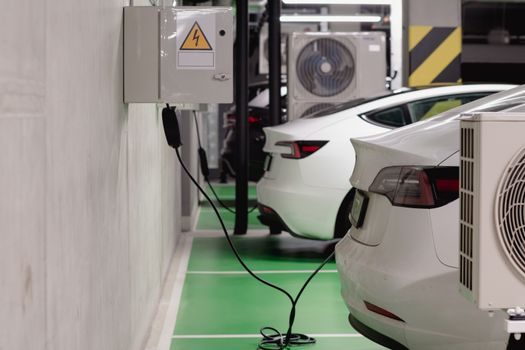
Engineering limitations remain on both architectures. Modular stacks above 150 kW require liquid-cooled dispensers or oversized copper cabling, and the three-vehicle mode cited for the Terra family [S1] realistically only delivers full per-port power if all three vehicles request it simultaneously, which depot controllers must enforce at the software layer. All-in-one units, by contrast, cannot be field-upgraded for higher power without replacing the entire cabinet. EV powertrain teams cross-checking on-board charger acceptance against the E-axle suppliers 2026 spec shortlist should also verify that the EV side supports 800 V architectures before specifying the upper end of 180 kW dispensers.
Standards applicable to DC fast charger deployment in 2026 include IEC 61851-1 for conductive charging systems, IEC 62196 for plugs and sockets, ISO 15118 for vehicle-to-grid communication, and OCPP 2.0.1 for backend interoperability, though exact compliance scope depends on the OEM's certification dossier rather than any single self-declared claim. The IDTechEx "All-in-One Direct Current (DC) Fast Charger Units" benchmark programme is the most cited independent comparative dataset on this category [S4]. Buyers monitoring the procurement landscape should track two signals: the share of new RFPs that pin on multi-standard modular cabinets (versus all-in-one), and the rollout pace of 350 kW+ liquid-cooled units that exceed both the Terra 184 and DCA10 envelopes.
Spec-level background on the components involved: pressure transmitter.